
Yemen's YPC slams STC’s move to form southern fatwa-issuing body
 3 Min Read
The Yemeni Presidential Council warns that the Southern Transitional Council’s Southern Fatwa Authority may cause sectarian strife and violate constitutional frameworks.
-
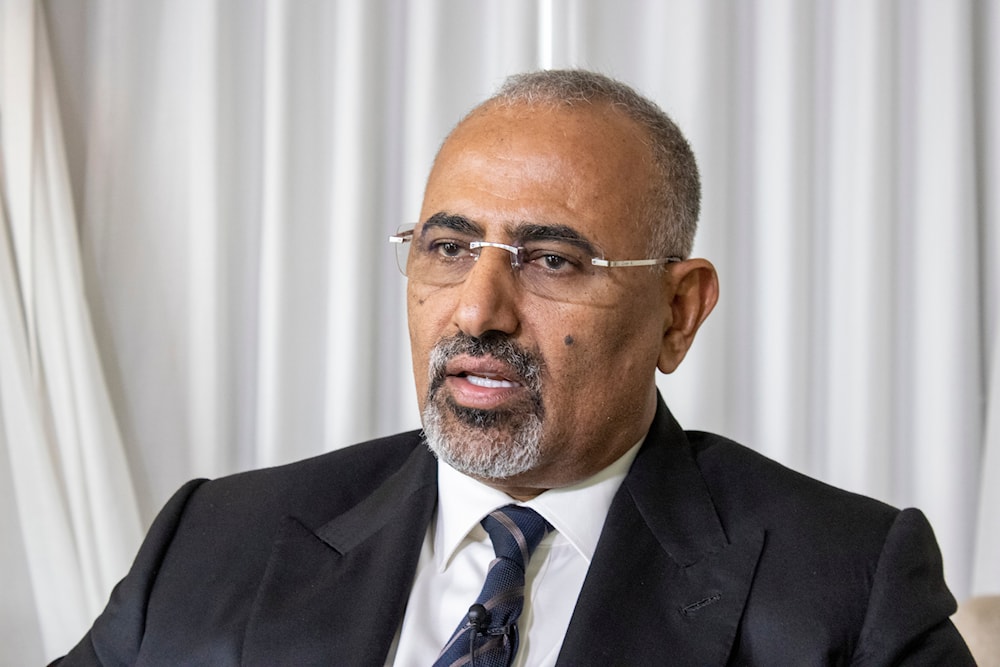
The president of Yemen's Southern Transitional Council, Aidarous al-Zubaidi, sits for an interview, Friday, Sept. 22, 2023, in New York. (AP)
A senior official from the Yemeni Presidential Leadership Council’s office expressed surprise at the decision by Southern Transitional Council (STC) member and council head Aidros al-Zubaidi to form a preparatory committee for a Southern Fatwa Authority linked to the Ministry of Awqaf and Guidance.
In an interview for Saba Net, the source described the move as “unilateral and in conflict with the constitution, the law, and the governing frameworks of the transitional phase, particularly the Declaration of Transfer of Authority.”
The official warned that the establishment of a Southern Fatwa Authority could undermine religious unity, potentially leading to sectarian divisions and opening the door to unnecessary religious conflict. He also cautioned that such measures risk politicizing religious rulings for political or partisan purposes, which could damage the universal standing of religion.
According to the source, the decision is part of a series of unilateral measures previously annulled by the Presidential Leadership Council’s legal team for lack of proper jurisdiction, describing it as a “dangerous precedent affecting the constitutional and institutional system of the state.”
Fragmentation takes over Yemen
This comes after the UAE-backed STC announced the launch of a military operation in the southern city of Abyan, named “Operation Al-Hasm,” aimed at continuing its “Sahm Al-Sharq” campaign. The STC recently claimed control over key areas in southern Yemen, including Brigade Mika 12, the vicinity of the Al-Aqla oil facility in Shabwa, and strategic locations in central Yemen.
The UAE controls the Balhaf area and port in Shabwa, Yemen’s only gas export platform since 2015, whose closure has cost Yemen an estimated $40 billion over the past decade.
Military activities are also accelerating in eastern cities, with the official spokesperson of the southern armed forces, Mohammed al-Naqeeb, announcing the deployment of elite Hadhrami forces to Seiyun in Wadi Hadhramaut to support operations aimed at “enhancing security and stability."
The latest developments reflect the increasingly fragmented nature of Yemeni territories outside the control of the Ansar Allah movement and the government in Sanaa, where multiple actors, the STC, al-Islah-aligned forces, remnants of the Saleh family, and the internationally recognized Presidential Council, vie for control.
The rivalry between UAE- and Saudi-backed factions has further complicated the scene, with the UAE strategically consolidating influence over key energy and strategic sites in the south and east.
Shabwa, Yemen’s third-largest governorate, and Abyan now stand at the center of this contest for control, as the STC continues its push to expand its territorial and political authority in southern Yemen, deepening existing divisions.


