
Yemen warns any state backing Saudi blockade will be deemed aggressor
 3 Min Read
Sanaa says Yemen will pursue its rights despite mounting pressure, while Ansar Allah urges Islamic states to oppose aggression rather than shield those responsible for the blockade.
-
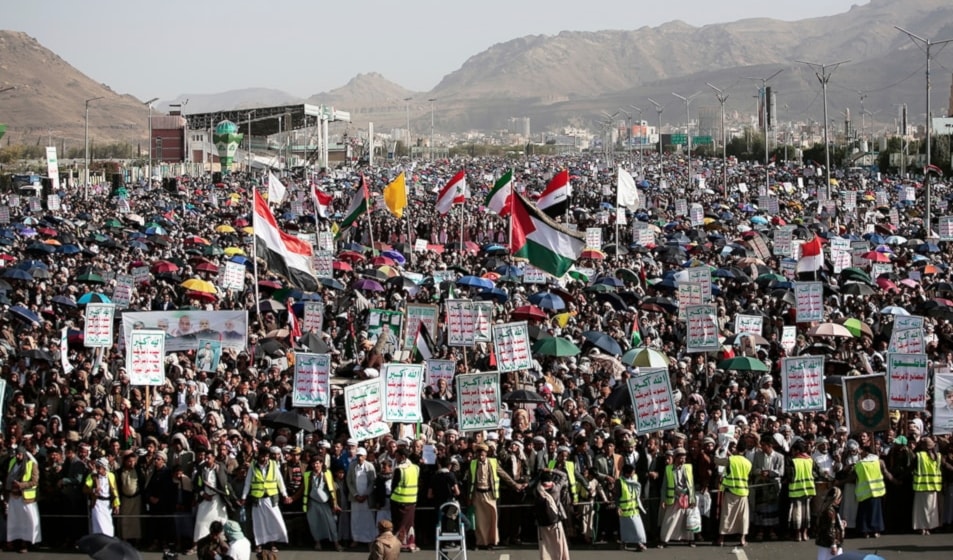
Thousands of Yemenis chant slogans during a weekly anti-US and anti-"Israel" rally in Yemen, June 13, 2025 (AP)
Any party that joins Saudi Arabia in its aggression and 12-year blockade against Yemen would itself be considered an aggressor, regardless of how such involvement is presented or justified, Mahdi al-Mashat, head of Yemen's Supreme Political Council, affirmed.
“Whoever participates with the Saudi aggressor in its aggression and blockade against our country is an aggressor,” with “Yemeni law” setting out “how to deal with hostile states,” al-Mashat said.
In messages to Riyadh, the head of Yemen’s Supreme Political Council warned that Saudi Arabia would gain nothing even if it rallied the entire world behind it, stressing that pursuing a just and honorable peace and good-neighborly relations would come at a far lower cost than war.
Furthermore, al-Mashat stressed that “agreements do not apply retroactively,” announcing that the “blockade-for-blockade equation” remains in effect until it achieves its objectives
Sanaa rejects any attempt to undermine its legitimate rights
For its part, the Foreign Ministry in Sanaa stated that "no regional or global bloc can strip the Yemeni people of their legitimate rights."
It added that any Islamic bloc that does not make the Palestinian cause its foremost priority serves the enemies of the nation and is destined to fail.
The Ministry further stated that “the Republic of Yemen has made up its mind to move forward in securing all of its legitimate rights, regardless of the scale of the challenges.”
Yemen warns Islamic states against backing aggression amid blockade
Ansar Allah political bureau member Mohammed al-Farah said the movement remains committed to breaking the blockade, regardless of the alliances being formed against it.
Al-Farah said, “We would not want Türkiye, Pakistan, or any other Islamic country to become a political cover for any aggression, blockade or violation of the sovereignty of a Muslim country.”
The Ansar Allah leader stressed that what is required of Islamic countries “is not to form alliances to protect the aggressor from the consequences of its policies, but to exert pressure on the aggressor to stop the aggression.”
The remarks come shortly after Saudi Arabia, Turkey, and Pakistan signed a joint defense agreement in Mecca on Friday, formalizing a trilateral security bloc among three Sunni Muslim-majority US allies rattled by months of regional escalation since Washington and Tel Aviv launched their war on Iran.
Under the pact, dubbed the Mecca Joint Defense Agreement, an attack on any one of the three signatories will be treated as an attack on all, the countries said in a joint statement. The agreement is framed as a collective-deterrence mechanism meant to shore up regional security, though the three governments have not disclosed the specific obligations each side has taken on.


