
FIFA leadership backs Infantino after commercial rights crisis
 5 Min Read
FIFA's leadership backed President Gianni Infantino after apologizing for its failed $4.2 billion commercial rights proposal, which triggered widespread criticism over transparency and consultation.
-
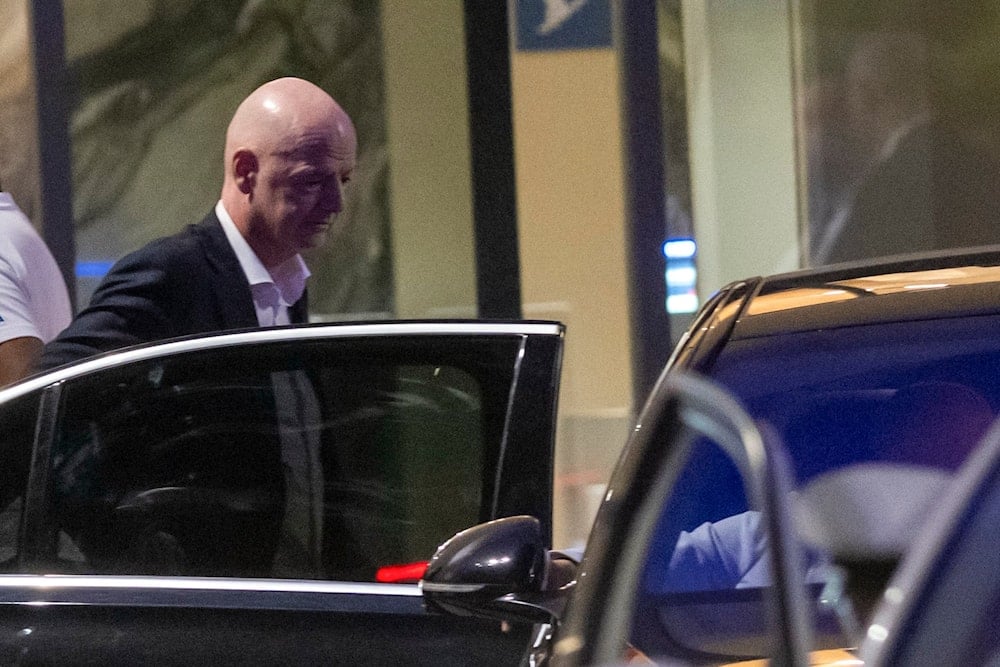
FIFA president Gianni Infantino leaves after attending a Women AFCON 2026 soccer match between Malawi and Zambia, in Rabat, Morocco, Wednesday, Aug. 5, 2026 (AP)
FIFA’s senior leadership has rallied behind President Gianni Infantino following an emergency meeting in Morocco over a controversial plan to bring private investment into the organization’s World Cup commercial operations, Reuters reported.
The proposal, which was abandoned last Friday after widespread opposition, would have allowed investors to acquire a 20% stake in a newly established commercial rights company. The transaction was expected to generate approximately $4.2 billion.
The plan faced strong resistance from football confederations and national associations, many of which accused FIFA of attempting to advance the project without sufficient consultation.
Following Wednesday’s meeting in Rabat, FIFA issued a statement seeking to demonstrate unity between Infantino and the organization’s senior administration.
“Following a meeting in Rabat, Morocco, the FIFA Secretary General and members of the FIFA management board in attendance reaffirmed their full support for FIFA President Gianni Infantino,” the statement said.
“In turn, the FIFA President reiterated his full support for the FIFA Secretary General and the FIFA administration for their necessary and outstanding work in the delivery of his vision.”
FIFA apologizes over consultation failures
FIFA said it had sent a separate letter to members of the FIFA Council and its 211 national associations acknowledging that the proposal had been mishandled.
“It was agreed that it was not the intention for the FIFA Council and FIFA member associations to feel excluded from the process and that the process should have been handled differently,” the organization said.
FIFA also promised to review the circumstances surrounding the failed project.
Secretary General Mattias Grafstrom addressed the controversy in an internal memorandum sent to staff this week, according to two sources cited by Reuters.
Grafstrom described the developments as a “sad and reproachable series of events” that resulted in the project being “permanently abandoned.”
Without naming Infantino, he added that “individuals, unstable moments and unfortunate episodes come and go,” while maintaining that FIFA’s broader work would continue.
His comments followed criticism from FIFA Chief Operating Officer Kevin Lamour, who said staff members had been “deceived” over the proposal and described it as the project of one person.
FIFA’s statement emphasized that Infantino, who has led the organization since 2016, was “the only official elected by the 211 FIFA member associations.”
The organization also warned that, following the withdrawal of the proposal, it would “no longer tolerate any attacks on its integrity, good governance and due process.”
Confederations question Infantino’s leadership
The abandoned plan triggered unusually direct criticism of Infantino from major regional football bodies.
UEFA said it had lost confidence in his leadership, while CONCACAF, which oversees football in North and Central America and the Caribbean, adopted a similar position.
The Asian Football Confederation also criticized the way the project had been presented, arguing that members had been confronted with a completed proposal rather than being consulted during its development.
The controversy attracted further scrutiny because a company linked through family connections to US President Donald Trump was reportedly involved in the proposed investment arrangement.
Several European football associations have since withdrawn their backing for Infantino ahead of FIFA’s presidential election next March.
Former Portugal international Luis Figo called on Infantino to resign, while UEFA Vice President Laura McAllister said the failed proposal had pushed his leadership into a serious crisis.
European Leagues, an organization representing more than 1,300 clubs, said FIFA must not be permitted to “continue taking unilaterally disruptive decisions” affecting clubs, players and supporters.
It also objected to FIFA giving stakeholders only four weeks to assess a separate proposal to expand the 2030 World Cup from 48 to 64 teams.
Under FIFA regulations, an Extraordinary Congress can be convened if at least 43 national associations submit a formal written request.
Infantino retains support from several associations
Despite the backlash, Infantino continues to receive support from several FIFA members, particularly national associations that depend heavily on the organization’s financial assistance.
Senior African football officials have expressed support for the FIFA president, although the Confederation of African Football has not yet announced an official position.
The Oceania Football Confederation’s executive committee is expected to meet next Wednesday to discuss the dispute.
Qatar, Kuwait, Lebanon, Sri Lanka, Indonesia and the Philippines have publicly backed Infantino, despite the Asian Football Confederation’s criticism of the commercial rights proposal.
FIFA’s voting structure may also work in Infantino’s favor. Each of the organization’s 211 members receives one presidential vote, regardless of the size or sporting success of the country it represents.
This means San Marino, ranked last among FIFA’s men’s national teams, holds the same voting power as former World Cup champions including Brazil, Germany, Argentina and Spain.
Infantino also benefits from the absence of a clear challenger in next March’s election, as he seeks to remain in office until 2031.
Morocco was among the first associations to support Infantino after the project was withdrawn. The country will jointly host the 2030 World Cup with Spain and Portugal and has expressed interest in staging the final.
A FIFA spokesperson rejected suggestions that Infantino had offered Morocco the final in exchange for political support.
“It is false and misleading to claim the FIFA president has made any promise in relation to hosting the FIFA World Cup 2030 final,” the spokesperson said.
“A decision will be made by FIFA in due course.”
Read more: FIFA under fire over unpaid $1mln to each World Cup host city


