
AI warfare has arrived and no one can fully control it: FT
 5 Min Read
A Financial Times investigation finds AI-assisted targeting is speeding up how militaries kill, from Ukraine to Gaza to Iran, while accountability grows harder to trace.
-
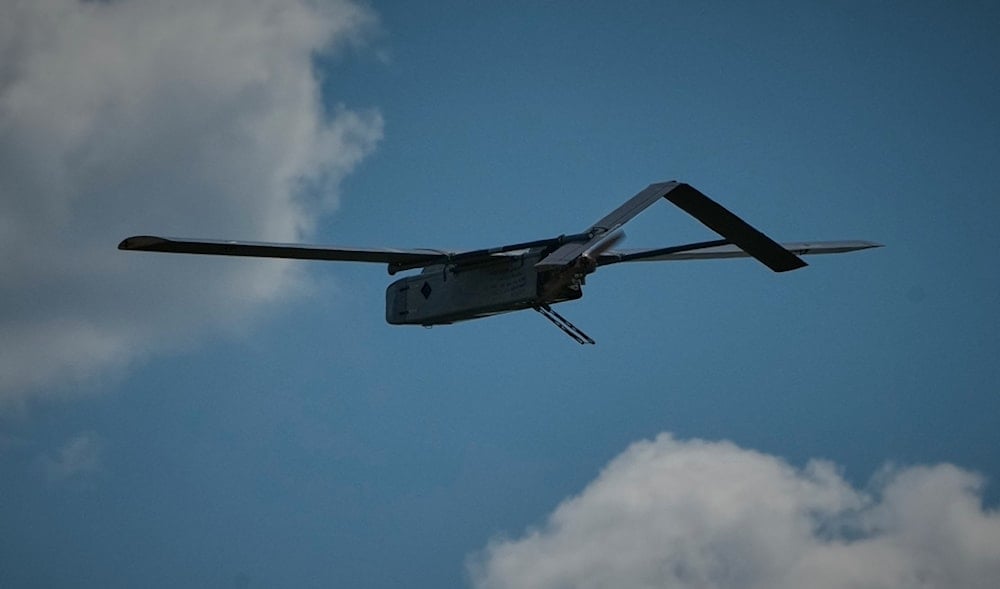
A Ukrainian FP-1 long-range attack drone is launched at an undisclosed location in Ukraine, Sunday, Aug. 16, 2026. (AP Photo/Efrem Lukatsky, File)
An investigation by the Financial Times has traced how artificial intelligence is being folded into military targeting systems across multiple active conflicts, and how the speed this brings to modern warfare is outpacing the ability of militaries, governments, and AI companies themselves to control it.
US targeting systems supported by artificial intelligence bombed 13,000 targets in the first 38 days of Washington's war on Iran. Among them was a girls' school, where more than 150 people, 120 of them children, were martyred.
Read more: US strike on Iranian school caused by human error, not AI: Semafor
At the outset of the war in Ukraine, identifying and striking a target could take up to 20 minutes. Military and technology officials say that process can now take under two minutes, sometimes only seconds.
Battlefield management platforms, including the Pentagon's Maven system, pull in drone footage, satellite imagery, signals intelligence, and sensor data, then use machine learning to sort and prioritize it at a pace human analysts cannot match.
One American intelligence official has said Maven helped raise the number of targets US forces could strike in a day from under 100 to as many as 5,000 once large language models were folded into the system.
Militaries describe this as compressing the "kill chain," the interval between spotting a target and destroying it. The shorter that interval, the more targets a force can hit, including ones that move.
But faster decision-making does not necessarily translate into strategic success. Analysts point to the US war on Iran as a case where fast, effective targeting failed to force a collapse, since there was no follow-up plan for what happens if overwhelming force alone does not bring the war to an end.
Machines can identify equipment, not intent
The technical limitation experts return to again and again is that these systems can recognize a tank, a rifle, or a uniform, but they cannot determine legal status, allegiance, or intent.
A machine cannot tell whether a fighter has surrendered or whether a vehicle marked as military still qualifies as a legitimate target under the circumstances. Ukrainian officers working on the country's own battlefield management system have said reliably identifying a soldier's status, without human confirmation, remains an unresolved problem.
Researchers who study autonomous weapons safety note to the Financial Times that the data behind these systems is frequently fragmentary or mislabeled, and that even routine issues such as lighting or camera angle can cause a system to mistake a civilian vehicle for a military one.
When flawed assumptions are built into a targeting model, experts warn, mistakes persist and accelerate.
Gaza and the human bottleneck
The pressure this creates on human oversight has been most visible during "Israel's" genocidal war on Gaza, where the accelerated pace of AI-assisted target generation has drawn sustained criticism.
According to war researchers cited by the Financial Times, officers reviewing AI-generated target lists were at times given only 15 to 20 seconds to determine whether a strike was justified, amid political pressure to demonstrate a high tempo of attacks.
Legal scholars point out that international law requires a genuine assessment of a target's legitimacy before a strike, a standard that is difficult to meet within a matter of seconds.
Researchers have used the term "moral crumple zone" to describe what happens when human operators, who have only limited real control over an automated recommendation, end up absorbing the blame when the system produces a fatal error.
Even when the data trail behind a strike can be reconstructed, researchers say there is no reliable way to determine why a large language model recommended a particular target in the first place. That opacity makes it difficult to establish whether a wrongful strike stemmed from bad data, a technical failure, or human error, and it creates space for responsibility to be diffused rather than assigned.
Legal accountability for how a war is conducted still formally rests with military commanders, but as more of the targeting process is automated, that line becomes harder to trace in practice.
Anthropic, the company behind the Claude models, has said its most advanced systems are not yet reliable enough to independently select and engage targets, a position that has put it at odds with the Pentagon over the military use of its technology.
Military and AI officials increasingly agree that these systems are being adopted faster than the rules meant to govern them. The question shaping the next phase of this shift is no longer how far armies are willing to push automation into the decision to kill, but whether governments and the companies building this technology will retain any ability to draw a line at all.


