
Pentagon to formalize Palantir AI as core military system
 5 Min Read
The Pentagon is set to formalize Palantir's AI-powered Maven system as a permanent military program, expanding its role in battlefield targeting despite growing ethical and technological concerns.
-
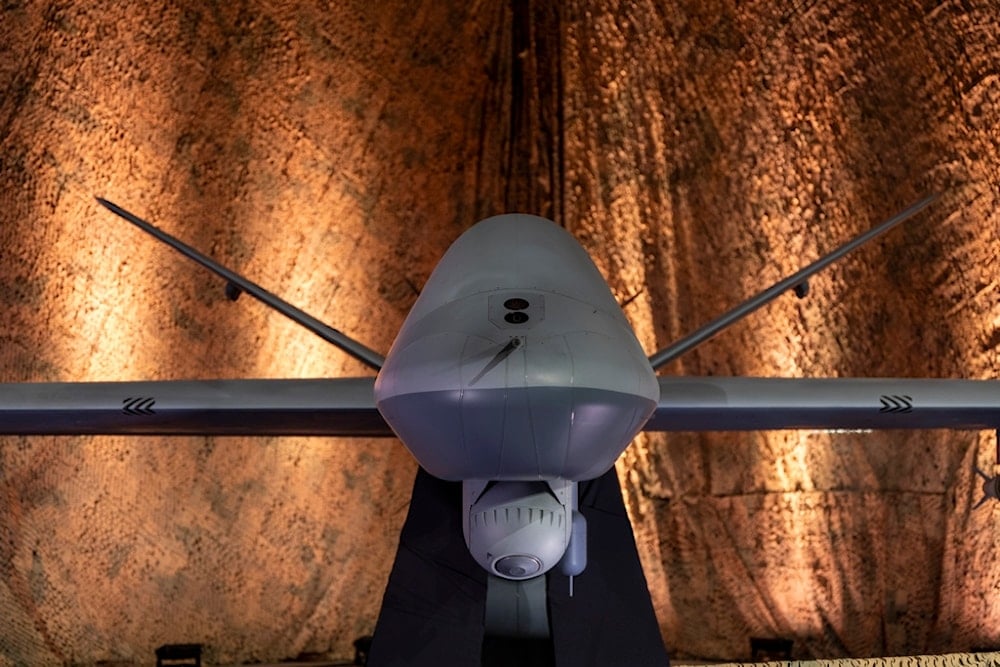
A MQ-9 Reaper drone is on display before President Donald Trump speaks at Al Udeid Air Base, Thursday, May 15, 2025, in Doha, Qatar. (AP Photo/Alex Brandon)
An exclusive report by Reuters on Saturday revealed that the United States is preparing to formally integrate Palantir’s Maven artificial intelligence platform into its long-term military infrastructure, marking a decisive step in embedding AI-driven targeting across the armed forces.
According to a March 9 letter sent by Deputy Secretary of War Steve Feinberg to senior Pentagon officials and military commanders, the system will be designated as a “program of record” before the end of the current fiscal year in September. The move ensures sustained funding, standardized deployment, and expanded use across all branches of the military.
Feinberg framed the integration as essential to maintaining operational superiority, stating that the adoption of Palantir’s Maven Smart System would equip warfighters “with the latest tools necessary to detect, deter, and dominate our adversaries in all domains”.
The designation elevates Maven from a high-level operational tool to a permanent pillar of US military strategy. Oversight of the system will also shift from the National Geospatial Intelligence Agency to the Pentagon’s Chief Digital Artificial Intelligence Office within 30 days, while future contracts with Palantir are expected to be handled by the US Army.
AI targeting goes mainstream
Originally developed under the Pentagon’s Project Maven initiative launched in 2017, the platform processes vast streams of battlefield data from satellites, drones, radar systems, and intelligence reports. Using machine learning, it rapidly identifies patterns and flags potential targets, including military vehicles, infrastructure, and weapons storage sites.
The system has already been widely deployed and is described as the primary AI operating platform used by US forces. Its role has expanded significantly in recent operations, including thousands of strikes carried out over recent weeks.
During a recent demonstration, Pentagon AI official Cameron Stanley illustrated the system’s capabilities, noting the dramatic acceleration in processing time. “When we started this, it literally took hours to do what you just saw," he said.
Feinberg’s directive underscores a broader strategic shift within the Pentagon toward integrating artificial intelligence into operational decision-making. “It is imperative that we invest now and with focus to deepen the integration of artificial intelligence (AI) across the Joint Force and establish AI-enabled decision-making as the cornerstone of our strategy,” he wrote.
Dispute with Anthropic drives shift
The push to formalize Maven is closely tied to tensions surrounding the Pentagon’s earlier reliance on external AI tools, including the Claude model developed by Anthropic. The company objected to its technology being used in military targeting and surveillance, citing safety concerns, triggering a dispute that forced the Pentagon to reconsider its dependencies.
In response, the Department of War moved to distance itself from Anthropic, designating it a potential supply chain risk and shifting more decisively toward Palantir’s in-house systems. The episode has effectively accelerated Maven’s consolidation as the military’s preferred AI platform.
The standoff escalated into a broader confrontation over the role of private technology firms in warfare, raising fundamental questions about whether companies can impose ethical constraints on how their tools are used, or whether such decisions ultimately rest with the state.
Mounting scrutiny over AI targeting
The expansion of AI-assisted targeting has drawn increasing concern from international experts. United Nations panels have warned that such systems carry serious ethical and legal risks, particularly where flawed or biased data may lead to misidentification of targets.
Analysts also caution that the speed of AI-driven systems, compressing decision-making timelines from hours to minutes, may erode meaningful human oversight and increase the risk of errors in high-intensity environments.
These concerns have been intensified by a recent strike on a school in Minab, Iran, which killed scores of civilians, many of them children. While officials have attributed the incident to human error, investigators and observers have questioned whether AI-assisted tools played a role in shaping the targeting process, particularly in cases involving outdated or misinterpreted intelligence.
Palantir maintains that its software does not autonomously make lethal decisions, insisting that human operators retain final authority over strike approvals. However, critics argue that as reliance on AI-generated assessments grows, the distinction between human judgment and machine influence becomes increasingly blurred.
The decision to formalize Maven, taken amid both operational expansion and rising controversy, signals that AI is no longer an auxiliary tool in modern warfare, but an organizing principle shaping how military power is exercised.
Read more: US strike on Iranian school caused by human error, not AI: Semafor


