
China’s solar capacity to overtake coal for first time in 2026
 4 Min Read
China’s solar generating capacity is expected to surpass coal in 2026, as renewables near half of total installed power capacity.
-
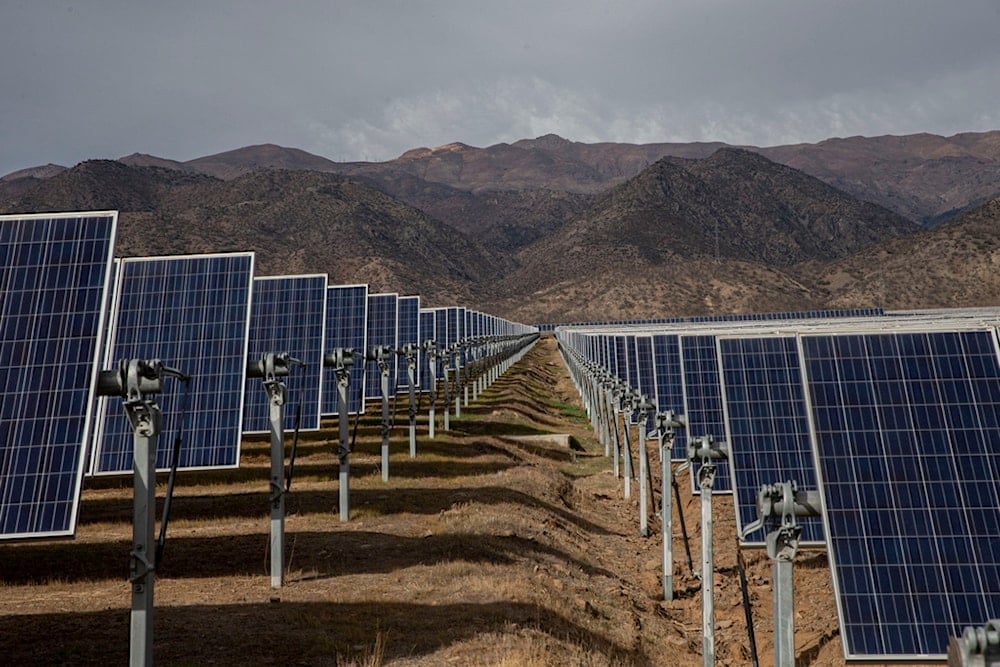
Solar panels stand in the Quilapilún solar energy plant, a joint venture by Chile and China, in Colina, Chile, August 20, 2019. (AP)
China’s solar power capacity is expected to surpass coal for the first time in 2026, marking a major milestone in the country’s long-running push to transition toward a cleaner electricity system, according to the China Electricity Council (CEC).
The world’s largest electricity producer is on track to source around half of its installed generating capacity from solar and wind by the end of the year, the CEC said in a report released Monday. Coal’s share of total capacity is projected to fall to roughly one third, despite continued construction of new coal-fired plants.
China currently operates one of the world’s cheapest and largest power systems, producing electricity at more than twice the scale of the United States. The shift reflects Beijing’s effort to balance energy security with emissions reduction while meeting rapidly rising power demand.
CEC estimates place China’s total coal-fired capacity at around 1,333 gigawatts by the end of 2026. Solar capacity stood at about 1,200 gigawatts at the end of 2025 and has expanded by an average of 270 gigawatts annually over the past three years, based on data from the National Energy Administration.
Massive increase in generation capabilities
New generating capacity across all energy sources is expected to exceed 400 gigawatts in 2026, broadly keeping pace with demand growth. The rapid buildout has helped China avoid widespread power shortages such as those seen in 2021 and 2022, an issue that has continued to affect parts of the US and Europe in recent years.
Most of the new capacity is expected to come from renewables, with wind and solar together accounting for about 300 gigawatts of additions. While still enormous by global standards, the pace represents a sharp slowdown from last year, when solar alone contributed 315 gigawatts of new capacity.
The deceleration follows policy changes adopted last year that push renewable projects toward market-based pricing, a move expected to reduce revenues for new developments. At the same time, Beijing has accelerated power market reforms, increasing competition among energy sources and exerting downward pressure on electricity prices.
China leads electric age as US clings to fossil fuels
China has rapidly positioned itself at the forefront of the global EV market, developing advanced battery technology and dominating production of essential components such as rare-earth magnets, The New York Times contributor Dan Wang wrote on January 20.
Chinese President Xi Jinping’s government has taken a long-term strategic approach, prioritizing the electrification of transportation and manufacturing to reduce reliance on oil.
By contrast, Wang writes that US President Donald Trump has made no secret of his ambitions to expand US access to fossil fuels. His intervention in Venezuela was bluntly described as a move to “take the oil,” and his administration has pursued policies that support coal, gas, and oil interests, often at the expense of renewable energy development.
Meanwhile, Chinese firms are surging ahead. Wang highlights that in 2025, over half of new vehicles sold in China were electric or plug-in hybrids, contributing to forecasts that the country's oil consumption will peak by 2027. Companies like BYD and Xiaomi have surpassed global competitors in performance, sales, and innovation, pushing China's electric vehicle dominance to new heights.
Electrification strategy fuels China’s industrial lead
Wang says that China’s rapid expansion of electricity generation capacity underpins its electrification push. In 2000, it produced just one-third of the power the US did. By 2024, it generated nearly 2.5 times more, fueled initially by coal but increasingly by wind, solar, hydro, and nuclear power. The construction of 40 new nuclear reactors and a massive new hydropower dam in Tibet demonstrates China's intent to stay ahead.
While Chinese battery technology has matured, US firms struggle to compete. Wang notes that the US once led in battery innovation and rare-earth magnet production, but many of these industries were offshored to China in recent decades. Now, China manufactures more than 90% of rare-earth magnets and dominates the global battery supply chain.
Electrification extends beyond vehicles. Bicycles, buses, boats, heating systems, and even household tools like lawn mowers are being electrified. China’s ability to scale production and build industrial infrastructure gives it a unique advantage in this transition.


