
Tesla loses title as world’s biggest electric vehicle maker as sales
 3 Min Read
Tesla lost its position as the world’s top electric vehicle maker in 2025 as sales fell 9% and BYD surged ahead.
-
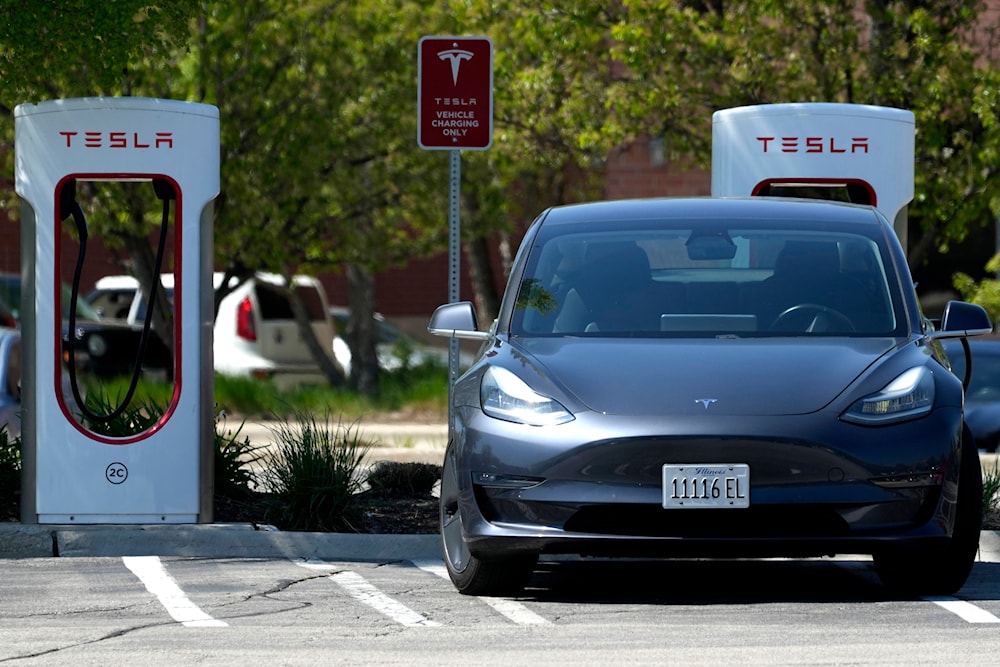
A Tesla electric vehicle is seen at a Tesla electric vehicle charging station in Northbrook, Ill., Wednesday, May 10, 2023. (AP Photo/Nam Y. Huh)
Tesla has lost its position as the world’s top electric vehicle manufacturer, with sales falling for the second consecutive year. The company delivered 1.64 million vehicles in 2025, marking a 9% decline from the previous year.
Rival Chinese automaker BYD overtook Tesla with 2.26 million units sold, cementing its position as the new global leader in electric vehicle production. This shift marks a significant reversal for Tesla, a company once seen as unstoppable in its rise, transforming the auto industry and propelling CEO Elon Musk to become the world’s richest person.
While Tesla struggled with a customer backlash linked to Musk’s political leanings and policy decisions, BYD’s growth reflected rising competitiveness in the EV market, particularly in Asia and Europe. Tesla’s fourth-quarter deliveries totaled 418,227, missing analysts’ lowered forecast of 440,000, according to FactSet.
One major factor behind the decline was the expiration of the $7,500 federal tax credit for electric vehicle purchases in the US. The tax break, phased out by the Trump administration in September, had previously bolstered demand.
Despite a promotional effort by President Donald Trump early in 2025, where he publicly endorsed Musk and praised Tesla, the sales downturn continued. The president's appearance, which included Teslas displayed at the White House, did little to reverse the trend.
Tesla stock fell 2.6% on the year’s final trading day, closing at $438.07.
Musk’s political profile and product strategy under scrutiny
In an effort to recover market share, Tesla introduced stripped-down versions of the Model Y and Model 3 in October. Priced at under $40,000 and $37,000, respectively, these models were aimed at competing with more affordable Chinese EVs.
Despite the new offerings, analysts expect Tesla’s fourth-quarter earnings (due in late January) to show a 3% drop in revenue and a nearly 40% drop in earnings per share, according to FactSet.
Musk has increasingly shifted the company’s focus from traditional car sales to autonomous driving and AI technologies. Tesla’s robotaxi service began testing in Austin in mid-2025, initially with safety drivers, later without.
The company also plans to begin production of the Cybercab, a fully autonomous vehicle with no steering wheel or pedals, in 2026. Musk claims that software updates will enable hundreds of thousands of Tesla vehicles to operate without human input by the end of the year.
Despite operational setbacks, Tesla shares rose approximately 11% in 2025. Investors have remained optimistic, betting on long-term gains in autonomous technology, energy storage, and robotics.
Tesla’s board approved a new compensation package for Musk in November to retain his leadership amid these strategic shifts. Separately, Musk received a major financial boost when the Delaware Supreme Court reversed a ruling that had blocked his controversial $55 billion pay package awarded in 2018.


