
US pressures Syria to drop Chinese telecom systems: Reuters
 5 Min Read
Washington urged Damascus to shift away from Chinese telecom technology over security concerns, as Syria weighs infrastructure diversification amid US export restrictions.
-
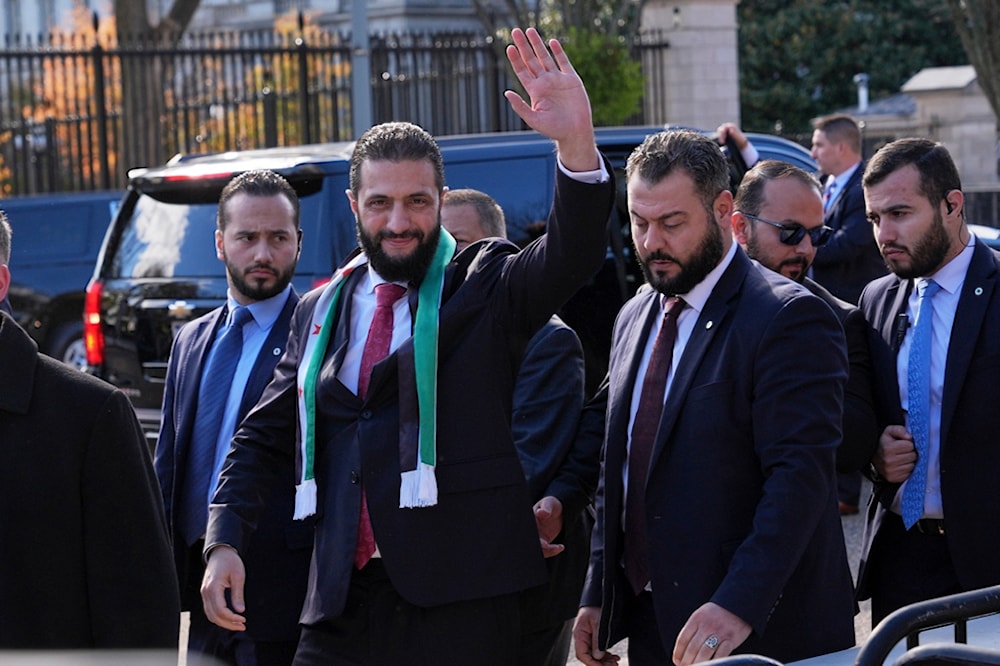
Syria's interim President Ahmad al-Sharaa waves as he greets supporters outside of the White House, Monday, Nov. 10, 2025, in Washington, following a meeting with President Donald Trump. (AP)
The United States has warned Syria against relying on Chinese technology in its telecommunications sector, citing national security concerns and broader strategic considerations, according to three sources familiar with the matter who spoke to Reuters.
The message was delivered during an unreported meeting between a US State Department delegation and Syrian Communications Minister Abdulsalam Haykal in San Francisco on Tuesday, the sources said.
The move underscores growing US-China technology rivalry and its implications for Syria’s telecommunications infrastructure as Damascus seeks to rebuild a sector devastated by years of war.
Unreported US-Syria meeting in San Francisco
According to sources briefed on the discussions, the US side pressed Syrian officials to clarify their plans regarding Chinese telecom equipment.
"The U.S. side asked for clarity on the ministry’s plans regarding Chinese telecom equipment," one source said.
A US diplomat familiar with the discussions told Reuters that the US State Department "clearly urged Syrians to use American technology or technology from allied countries in the telecoms sector."
It remains unclear whether Washington offered financial or logistical support to facilitate a shift away from Chinese suppliers.
Damascus weighs Chinese technology for telecom infrastructure
Syria is exploring the possibility of procuring Chinese technology to support telecommunications towers and the infrastructure of local internet service providers, according to a Syrian businessman involved in the talks.
Syrian officials reportedly stressed that infrastructure development projects are time-sensitive and that Damascus is seeking to diversify vendors rather than depend on a single supplier.
Since 2024, Washington has coordinated closely with Damascus following the rise of President Ahmad al-Sharaa, who replaced longtime leader Bashar al-Assad. Under previous governments, Syria maintained a strategic partnership with China, particularly in infrastructure and telecommunications.
US cites national security risks
Responding to Reuters questions, a US State Department spokesperson said, "We urge countries to prioritize national security and privacy over lower-priced equipment and services in all critical infrastructure procurement. If it seems too good to be true, it probably is."
The spokesperson added that Chinese intelligence and security services "can legally compel Chinese citizens and companies to share sensitive data or grant unauthorized access to their customers' systems" and that promises by Chinese firms to safeguard privacy were "entirely inconsistent with China's own laws and well-established practices."
China has repeatedly rejected allegations that it uses telecommunications technology for espionage purposes.
US export controls on Syria remain a barrier
Syrian officials signaled openness to cooperation with American firms but cited obstacles linked to US export controls and what they described as “over-compliance” by international companies.
According to a person familiar with the San Francisco meeting, Syrian representatives emphasized the urgency of telecommunications upgrades and the need for immediate solutions.
The Syrian Ministry of Telecommunications told Reuters that decisions regarding equipment and infrastructure are made "in accordance with national technical and security standards, ensuring data protection and service continuity."
The ministry added that it is prioritizing diversification of partnerships and technology sources to serve the national interest.
It further stated that US restrictions "hinder the availability of many American technologies and services in the Syrian market," while welcoming expanded cooperation with US companies if such restrictions are lifted.
Huawei’s dominance in Syria’s telecom sector
Syria’s telecommunications infrastructure has relied heavily on Chinese technology, largely due to US sanctions imposed on successive governments during the war that began in 2011.
Huawei technology accounts for more than 50% of the infrastructure used by Syriatel and MTN, the country’s only telecom operators, according to a senior source at one of the companies and documents reviewed by Reuters. Huawei did not immediately respond to a request for comment.
Rebuilding Syria’s war-damaged telecommunications infrastructure
After 14 years of war, Syria is seeking to develop its private telecommunications sector by attracting foreign investment and modernizing infrastructure.
In early February, Saudi Arabia’s largest telecom operator, STC, announced plans to invest $800 million to "strengthen telecommunications infrastructure and connect Syria regionally and internationally through a fibre-optic network extending over 4,500 kilometres."
Despite such initiatives, Syria’s telecommunications infrastructure remains inadequate. Network coverage is weak outside major urban centers, and connection speeds in many areas barely exceed a few kilobits per second.
As Damascus weighs Chinese telecom systems against US pressure and export restrictions, the outcome could shape not only Syria’s digital future but also its position within the broader US-China technology rivalry.


