
US pushes worldwide narrative control with crowdsourced tools on X
 5 Min Read
A State Department cable instructs US embassies to coordinate with Pentagon psychological operations units and use Elon Musk's X platform to counter foreign "hostility".
-
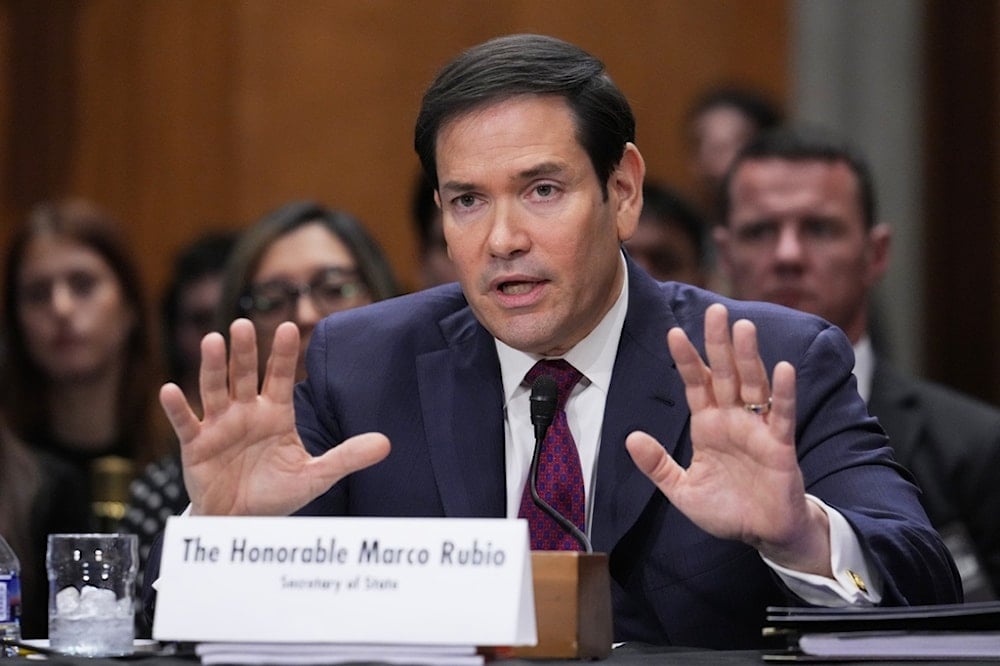
US Secretary of State Marco Rubio appears before the Senate Foreign Relations Committee at the Capitol in Washington, Wednesday, January 28, 2026 (AP)
The United States has directed every American embassy and consulate worldwide to launch coordinated campaigns against foreign propaganda and endorsed Elon Musk's X as an "innovative" tool to help do it, according to a cable signed by Secretary of State Marco Rubio and obtained by The Guardian.
The cable, issued Monday, also suggests embassies and consulates work alongside the US military's psychological operations unit to address what it describes as "rampant disinformation". It lays out sweeping instructions for how embassy staff should push back against coordinated foreign efforts to undermine American interests abroad.
The directive comes as the United States is at war with Iran and as the US continues to worry about Russian and Chinese influence.
A five-point strategy
The cable instructs embassies and consulates to pursue five broad goals: countering hostile messaging, expanding access to information, exposing adversary behavior, elevating local voices who support American interests, and promoting what it calls "telling America's story."
Embassies are told to recruit local influencers, academics, and community leaders abroad to carry counter-propaganda messaging, an approach designed to make American-funded narratives feel locally organic rather than centrally directed.
"These campaigns seek to shift blame to the United States, sow division among allies, promote alternative worldviews antithetical to America's interests, and even undermine American economic interests and political freedoms," the cable says. "Using digital platforms, state-controlled media, and influence operations, they pose a direct threat to US national security and fuel hostility toward American interests."
Coordination with military psychological operations
Notably, the cable tells diplomatic offices to coordinate their work with "the Department of War's Psychological Operations," the military unit more commonly known as MISO, or Military Information Support Operations, formerly Psyop, which is part of the Pentagon.
It is not common for the State Department to openly combine public diplomacy with military psychological operations. Previous administrations funded counter-disinformation efforts through the Global Engagement Center, which lost its funding just before Donald Trump returned to office and had been made the poster child of supposed censorship of conservative speech, though its remit had always been to target foreign disinformation outside the United States.
Last year, the FBI had its foreign influence task force dissolved, and the State Department shuttered the Counter Foreign Information Manipulation and Interference hub.
Endorsement of X
The cable endorses Elon Musk's platform X by name, specifically its Community Notes feature, as an "innovative" and "crowdsourced" instrument to cull disinformation in "countering anti-American propaganda operations without compromising free speech or privacy."
That endorsement comes as the European Union has already fined X €120 million ($137.5 million) under its Digital Services Act for deceptive practices, the first such fine under the law, and has opened further investigations into the platform's AI tools and recommendation algorithms.
Musk, who owns X, had an influential special advisory role in the Trump administration through the so-called Department of Government Efficiency (DOGE).
Branding and information distribution
The cable instructs embassy staff to ensure that US foreign assistance is visibly branded, directing consular posts to use "prominent, flag-forward branding" so that foreign audiences know when aid or programming is coming from the American government.
Offices and embassies globally are also told to increase the availability of international news and independent analysis translated into local languages, effectively tasking embassies with becoming distribution hubs for foreign-language media in countries where, the cable notes, "anti-American propaganda is pervasive or where information is restricted."
More than 700 "American spaces", cultural centers, libraries, and exchange hubs that the US government funds in countries around the world are to be repositioned under the guidance as platforms for uncensored information and promoted explicitly as free speech "zones".
A shift in US propaganda strategy
A State Department spokesperson told The Guardian that Sarah B. Rogers, the under secretary for public diplomacy nominated in March, had made countering foreign "anti-American" propaganda "a top priority" and that the department would take "an assertive stance on this pernicious issue" by "fully harnessing every tool in our diplomatic toolkit."
The directive reflects a significant shift in how the United States approaches global information warfare. By openly coordinating diplomatic posts with military psychological operations units and embracing a social media platform owned by a Trump ally, Washington is blurring the lines between public diplomacy, propaganda, and military information operations, all under the banner of countering foreign influence.
As the US-Israeli war on Iran enters its sixth week, the new strategy raises questions about what exactly the United States is trying to hide from the world and how far it is willing to go to control the narrative. When a government at war instructs its diplomats to coordinate with psychological warfare units, the line between defending truth and manufacturing it becomes dangerously thin.


