
What Lebanon actually signed away in its deal with 'Israel'
 15 Min Read
Lebanon's framework with "Israel" never mentions withdrawal. It legitimizes occupation and lets "Israel" alone judge when Lebanese sovereignty has been earned.
-
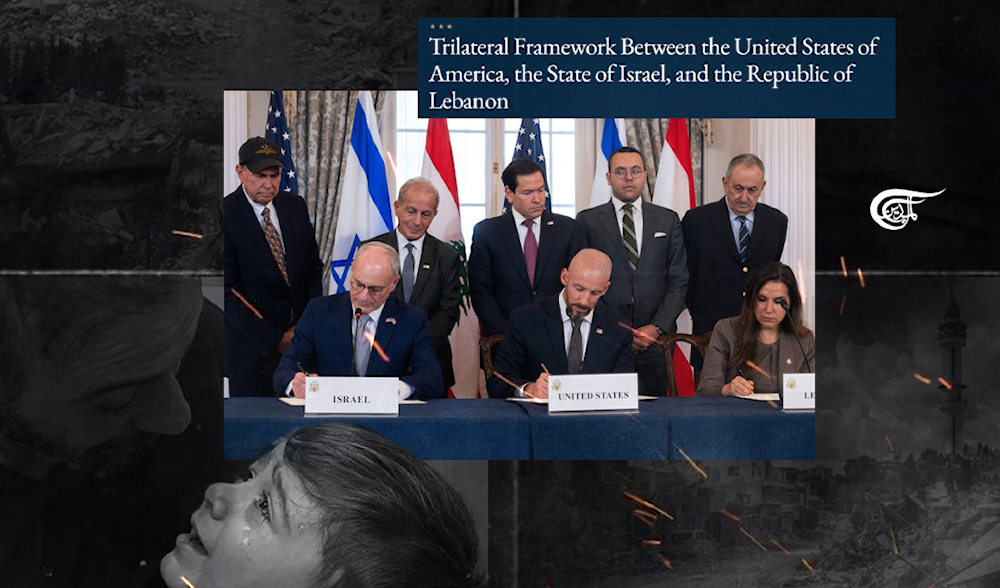
Israeli, American, and Lebanese officials sign the trilateral framework in Washington, while the South remains occupied (Illustrated by Batoul Chamas for Al Mayadeen English)
What's worse than signing away sixty southern Lebanese villages to the Israeli occupation in exchange for nothing? Doing it when a far better alternative was sitting on the table. And what's worse than that? Doing it in the name of "sovereignty."
Lebanese and Israeli officials are both calling Friday's trilateral framework, signed in Washington under US sponsorship, "historic." In a narrow sense, they are right. The Lebanese state has legitimized the continued occupation of the South, handed "Israel" an outcome it could never have secured through war, and thrown a lifeline to a Netanyahu government that badly needed one.
Yet, calling Friday's framework "trilateral" is somewhat misleading. The word suggests three sides walked into the room, when in essence, there was one. The Lebanese delegation arrived with its friends and enemies already settled, just as the US and Israeli delegations did.
Lebanon's friends, by this framework's own logic, are Washington and the occupation. Its enemies, based on the March 2 governmental decree to criminalize the Resistance, are Hezbollah and, behind it, Iran.
The Resistance is now the enemy
The text states plainly that "Israel's" military actions in Lebanon are "solely a consequence" of the threat posed by "non-state armed groups," and that ending this threat through their disarmament will "eliminate any future need" for Israeli military action in Lebanon.
In other words, the Lebanese authority has signed onto the idea that "Israel," an enemy state under Lebanon's own law, is no longer the aggressor; Hezbollah is. Contrary to what a chronically online vocal minority might want you to believe, the Israeli regime is not an enemy state in Lebanese law only; roughly 87% of the Lebanese population views "Israel" as an enemy.
The Lebanese state goes on to commit, in its own words, to rejecting "the claims of any state or non-state actor to use force on its behalf without its explicit authorization," and to treating any such claim as "illegal" and "contrary to Lebanese national interests." Resistance to occupation, something international law has never required a government's permission to exercise, becomes a domestic crime the moment a government decides to call it one.
This matters because of who exactly the Lebanese state has just declared a threat to itself, as Hezbollah's constituency is not a fringe. Beyond being the largest political party in the country, recent polling puts opposition to disarmament at somewhere between 92 and 96 percent among Lebanon's Shia community. A government cannot describe more than a third of its own population as a security threat and call that an act of sovereignty.
Redeployment is not withdrawal
Search the entire text of the framework for the word withdrawal, and you will not find it. "Israel" commits only to "progressively redeploy," a phrase that appears nowhere in international law and exists only for to avoid the obligations that come with acknowledging an occupation.
Aaron David Miller, who spent twenty-four years at the US State Department negotiating Arab-Israeli normalization deals, pointed it out. "Israel had pretty good lawyers," he wrote. "The word withdrawal doesn't appear, redeployment does."
Netanyahu and his war minister have also removed any ambiguity about what redeployment actually means. "Israel will not withdraw from Lebanon," war minister Israel Katz said after the signing, "and will maintain the security zone in the south, and will preserve the army's freedom of action." Netanyahu described the same outcome as "a major achievement" that the occupation "will maintain as long as Hezbollah has not disarmed and as long as there is a threat to the State of Israel," a condition that "Israel" alone gets to assess.
Even the two pilot zones offered as evidence of Israeli concessions are not what they appear to be. One sits south of the Litani River, outside the "security zone" that the Israeli occupation already controls. The other, Netanyahu explained, is "a small part of the expanded security zone we gained over the past two weeks, which the Israeli army does not need, and it says so in the clearest possible terms."
However, to no one's surprise, Netanyahu is lying. The occupation never actually established control over those areas to begin with, so Netanyahu is offering up land he only ever claimed to have taken.
Lebanon is being asked to celebrate the return of land the Israeli military says has no value to it, or even putting territories that were never occupied under the so-called pilot zone model, while the original security zone, including the area occupied specifically to allegedly "push back the Radwan Force," stays put regardless of what happens with disarmament.
Still no ceasefire
For all the talk of de-escalation, the framework does not contain a ceasefire either.
"Israel" is not named anywhere in relation to halting its own attacks. The document conditions calm not on "Israel" ending its aggression, withdrawing from occupied territory, releasing prisoners, or allowing the displaced to return, but on Hezbollah ceasing fire and withdrawing.
What is being sold as a cessation of hostilities is structured, in practice, as the removal of Lebanese citizens from their own land, not the removal of an occupying army from it.
No court, no compensation, no answers on the prisoners
Ironically, the Lebanese government, headed by the former President of the International Court of Justice, signed away its own legal recourse.
The text commits both sides to "the cessation of all hostile or adverse actions in international political or legal fora," language that independent lawmaker Halima El Kaakour challenged directly to the president and prime minister. "Does this mean not pursuing the enemy for its war crimes and crimes against humanity?" she asked, warning that the clause "deprives Lebanon of the possibility of substantial financial compensation" and amounts to enshrining impunity rather than building peace.
Under this clause, Lebanon gives up any path to the ICC, any formal complaint at the UN Security Council, any pursuit of accountability for the Black Wednesday massacre, the pager attacks, or any of the killings carried out over the past three years.
The same passage leaves Lebanese prisoners and the forcibly disappeared in legal limbo. There is no commitment from "Israel" to disclose their fate, allow Red Cross visits, or guarantee their release, the obligations international humanitarian law already requires.
The fine print
Almost everything written into this framework imposes a hard, specific obligation on Lebanon while leaving "Israel" and the United States with language soft enough to mean whatever they need it to mean later.
Lebanon's commitment to disarm "all non-state armed groups" across the entire country is unconditional and described as irreversible. The Israeli regime's "redeployment," by contrast, depends on a "Security Annex" that has not been published, verified by criteria the US will set, with Washington cast as a neutral arbiter despite being "Israel's" principal sponsor and arms supplier.
Reconstruction is structured the same way. Funds are barred from reaching any "individual" affiliated with a non-state armed group, not just organizations. Given how much of the South's population has some connection to the Resistance, this clause functions less like counterterrorism financing and more like a blanket ban on rebuilding most of the destroyed villages in the South.
Even the word "communities" appears only once in the entire text, and it refers to Israeli communities. South Lebanon, where the actual destruction happened, is treated as a depopulated piece of land, empty of a "community" in need of protection.
April 8: The original sin
To understand just how little weight Lebanon's own diplomacy carried in any of this, and how easily its government let itself be used by the same regime bombing it, it helps to go back to how these talks actually started.
President Joseph Aoun signaled willingness for direct talks with the occupation regime back in early March, only for "Israel" to publicly humiliate the offer. Sources told Reuters that Lebanon had "nothing tangible to offer at a negotiating table." Foreign Minister Gideon Saar was asked whether talks with Lebanon were planned and answered, "No." For roughly four weeks, the same government that insisted only it had the standing to negotiate a ceasefire could not get "Israel" to even sit down, while the bombing continued.
The turning point came on April 8, when Pakistan's prime minister announced a ceasefire across all fronts, including Lebanon, as part of the Islamabad track Iran had insisted on. Within hours, the 'Israeli' regime made clear it was not committing to any ceasefire in Lebanon specifically. Simultaneously, Prime Minister Nawaf Salam declared that securing a ceasefire was a "sovereign matter" only the Lebanese government could negotiate, rejecting any truce that arrived through Iran.
In doing so, Salam handed legitimacy to the massacre that followed within hours, on what has since become known as Black Wednesday, when Israeli attacks murdered more than 350 people across Lebanon in ten minutes.
The killings drew international condemnation, the kind that under any government with a spine would have hardened Beirut's position rather than softened it. Instead, the Lebanese state kept pursuing the same direct, bilateral channel, the first of its kind in decades, with the same regime that had just massacred hundreds of its people in minutes.
Then, just as suddenly, Netanyahu reversed course entirely. He framed it as responding to Lebanon's "repeated requests" for talks, the same requests his government had spent a month publicly mocking. "Israel" was not responding to an improvement in Lebanese diplomacy. It was responding to Iran, which had just made an end to hostilities in Lebanon a non-negotiable piece of any wider de-escalation.
Netanyahu was not about to let Tehran dictate the terms of Israeli activity in Lebanon, so he made sure Beirut delivered those terms to him directly instead.
What Pakistan got that Washington didn't
The contrast with what Iran actually negotiated for Lebanon in the Islamabad track versus what Lebanon's own government did in Washington is immense.
The Islamabad memorandum called for an immediate ceasefire on the Lebanon front, full Israeli withdrawal from the South and all Lebanese territory within two months, extension of Lebanese state authority over the entire country, and a Hezbollah weapons question handled through an internal national security strategy rather than as a precondition for anything. Both sides retained the right to self-defense if attacked, and the threshold for declaring the danger over was never left to "Israel" alone to decide.
The Washington framework inverts every one of those terms. There is no immediate ceasefire. There is no timeline at all. The Lebanese state's authority expands only gradually, based on Israeli judgment, through pilot zones, after weapons are removed, not before.
"Israel" keeps the so-called "freedom of military action" throughout the South whenever it perceives a threat, while Lebanon's army is confined to specific zones it must first earn through performance. And withdrawal, such as it is, depends entirely on "Israel's" own assessment of whether the threat has ended.
The Iran-US memorandum required full Israeli withdrawal from Lebanon as a condition of any comprehensive deal. Lebanon's government had that outcome sitting in front of it, unconditional and on a clock, without having to give up anything in return. It chose this framework instead.
A sovereign decision, as long as 'Israel' signs off first
What makes this hardest to defend is the gap between what Lebanese officials are telling the public and what "Israel's" own officials are saying about the exact same document.
President Aoun's office described Friday's signing as the first step toward restoring "the sovereignty of the Lebanese state over all its territory, without the loss of a single inch," and promised the Lebanese people they would return to a fully liberated land, with "no more occupation, no prisoners, no dependency, and no tutelage." Prime Minister Salam went further, saying the framework "aims to secure an Israeli withdrawal from all Lebanese territory" and restore full state sovereignty.
War minister Katz called the same agreement "a historic event and an important political and security achievement for Israel." Asked what that achievement actually was, he proclaimed that "Israel will not withdraw from Lebanon," adding that it "will maintain the security zone in the south, and will preserve the army's freedom of action."
Netanyahu opened his address on Saturday the same way. "I want to tell you about a major achievement for the State of Israel," he said, before explaining that the achievement was that "Israel" "remains, first and foremost, in the security zone in southern Lebanon," a presence he said it "will maintain as long as Hezbollah has not disarmed."
Both governments are describing the same piece of paper. One says it secures full withdrawal and total sovereignty. The other says, in plain language, on the record, on the same day, that nobody is withdrawing and that staying put is the achievement. Either Lebanon's government did not read the document it signed, or it is telling its own people something it knows is not true.
A recipe for civil war
Israeli settlers received a far clearer picture of the agreement from their national broadcasters than the Lebanese population. Channel 13 host Rafi Droker said plainly that "the Israeli plan in Lebanon is to divide the country and plunge it into a civil war to force the Lebanese government to confront Hezbollah militarily," and military correspondent Alon Ben-David confirmed it was "the Israeli goal from the beginning."
It is not hard to see how that would actually play out. The framework asks the Lebanese army, a national institution built on cross-sectarian consensus, to enter the South and dismantle Hezbollah's positions under Israeli and US supervision.
Hezbollah is not going to disarm voluntarily, and the army has no mandate, no appetite, and no realistic capacity to force the issue without turning its own ranks, and the country around them, against each other.
A force meant to hold Lebanon together would become the instrument that tears it apart, fighting a domestic enemy on behalf of the same regime still occupying its land.
Lebanon already tried this in 1983
This is not the first time a Lebanese government has signed an agreement with "Israel" under US sponsorship that promised peace and delivered occupation.
In 1983, the Gemayel government signed the May 17 Agreement after the 1982 invasion, with a written, named Israeli commitment to withdraw all forces within eight to twelve weeks. It collapsed within a year, rejected by the political forces strong enough to block it, and canceled by the Lebanese parliament in March 1984.
The 2026 framework does not even reach the bar that the May 17 Agreement set.
The earlier document at least named Israeli withdrawal as an obligation, however, conditional in practice. This one does not contain the word at all. And unlike 1983, when Israeli troops occupied Beirut, and the Lebanese state was negotiating, effectively with a gun to its head, today's government has no such excuse. There is no foreign army in the capital, and Hezbollah's military capacity is reconstituting rather than collapsing, with its drone and anti-tank tactics already producing real losses on the IOF. Iran is negotiating with Washington from a position of regional strength, not weakness, and made a Lebanon ceasefire a centerpiece of those talks. Lebanon had diplomatic leverage in 2026 that it simply did not have in 1983, and chose not to use it.
It is worth letting Hezbollah have the last word here, since this is the side the entire framework was built to silence. Hezbollah MP Hassan Fadlallah addressed Netanyahu directly on the day the agreement was signed. "You have reached an agreement with one who possesses nothing," he said. "The state of hostility toward Israel will remain, and whoever shakes hands with the enemy is complicit in its crimes."


