
Hunger Strike Reaches Day 50: Multiple Hospitalisations as Government Remains Silent
-
 Sul Nowroz
- 23 Dec 2025 23:58
- 2 Shares
 13 Min Read
Six young activists are on a 52-day hunger strike in UK prisons over a year-long pretrial detention for Gaza protests, as ministers refuse talks and deaths loom.
-
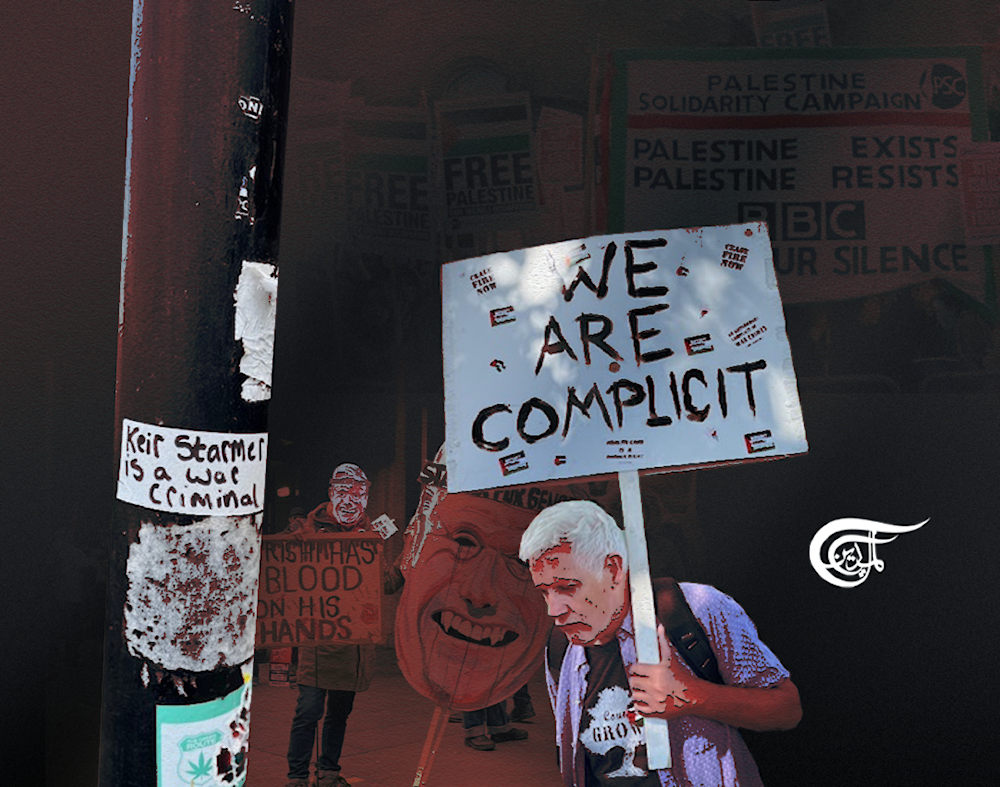
Six UK activists face death on hunger strike after over a year in pretrial detention for Gaza protests, as the government ignores calls to intervene (Illustrated by Mahdi Rteil to Al Mayadeen English)
Six activists, aged 20 to 31, are dying in British prisons. Since November 2nd, they have been on hunger strike to protest their extended pre-trial detention and the UK government's complicity in what they describe as genocide in Gaza. Most have been held on remand for over a year without trial, far exceeding the UK's statutory six-month pre-trial custody limit, facing charges of property damage for breaking into Elbit Systems weapons facilities and a British air force base. None have been convicted of any crime.
As the strike enters its 52nd day, six remain committed to their protest despite multiple hospitalisations. Yet Justice Secretary David Lammy has refused to meet with their legal representatives, and the government maintains a silence that many interpret as a calculated decision to let these young Britons die rather than address their demands.
A Medical Emergency Ignored
-

Qesser Zuhrah
On December 18th, Qesser Zuhrah, just 20 years old, collapsed in her cell at HMP Bronzefield. It was day 46 of her hunger strike. The ambulance that arrived to rush her to hospital came not because prison authorities had been monitoring her deteriorating condition with appropriate medical care, but because her body had finally reached the point where it could no longer function. She had lost 13 percent of her body weight. Her friends report that prison authorities have refused to provide information about her condition even to those designated as her emergency contacts.
-

Amu Gib
The following day brought more emergency hospitalisations. Amu Gib, 30, was taken from Bronzefield on day 48, unable to walk, they required a wheelchair. Amu had been experiencing brain fog and double vision, symptoms that medical experts identify as warning signs of severe neurological damage.
-

Kamran Ahmed
Also on December 19th, Kamran Ahmed, 28, was hospitalised from HMP Pentonville for the second time. On day 42 of his hunger strike, he had suffered intense chest pains, tremors he described as feeling like being electrocuted, and slurred speech. His weight had dropped to just 61 kilograms. The prison did not inform his family that he was being rushed to the hospital. They cut off all his phone access so he could not contact them himself. When his father finally called the prison, the staff told him Kamran was just going for a test and would be right back. Two days later, the family still had not heard from him.
These are not isolated incidents of inadequate care. They represent a pattern of medical neglect that over 800 doctors, nurses, and healthcare professionals have condemned in an unprecedented open letter to Justice Secretary David Lammy. The healthcare workers warn that without immediate intervention, there is "the real and increasingly likely potential that young British citizens will die in prison, having never even been convicted of an offence."
The Bodies Breaking Down
Dr. James Smith, an emergency physician with 11 years’ experience, has been monitoring the hunger strikers' condition.
"After approximately three weeks, the body has exhausted fat stores and begins to break down muscle and organ tissue in order to generate enough energy simply to maintain essential bodily functions," Dr. Smith explains. "Thereafter there is a risk that grows with every passing day of sudden, severe, and unpredictable bodily dysfunction." At 50 days, the strikers are well past this threshold. Their bodies are cannibalising themselves. Hearts are weakening as the cardiac muscle breaks down. Kidneys are struggling to filter waste. Muscles essential for breathing are deteriorating. Any of them could experience sudden cardiac arrest or organ failure at any moment.
A Government That Will Not Speak
The silence from Westminster is deafening. Justice Secretary David Lammy has refused every request for a meeting with the hunger strikers' legal representatives. More than 50 MPs, including Labour's John McDonnell and independent Jeremy Corbyn, have urged Lammy to engage. Over 20,000 people have signed petitions calling for government intervention. More than 800 healthcare professionals have written warning of imminent deaths. The Speaker of the House of Commons, Lindsay Hoyle, has publicly called the government's lack of response "totally unacceptable."
Yet Lammy has not responded. The government has not addressed the crisis publicly. Ministers have not indicated any willingness to engage with the strikers or their supporters. When Labour MP John McDonnell asked the parliamentary under-secretary of state at the Ministry of Justice, Jake Richards, for a meeting about the hunger strike in the House of Commons, Richards flatly refused. Other MPs in the chamber were heard laughing.


This silence is not accidental. It is not bureaucratic oversight. Ministry of Justice policy explicitly states that relevant authorities must seek to address and resolve all hunger strikes. In this case, neither prison governors nor ministers have listened to the hunger strikers or discussed their demands. The government's position, or rather, its calculated absence of position, appears to be that if they simply refuse to acknowledge the crisis, if they let the prison system handle it behind closed walls, if they maintain institutional silence, then eventually the problem will resolve itself when the strikers either give up or die.
The Question of Complicity
-
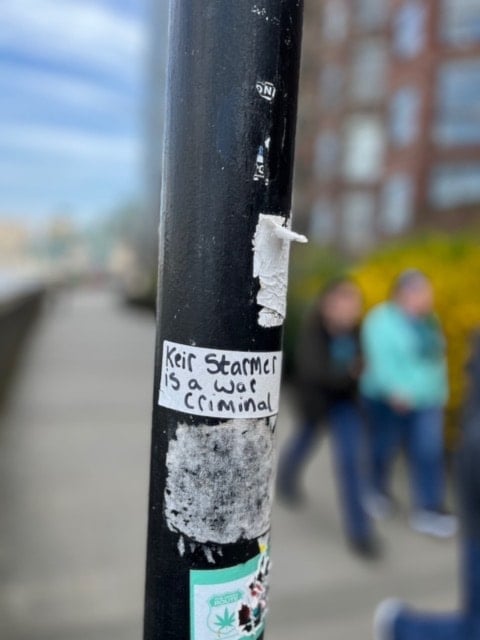
A homemade sticker calling British Prime Minister Kier Starmer a war criminal decorates a London lamp post (Image – Sul Nowroz)
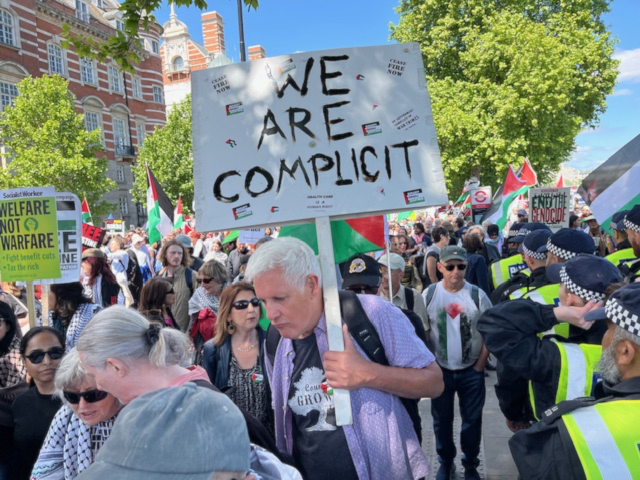
To understand why the government refuses to engage, one must understand what the hunger strikers are protesting. They are not simply objecting to their own detention. They are drawing attention to what they describe as British complicity in genocide, and the evidence they cite is damning.
According to investigations by Declassified UK, Britain has conducted over 500 surveillance flights over Gaza since October 2023. These are not passive observation missions. British air force aircraft operating from British sovereign base areas in Cyprus have flown extensive reconnaissance sorties, gathering detailed intelligence on the ground situation in Gaza, intelligence that activists argue has been used to facilitate military targeting by Israeli forces. This represents direct operational support, not merely diplomatic backing. Britain is providing the surveillance infrastructure that enables precision strikes in a bloody campaign that has largely targeted and killed civilians.
Meanwhile, Elbit Systems, The Israeli largest weapons manufacturer, operates multiple facilities across Britain, producing drones, weapons systems, and surveillance technology that are deployed in Gaza. The UK government licenses these operations, approves the exports, and provides the legal and regulatory framework that allows an Israeli arms company to manufacture weapons on British soil that are then used in operations that numerous international human rights organisations, legal experts, and UN investigators have characterised as genocidal.
The activists who broke into Elbit's Bristol facility and disabled aircraft at the Brize Norton air force base were trying to stop this. They were attempting to disrupt what they viewed as Britain's direct participation in war crimes. And for this, they have been held without trial for over a year, prosecuted under terrorism legislation, and denied bail, treatment typically reserved for those accused of violent crimes, not property damage.
Media Complicity in Silence
-
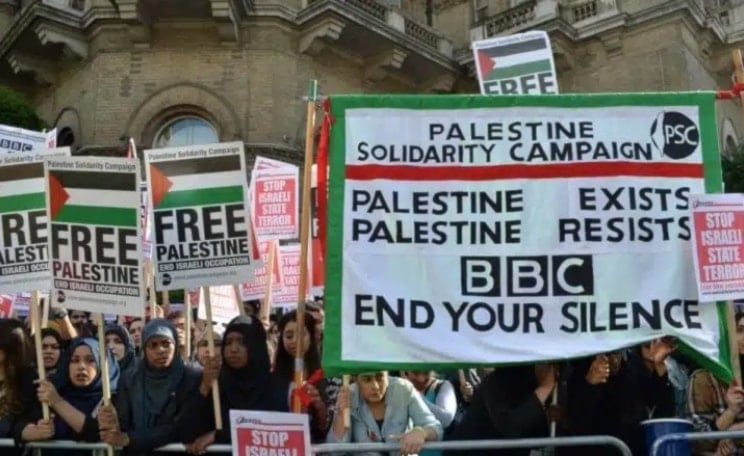
Hunger Strike Reaches Day 50: Multiple Hospitalisations as Government Remains Silent
The government's silence has been matched by what many characterise as a deliberate media blackout. This is the largest coordinated hunger strike in UK prisons since 1981, when Irish Republican prisoners led by Bobby Sands refused food. That strike generated, as one academic study documented, "unprecedented levels of media coverage." The Suffragette hunger strikes of 1909-1914 were extensively covered by the popular press of the day. Even when newspapers condemned the protesters' tactics, they provided sustained attention to their cause and their deteriorating condition.
By contrast, the current hunger strike has been met with near-total silence from British mainstream media. From October 20th, when the strike was announced, to December 10th, a period of nearly two months, the hunger strike was mentioned just 12 times across all British newspapers: four times in The Guardian, twice each in The Times, The Independent, and the Daily Mail, and once each in The Telegraph.
The BBC published its first online piece about the strike on December 10th, more than a month after it began, and that article failed to mention that the day before, one of the strikers had been rushed to hospital with severe health complications.
Broadcasters have been even more silent. A search of Box of Broadcasts, which archives UK television and radio content, yielded no results at all for coverage of the hunger strike in the same period. In fact, the British press has published more articles about a BBC drama series depicting the hunger strikes of Nazanin Zaghari-Ratcliffe, a British-Iranian woman imprisoned in Iran, than about the actual hunger strike of British citizens occurring right now in UK prisons.
Professor Bart Cammaerts of the London School of Economics, analysing this media silence, writes: "In contrast to the robust media coverage of the Irish hunger strikes in the 1980s, the current hunger strikes have been largely met with media silence. What will it take for the British media to pay attention to the plight of jailed pro-Palestine activists?" The answer, he suggests, is that the silence is "a deliberate editorial choice by the British media."
A Crisis Point
As of December 23rd, the hunger strike has entered its 52nd day. Two of the original eight strikers, Jon Cink and Muhammad Umer Khalid, have ended their strikes due to hospitalisations and underlying health conditions. Six continue refusing food.
Outside the prisons, family members wait in anguish. Shahmina Alam, Kamran Ahmed's sister, says: "At any moment now, you could receive a phone call to get the most unfortunate news." Rahma Hoxha, sister of Teuta Hoxha, describes the terror of waking up each morning and checking her phone, "scared that there'll be a call from the prison." These families are living with the knowledge that the British government is choosing, actively, deliberately choosing, to let their loved ones die rather than sit down and talk.
-
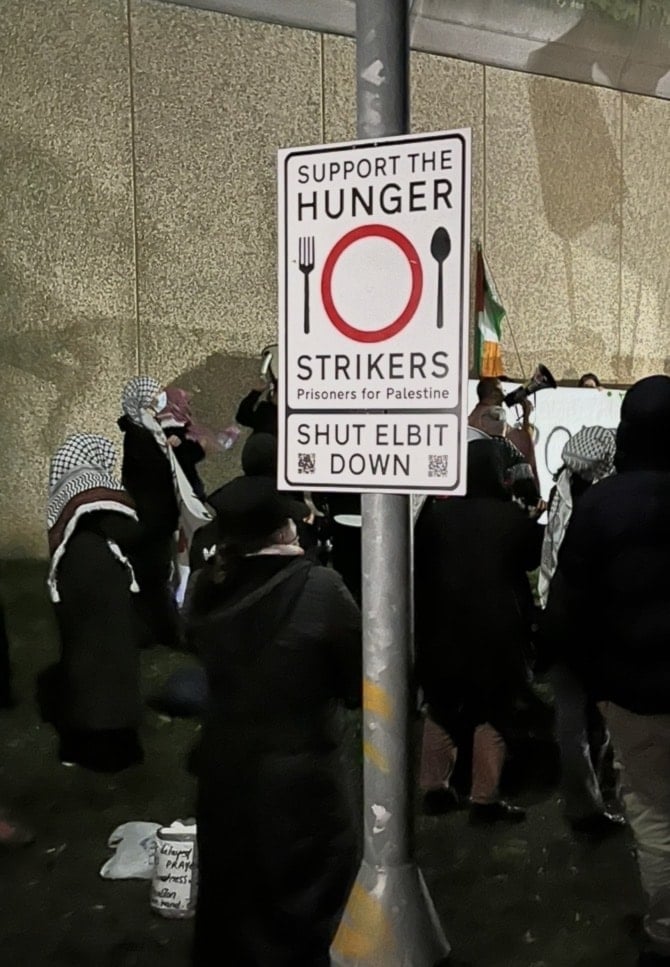
Hunger Strike Reaches Day 50: Multiple Hospitalisations as Government Remains Silent (Image – Sul Nowroz)
The Question Britain Must Answer
-
Hunger Strike Reaches Day 50: Multiple Hospitalisations as Government Remains Silent (Image – Sul Nowroz)
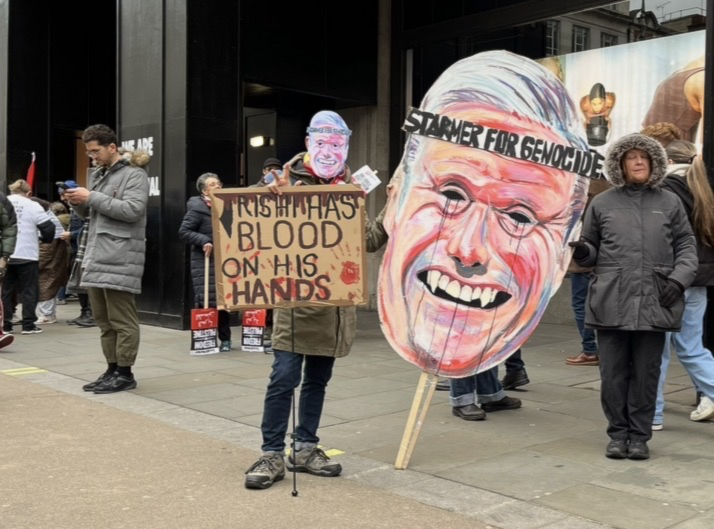
The crisis unfolding in British prisons forces a question that the government has refused to address: Why does the United Kingdom value its relationship with "Israel" more than the treatment and welfare of its own citizens?
This is not a rhetorical question. It is a practical one with life-and-death implications. The British government has a choice. It could meet with the hunger strikers' legal representatives tomorrow. It could grant bail to defendants who have been held for over a year on remand. It could ensure that young people dying in state custody receive appropriate medical care. Instead, it does nothing. It maintains silence. It allows the situation to deteriorate while continuing to provide military and intelligence support to Israeli operations in Gaza.
The government's position becomes indefensible when one considers the full scope of what is happening. Britain is not merely diplomatically supporting "Israel". It is providing direct operational support through surveillance flights. It is hosting weapons manufacturing for Israeli military operations. And when British citizens take action to disrupt this support, action they describe as trying to prevent genocide, the government prosecutes them under terrorism legislation, holds them for over a year without trial, and then refuses to respond when they undertake a hunger strike to protest their treatment.
This reveals a profound moral calculation: the British government has decided that maintaining its military relationship with "Israel" is more important than preventing the deaths of eight young British citizens in its own prisons. It has decided that continuing to facilitate what many characterise as genocidal operations in Gaza is worth the price of letting its own people die in protest.
Critics argue there is a word for what this represents: complicity. The government stands accused of complicity in genocide in Gaza through its intelligence sharing and arms manufacturing support. Now it faces accusations of complicity in another set of potential deaths, those of the hunger strikers themselves. If any of these activists die in British prisons, it will not be because of unavoidable circumstances. It will be because the government chose their deaths over dialogue. It will be because someone in power decided that engaging with their demands was too politically costly, and that letting them die was preferable to addressing British involvement in what is happening in Gaza.
The Final Question
-
Hunger Strike Reaches Day 50: Multiple Hospitalisations as Government Remains Silent (Image – Sul Nowroz)
Will the British government be complicit not only in genocide abroad but also in the deaths of six of its own citizens at home?
This is the question that hangs over the crisis as it enters its eighth week. The medical evidence is clear: without intervention, some or all of these hunger strikers may die. The legal obligations are clear: Ministry of Justice policy requires authorities to address and resolve hunger strikes. The moral imperative is clear: young people in state custody should not be left to die because their government finds their political demands inconvenient.
Yet the government remains silent. David Lammy has not responded to meeting requests. Ministers have not addressed the crisis publicly. The institutional machinery grinds on as if six people were not dying in British prisons, as if over 800 healthcare workers had not warned of imminent deaths, as if tens of thousands of citizens had not demanded action.
The families keep vigil outside prison walls. The healthcare workers continue to sound the alarm. The hunger strikers' bodies continue their slow, irreversible decline. And in the corridors of power, the decision has apparently been made: Let them die. It is easier than explaining why Britain continues to support operations in Gaza that much of the world has condemned as genocidal. It is easier than justifying why property damage activists are held as terrorists. It is easier than admitting that the UK's relationship with "Israel" has become so important that the government is willing to sacrifice its own citizens rather than question that relationship.
History will record what happens next – whether the British government allowed six young people to die in its prisons rather than address their concerns about British complicity in atrocities abroad. History will record the names: Qesser Zuhrah, 20 years old. Amu Gib, 30. Kamran Ahmed, 28. Heba Muraisi, 31. Teuta Hoxha, 30. Lewie Chiaramello, 22. And history will ask why no one with the power to stop this chose to act.
* * *
As this article goes to press on December 23, 2025, the hunger strike has entered day 52. The government has still not responded. The strikers continue to deteriorate. Time is running out.


