
Greenland, Trump and the return of imperial thinking
-
 Leila Nezirevic
- 23 Jan 2026 14:13
 9 Min Read
Washington’s bid for Greenland was dismissed as bluster, but it revealed cracks in NATO, questioned the reliability of the US as Europe’s security guarantor, and signaled a revival of imperial thinking in global politics.
-
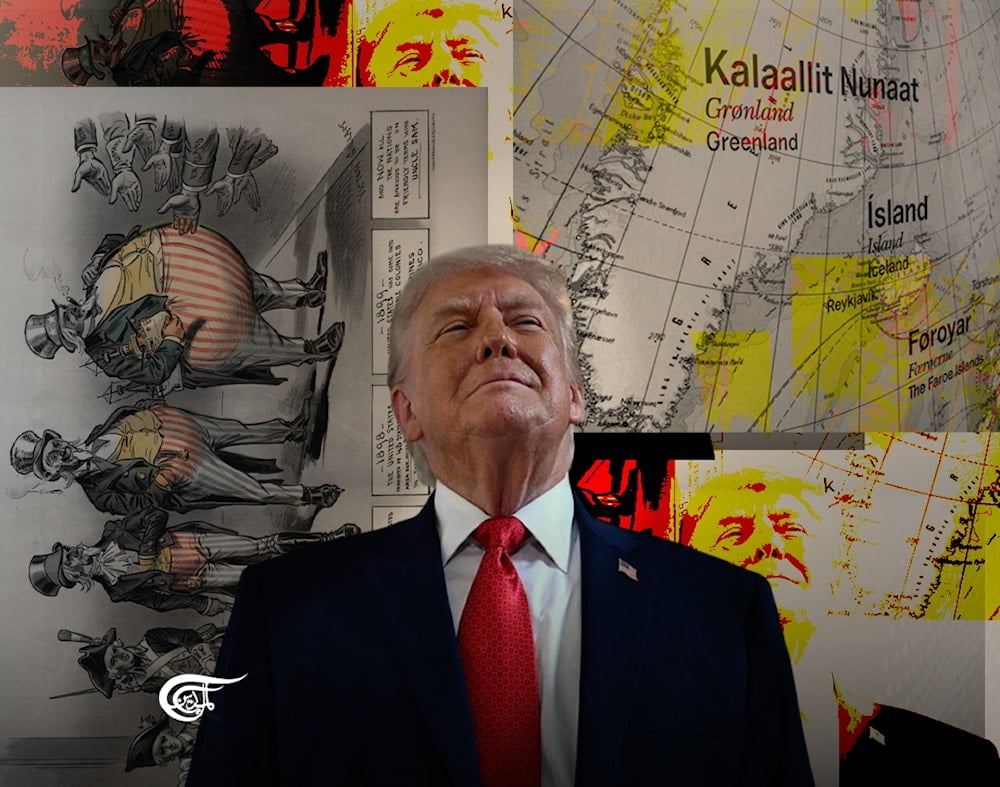
Greenland is a mirror, reflecting a world in which empire is no longer unthinkable, alliances are no longer assured, and the rules that once governed power are increasingly up for negotiation. (Al Mayadeen English; Illustrated by Batoul Chamas)
When Donald Trump revived the idea that the United States should acquire Greenland, many dismissed it as bluster—another provocation in a presidency defined by spectacle. But as Washington’s rhetoric hardened, and European capitals began quietly reassessing their assumptions about American power, the episode took on a deeper significance. What once sounded like a diplomatic oddity now looks increasingly like a stress test for the post-war order, NATO’s cohesion, and the West’s moral authority.
Greenland is not simply a vast Arctic island with a tiny population of 57,000. It is a geopolitical hinge point: between North America and Europe, between the Atlantic and the Arctic, and between an old order of politics and a new era of strategic anxiety. The question is no longer whether the United States can legally take Greenland—it cannot, without consent—but what Washington’s posture reveals about a superpower grappling with decline, and what this means for Europe’s future security.
“This is not just about Greenland,” says Paul Rogers, the UK’s leading global security expert and emeritus professor of peace studies at Bradford University. “It’s about how other countries now see the United States—not as a straightforward ally, but as an increasingly unpredictable power.”
Anxiety behind the rhetoric
Rogers argues that Trump’s Greenland fixation reflects both a tactical shift and a deeper structural unease within American power. “We’re at a very early stage and things are changing almost day to day,” he says. “Trump himself is thoroughly unpredictable, but he has an utter self-belief that’s very difficult to shift.”
That unpredictability, Rogers says, is now forcing European governments to rethink their relationship with Washington on the basis of worst-case scenarios. The assumption that the United States will always act as a benign guarantor of European security no longer holds.
In foreign ministries across Europe, Rogers says, there is a re-evaluation underway, with officials having to assume that what is unfolding could shape American foreign policy for the next five or six years.
The Greenland episode has accelerated that process. Denmark, a NATO member, suddenly found itself under pressure from the alliance’s dominant power over territory that is legally and politically its own. For many European officials, it was a shock not because of its novelty, but because of its familiarity.
“But you’d have to go right back to the Suez crisis of 1956,” Rogers says, “when essentially the United States pulled the plug on the Franco-British endeavour.” What is striking this time, he adds, is how colonial the episode feels—echoing the behaviour of great powers in the late colonial period.
NATO’s internal contradiction
For Jamie Shea, former NATO Deputy Assistant Secretary General, the danger lies not only in the outcome, but in the precedent. NATO, he stresses, was designed to deter external threats—not to manage territorial coercion from within.
“If President Trump were to seize control of Greenland or declare it the 51st state,” Shea says, “it would be a violation of international law and Danish sovereignty.” Such a move, he warns, would cause a real and permanent rift between the United States and its European allies.
Shea believes Europe’s priority must be preventing that worst-case scenario from materialising. NATO, he says, is already trying to offer Trump a collective solution—greater alliance involvement in Greenland’s defence—that would render unilateral US control unnecessary.
The irony, Shea notes, is that the United States already enjoys extensive military access to Greenland under a 1951 treaty with Denmark. During the Cold War, Washington operated 17 bases on the island with some 15,000 personnel. Today, it maintains just one radar station with around 150 troops—a drawdown decided by Washington itself.
“So why invent an artificial problem,” Shea asks, “when the solution is already there?”
Yet even if Trump were to back down, the damage may already be done. NATO’s credibility rests on trust: the belief that allies do not threaten each other, and that collective defence is a shared commitment rather than a transactional bargain.
“The glue that holds NATO together,” Shea warns, “would dissolve if that trust disappears.”
What would happen if #Greenland became the next flashpoint between the United States and its closest allies?
— Al Mayadeen English (@MayadeenEnglish) January 23, 2026
Former NATO Deputy Assistant Secretary General Jamie Shea told Al Mayadeen English that any move by US President Donald #Trump to "seize control of Greenland or attempt… pic.twitter.com/y6pG81S5H8
A fragile alliance
That fragility is central to the analysis of Dr Ian Davis, an independent security consultant and editor of NATO Watch. He argues that the Greenland crisis has exposed fault lines that long predate Trump—but which his presidency has pushed to breaking point.
“The biggest and potentially terminal fault line is the ‘Trump factor’ itself,” Davis says. The reliability of US security guarantees, he argues, is now openly in question.
Other divisions compound the problem. Washington’s strategic pivot toward China sits uneasily with Europe’s immediate focus on Russia and Ukraine. Disputes over defence spending persist, with several NATO members privately acknowledging they cannot meet new targets. Meanwhile, regional priorities diverge.
“NATO’s political cohesion has never been so fragile,” Davis says, adding that it is under pressure from both internal political shifts and external challenges.
European troop deployments to Greenland in recent months, he says, should not be mistaken for genuine military reinforcement. “They’re a political gesture—nothing more,” he says. “There is no prospect of an intra-NATO military showdown.”
The real leverage Europe holds, Davis notes, is economic and political—not military.
Former #NATO Deputy Assistant Secretary General Jamie Shea explains the complex dynamics surrounding Greenland, where #Denmark remains sovereign but hosts a limited #US military presence under a 1951 agreement.
— Al Mayadeen English (@MayadeenEnglish) January 24, 2026
"Denmark would welcome more forces," Shea noted, but any expansion… pic.twitter.com/89GHfRLfKx
The law, and the limits of force
Legally, the barriers to the US acquisition of Greenland are clear. International law allows borders to change only through negotiation and consent. Denmark has explicitly rejected any sale, and Greenlanders themselves—who enjoy extensive self-rule—have repeatedly made clear they do not wish to become Americans.
“85% of the population opposes it,” Shea says. “You can’t force a sovereign territory to sell itself.”
But Rogers warns that legality alone may not be sufficient. “If the United States can behave this way,” he says, “it lays the ground for others to act with a degree of impunity.”
The implications stretch far beyond the Arctic. Western criticism of Russian aggression in Ukraine or Chinese ambitions in Taiwan rings hollow, Rogers argues, if Washington openly flirts with territorial acquisition.
“This weakens the West’s moral authority,” he says. “It makes the international system more permissive of force.”
Does international law allow US President Donald Trump to seize Greenland?
— Al Mayadeen English (@MayadeenEnglish) January 23, 2026
Former NATO Deputy Assistant Secretary General Jamie Shea laid out in an interview with Al Mayadeen English the legal red lines around changing borders, stressing that international law allows territorial… pic.twitter.com/kaP5P7ybGx
Climate change and militarisation
The Arctic’s growing strategic importance is inseparable from climate change. Melting ice is opening new shipping routes and access to resources, intensifying competition among major powers. But Rogers cautions against overstating the military dimension.
“The biggest single security threat worldwide by far is climate breakdown,” he says. “Yet we have a US presidency that doesn’t believe it’s happening.”
China, by contrast, is investing heavily in renewable energy and climate adaptation. Over the next decade, Rogers predicts, Beijing will reap the geopolitical dividends of that foresight.
“When the world finally accepts that climate breakdown must be addressed,” he says, “China will benefit enormously.”
Empire’s shadow
“I never thought I’d use the term imperialism in this context,” Rogers says. “But this is old-fashioned imperialism.”
An economically declining power that remains militarily dominant, he argues, is particularly dangerous. “It’s natural for such a power to lean on military solutions to preserve leadership,” he says. “That’s what makes the coming months so risky.”
Trump’s domestic political pressures only heighten that risk. With approval ratings falling and midterm elections looming, Rogers warns of the temptation to seek external confrontation as distraction.
“A smallish war,” he says, “can be very useful politically.”
Europe’s dilemma
“Europe mustn’t be weak,” Shea says. “It has to be united, strong, and able to show that a NATO solution is better value for the United States.”
Davis is less sanguine. “To safeguard its security and values,” he says, “Europe must act swiftly to prepare for a post-NATO scenario, or a NATO in which the US plays a much smaller role.”
“These options are rarely taken seriously,” he says, “because we still cling to outdated ideas of what security means.”
For now, Greenland remains Danish, and Trump’s rhetoric has not translated into action. But the episode has already achieved something more profound: it has stripped away comforting illusions about alliance politics in an era of shifting power.
Whether NATO adapts, fractures, or fades will depend not only on Washington’s next move, but on Europe’s willingness to confront uncomfortable truths about dependency, sovereignty and security.
As Rogers puts it, “We are in a new ball game. And we simply don’t yet know how far this will go.”
What is clear is that Greenland is no longer a peripheral outpost at the edge of the map. It is a mirror—reflecting a world in which empire is no longer unthinkable, alliances are no longer assured, and the rules that once governed power are increasingly up for negotiation.


