
Strait Resistance: How the Hormuz crisis challenges Western economic hegemony
-
 Leila Nezirevic
- 18 Mar 2026 21:52
 12 Min Read
Disruption in the Strait of Hormuz is not only a military crisis; it is revealing deeper vulnerabilities in the Western-led system that has governed global shipping for decades.
-
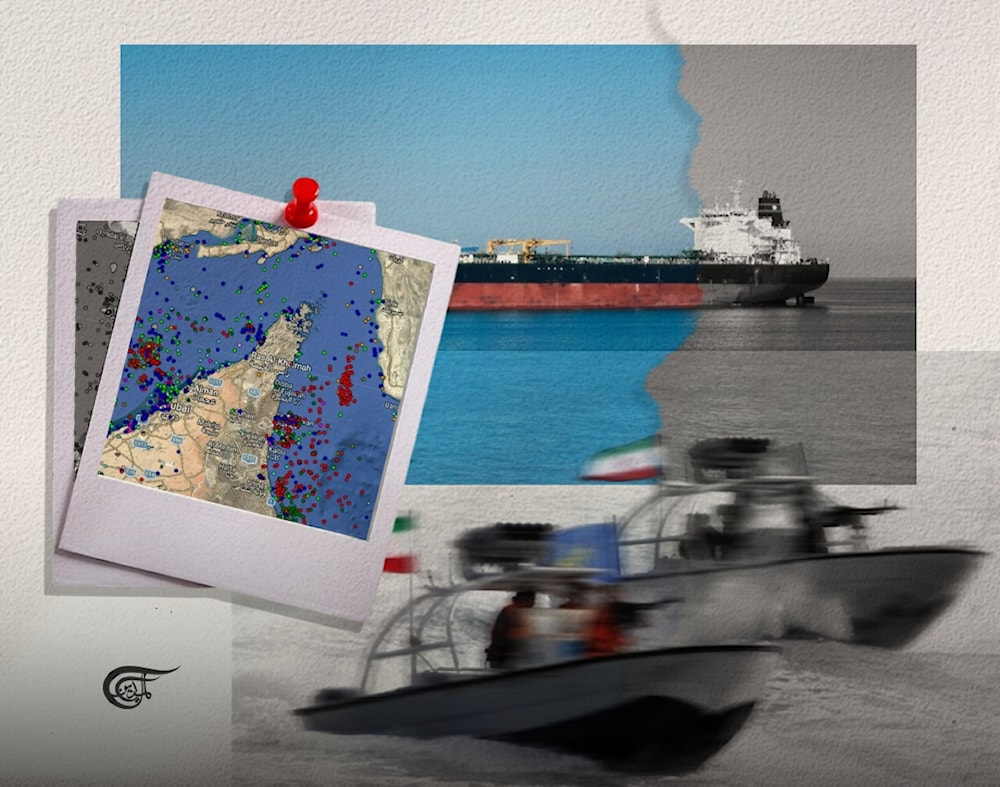
For Iran, the narrow waters of the Strait of Hormuz offer something few conventional battlefields can provide: leverage over the economic arteries of the modern world. (Al Mayadeen English; Illustrated by Batoul Chamas)
For decades, the narrow waters of the Strait of Hormuz have been described primarily through the language of security: naval patrols, tanker routes, and strategic chokepoints. Yet the current crisis in the Gulf suggests that something deeper is unfolding.
What appears at first glance to be a maritime confrontation between Iran and the United States may also represent a far broader challenge to the global economic order that has dominated international trade since the end of the Second World War.
Nearly a fifth of the world’s oil passes through the strait each day, making it one of the most critical arteries of global commerce. When this artery tightens, the consequences ripple far beyond the Gulf.
In the current conflict between Washington, "Israel", and Tehran, the disruption of maritime traffic is no longer simply a military tactic. It is becoming a form of strategic resistance, one that exposes the vulnerability of Western-led systems of trade protection and potentially shifts economic leverage toward regional and emerging powers.
A chokepoint with global consequences
The Strait of Hormuz has long been recognized as the most powerful asymmetric lever available to Iran in the event of war with the United States.
Despite decades of Western military planning aimed at keeping the corridor open, the current disruption suggests the situation may not have unfolded as Washington expected.
Dr. Salvatore Mercogliano, associate professor of History and a world leading maritime logistics expert, told Al Mayadeen English that the early paralysis in shipping had less to do with military confrontation and more to do with a commercial reality that policymakers underestimated. “I think the US assumed, based on its strike back in June, that any disruption of the Strait would have been minimal,” he said.
According to Mercogliano, the first shock to the system was not missiles or naval battles but insurance markets. “One of the things that has been planned for over 40 years has been a potential effort by the Iranians to shut the Strait of Hormuz. I think the US failed on a couple of points. It's number one, they didn't realize that initially, the issue that was going to lock up the straits was going to be the issue of insurance. War risk insurance was the primary issue that materialized that first week that caused ships to kind of hold in place.”
In global shipping, risk calculations often carry more weight than military assurances. Even a small probability of catastrophe can halt commercial traffic. “If you're the military, you have a 99% chance of success. You're going to take that chance any day of the week. If you are a commercial firm and you have a 1% chance of complete and utter failure, you're going to do everything you can to protect your downside.”
That logic has effectively frozen large portions of the maritime economy in the Gulf.
A strategic miscalculation?
For Washington, the disruption of Hormuz poses uncomfortable questions about strategic planning. For decades, US military doctrine has treated the protection of the strait as a core priority. Yet the current crisis unfolded without a visible coalition response from traditional allies.
Mercogliano argues that the gap may not lie in military planning itself, but in political decision-making. “I think the US has plans in how to deal with this. I just think politically and strategically at a much higher level… this is a decision that's being made at a much higher level.”
He suggests the conflict may have been launched without the broader coordination that traditionally underpinned Western maritime security operations. “The US really hadn't coordinated with the British, with the Japanese, with the Koreans and with even some of the Arab states in the region. So, I mean, this was pretty much a dual strike by US and Israel against Iran.”
That lack of coordination could have profound implications. If other powers begin protecting only their own shipping rather than participating in collective maritime security, the decades-old system of open sea lanes could begin to fragment.
“What if the Indian Navy, the Japanese, the Korean, the Chinese Navy, the French, the British all come in and just protect their shipping, but nobody else's? Again, what we start seeing is that return to national powers at sea,” he said. Such a shift would represent a significant break from the post-war maritime order dominated by Western navies.
Economic warfare at sea
The closure of Hormuz is not simply a geopolitical confrontation. It is an economic shock with cascading global consequences.
Mercogliano compares the disruption to a critical medical emergency. “If you look at global shipping moving around the world, it's kind of like the circulatory system of the human body… and what we've done is kind of pinched off the femoral artery in one of your legs. That's how significant it is.”
While oil flows can sometimes be rerouted or substituted, the secondary economic effects may prove far more destabilizing. “We're seeing the secondary impacts of this… fertilizer, helium, the impact it's going to have in container shipping.”
Shipping fuel prices have surged dramatically. “The absolute impact this is having on global bunker fuel, the fuel for ships. We're seeing that almost double, if not triple right now.”
The consequences extend into aviation and manufacturing as well. “Same thing with aviation fuel… we're seeing shortages in aviation fuel.”
In an interconnected supply chain economy, disruptions rarely remain contained. “You can't do anything on the planet anymore without impacting multiple other issues… it's like a web. You impact everything at the same time.”
Challenging Western maritime dominance
For more than seventy years, global trade has operated under an assumption: that the seas would remain open. That assumption was largely enforced by Western naval power, particularly the United States. But recent maritime crises, from the Red Sea attacks by Yemen’s Houthis to the war in the Black Sea, have begun to challenge that model.
“We've seen the issue of maritime chokepoints throughout history… but post-World War II, we created this concept of the Blue Highway, this large ocean that's open to everybody.”
That system now appears increasingly fragile. “As we've seen now in the early 21st century, that situation is changing. We're seeing geopolitical threats materialize on the ocean.”
The Strait of Hormuz crisis may therefore signal something broader: a re-politicisation of maritime space.

For Iran, control over chokepoints provides leverage far beyond conventional military power.
Mercogliano points to the possibility that Tehran could selectively allow passage for certain nations. “Several nations, China and India, for example, may broker separate deals with Iran to open up the strait for their traffic and their traffic alone… this would give Iran kind of de facto control over the Strait of Hormuz.”
Such a scenario would dramatically reshape the balance of economic power in the region.
War and the global economy
Beyond the maritime dimension, the war itself is already reshaping geopolitical calculations.
Professor Paul Rogers, emeritus professor of peace studies, believes the wider economic consequences could define the trajectory of the conflict. “In terms of the wider international system, it will depend very much on the economic impact, at least in the short term, particularly in relation to oil and gas prices… that could be quite considerable, " he told Al Mayadeen English.
While he does not expect a crisis on the scale of the 1973 oil shock, he warns the consequences could still be serious. “Not at the level of the disastrous period you had in 1973-74, but still serious enough and possibly affecting the economies of some countries.”
More broadly, Rogers sees the conflict as strategically uncertain. “We are told that the war is going extremely well by people in the United States. I wouldn't believe it. I think it's problematic for both them and Israel."
Asymmetric resistance
Iran’s approach in the conflict reflects a long-standing strategic doctrine: asymmetric warfare. Rather than attempting to defeat Western militaries directly, Tehran aims to raise the costs of confrontation.
Rogers believes this strategy could place increasing pressure on Western governments. “One of the decisions of the Iranian Revolutionary Guard Corps is to take it to neighboring countries… to put heavy pressure, particularly on domestic populations in Europe and the United States, who are faced with economic problems resulting from the increase in oil prices.”
In that sense, maritime disruption becomes not only a regional tactic but also a political one.
If energy prices rise sharply, the domestic political consequences in Western countries could prove decisive.
The shifting geography of energy
While the immediate disruption is severe, the global energy system has built-in buffers.
Oil reserves and alternative suppliers can soften short-term shocks. “There's about 100 million barrels of oil floating off Singapore and Malaysia… other oil can be substituted in there—Nigeria, Brazil, the United States, Canada,” Mercogliano explained to Al Mayadeen English.
But some resources are far less flexible. “Liquefied natural gas… is not as fungible. You cannot go out and find more liquefied natural gas out there because literally the world is at its max capacity,” he added.
If exports from the Gulf were seriously disrupted, the consequences could ripple through energy markets worldwide.
Meanwhile, geopolitical rivals may benefit. “The other nation that's benefiting probably the most from this is Russia… we've seen the US and the EU back away from sanctions on Russian oil,” Mercogliano emphasized.
Such shifts underline how regional conflicts can reconfigure global economic relationships.
A turning point for maritime power?
The crisis also raises deeper questions about the future of maritime security. For decades, the United States functioned as the guarantor of open sea lanes. But the current situation suggests that system may be eroding.
Mercogliano believes the absence of a coordinated international response is telling. “The US does not really go into this with any allies beyond the Israelis here.”
Without broad cooperation, global shipping could begin to fragment along national lines. “We may see kind of a nationalization of world shipping and world navies… protecting their own.”
If that happens, the global trading system could become far more unstable.
The hidden cost: sailors
Lost amid the geopolitical calculations are the thousands of seafarers caught in the middle of the crisis.
Mercogliano warns that the human dimension of the conflict is often overlooked. “I want to talk about the 20,000 merchant mariners who find themselves being challenged and facing conflict once again.”
Global trade relies on a relatively small workforce of seafarers. “We rely on about 1.3 million merchant mariners to move the ships… and move cargo around it.”
Yet they increasingly operate in dangerous waters. “We've seen about 20 ships attacked in the Persian Gulf… we've seen merchant mariners wounded, and more importantly, we've seen merchant mariners killed.”
Despite their central role in the global economy, they often receive little attention. “They work for very little money. They do a job that's absolutely crucial for everyone on the planet, yet they seem to become more and more a target.”
A new era of strategic chokepoints
The vulnerability of maritime chokepoints has become increasingly clear in recent years. From the Ever Given blocking the Suez Canal to attacks in the Red Sea, a handful of narrow waterways have repeatedly demonstrated their outsized influence on global trade.
Mercogliano believes the world is only beginning to grasp the implications. “Five years ago we saw a ship go sideways in the Suez Canal… and for six days the canal shut. That was a real big wake-up call for many people of how vulnerable maritime chokepoints are.”
If Hormuz remains contested, the lesson may become impossible to ignore. “When you have an effect down one order of the supply chain, it resonates across the entire supply chain.”
For countries far removed from the conflict, the crisis is a stark reminder of global interdependence. “Many countries around the world… are not the US or Israel or Iran, yet they are feeling the effects of these three nations fighting among themselves.”
Rethinking the global trade order
Ultimately, the Hormuz crisis may mark more than a temporary disruption. It may signal a shift in how power operates within the global economic system. Control over maritime chokepoints, once considered a relic of imperial strategy, may again become central to international competition.
For emerging powers dependent on Gulf energy, the lesson is clear: reliance on trade routes protected by Western navies carries risks. For Western states, the crisis exposes the limits of military dominance in an era of asymmetric warfare and interconnected supply chains.
And for Iran, the narrow waters of the Strait of Hormuz offer something few conventional battlefields can provide: leverage over the economic arteries of the modern world.
If that leverage endures, the current confrontation may be remembered not simply as another Middle Eastern conflict, but as a moment when the balance of economic power at sea began to shift.


