
Trump’s 'Board of Peace' and the architecture of illusion: What Bosnia’s unfinished justice reveals about Gaza’s future
-
 Leila Nezirevic
- 12 Feb 2026 15:30
 11 Min Read
From Bosnia’s unfinished reckoning to Gaza’s unfolding catastrophe, history offers a stark warning: peace cannot be engineered through glossy initiatives that ignore accountability.
-
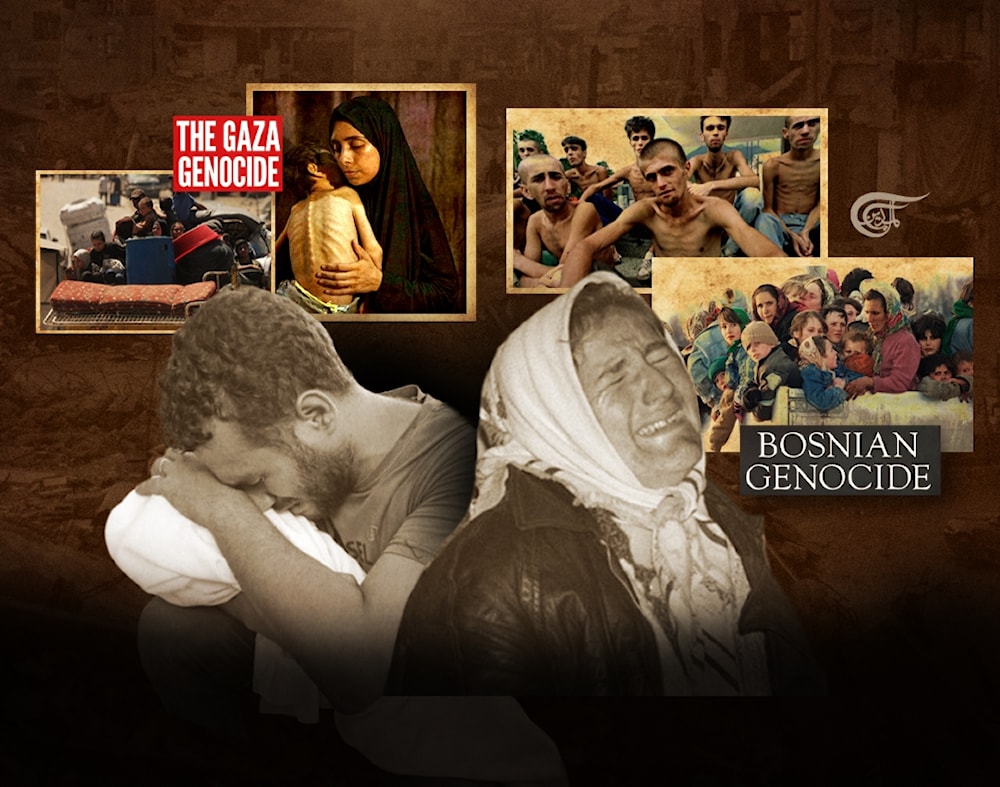
Trump’s “Board of Peace” risks Gaza repeating Bosnia’s mistakes (Illustrated by Zeinab al-Hajj; Al Mayadeen English)
From Bosnia’s unfinished reckoning to Gaza’s unfolding catastrophe, history offers a stark warning: peace cannot be engineered through glossy initiatives that ignore accountability. As Donald Trump promotes a lifetime-chaired "Board of Peace" to oversee Gaza’s future, experts caution that the world may once again be mistaking institutions on paper for justice on the ground.
When Donald Trump announced the creation of a new “Board of Peace” to oversee Gaza’s reconstruction, the language was familiar: bold, historic, unprecedented. The initiative was framed as a visionary mechanism that would bring order, investment, and stability to a devastated territory. Supporters described it as a pragmatic alternative to what they call decades of failed diplomacy.
But for many who have spent their lives inside war zones, courtrooms, and mass-grave investigations, the proposal feels less like innovation and more like repetition.
It resembles a pattern that has haunted post-conflict societies from Bosnia to Afghanistan, from Iraq to Libya: the creation of high-profile international structures that promise transformation while quietly sidestepping the hardest question of all—accountability.
At its core, Trump’s "Board of Peace" raises fundamental concerns. It is chaired for life by Trump himself. Permanent membership reportedly requires vast financial contributions. Its design places it outside established multilateral institutions. And rather than strengthening international legal mechanisms, it risks displacing them.
Critics describe it not as a peace body, but as a political brand.
To understand why that matters, one must look not only at Gaza but also at Bosnia, where genocide was legally recognized, perpetrators were convicted, and yet survivors today still live with trauma, denial, and political marginalization.
Bosnia shows what happens when justice exists primarily in verdicts, not in daily life.
Gaza may be headed down the same road.
The law already exists
Before any new board is invented, international law already defines who bears responsibility for Gaza and what those responsibilities entail.
“Well, first and foremost it would be Israel. Israel is an occupying power in Gaza. It's an occupying power since 1967 and that status didn't change when Israel removed its first signatures in 2005 that Israel continued to maintain decisive control over the airspace, the sea and the land entry points going into Gaza,” says Prof. S. Michael Lynk, former UN Special Rapporteur on the situation of human rights in Palestine.
This distinction is not semantic. Under international humanitarian law, occupation triggers concrete obligations: to ensure civilian welfare, facilitate humanitarian access, and refrain from collective punishment.
In 2024, the International Court of Justice went further.
“As we know, in 2024 the International Court of Justice ruled in an important advisory opinion that Israel was now illegal occupying power in East Jerusalem, the West bank and in Gaza and that it had to remove its troops and its presence and its denial of Palestinian selfdetermination as rapidly as possible.”
Yet instead of enforcement, the world witnessed institutional paralysis.
The problem is not a lack of law. It is a lack of will.
“Almost every country in the world has signed on to the Geneva Conventions of 1949… Common article number one of the four conventions says on every signatory… has a responsibility to ensure that they respect the Geneva Conventions and that they ensure that others respect Geneva Convention.”
In theory, this makes Gaza a test case for collective responsibility. In practice, it has become a demonstration of collective evasion.
Major powers that supply "Israel" with weapons, trade privileges, and diplomatic cover have chosen not to use that leverage to stop mass civilian harm.
The result is a strange inversion: instead of enforcing existing law, powerful states search for alternative frameworks, new boards, new initiatives, new “solutions".
Trump’s "Board of Peace" fits squarely into this pattern.
The soft underbelly of the international system
International law, Lynk explains, was never designed to function on autopilot.
“The so underbelly is the fact that international law, unlike domestic courts, international law doesn't have its own police, it doesn't have its own army. It requires upon political will through the United nations and through regional organizations to enforce and ensure compliance with these demands.”
Where political will collapses, impunity expands.
Nowhere is this clearer than in the UN Security Council.
“We certainly see that with respect to the dysfunction at the United Nations Security Council… where Russia can prevent any kind of resolutions critical of its war on Ukraine and the United States can prevent resolutions critical of Israel with respect to its occupation of Palestine.”
This dynamic has normalized a world in which powerful states treat international law as optional.
“That gives a green light to other countries saying you're not just international law. You say it doesn't apply to you, one should apply to us.”
Against this backdrop, the "Board of Peace" does not appear as a bold corrective. It appears as an accommodation to dysfunction.
Rather than confronting veto politics, arms transfers, or occupation, it proposes a parallel structure, one that speaks the language of development while avoiding the language of responsibility.
A board designed to bypass
Lynk is blunt about what the Board represents.
“Yes, yes. Well, the Board of Peace was I guess formally endorsed by the Security Council by a resolution in 2803, in November of 2025. And I fear that this is going to be looked upon by historians of the United nations and by international relations practitioners as one of the sorrier moments in the 80-year history…”
He describes it as the endorsement of “an American president's irrational approach towards trying to bring justice and peace.”
More striking is how Gaza is imagined within this vision.
“The only announcer's goal one would cheer him on for the Board of Peace probably would wind up meeting is that he's installing if you like, a real state of Oliver's vision of what Gaza should look like.”
This is not reconstruction as collective recovery. It is reconstruction as speculative development.
Luxury towers. Tourist zones. Enclaves.
And Palestinians themselves are almost entirely absent from the decision-making architecture.
“There's a saying that the disability rights movement many years ago saying nothing without us, without us. And yet everything that's being talked about with respect to who sits on the Board of Peace… none of this appears to be need any involvement by the Palestinians Gaza, or by the Palestinian Authority legitimate recognized political body of the Palestinians by the international community.”
What emerges is not a peace mechanism but a managerial body that treats Gaza as a project, not a polity.
This approach has precedents.
Bosnia is one of them.
Bosnia: Justice without transformation
The International Criminal Tribunal for the former Yugoslavia (ICTY) delivered historic verdicts. The genocide at Srebrenica was legally established. Senior political and military leaders were convicted. The tribunal reshaped international criminal law.
But legal triumph did not translate into societal repair.
“Well, I think when we look at the fact of what changed… the key thing that it delivered is justice to a large number of victims. And then also that it defined in many ways our war in terms of its understanding and its history in terms of the court determined facts,” says Denis Dzidic, the Executive Director and Editor for BIRN Bosnia and Herzegovina.


Those court-determined facts matter enormously. They prevent history from being erased.
Yet courts alone cannot rebuild trust, return dignity, or dismantle nationalist power structures.
“I think any kind of societal significant change because of the fact that, you know, war crime trials alone can't really enact societal change.”
Bosnia never developed a comprehensive transitional justice strategy.
“Unfortunately, in Bosnia, we've never had a strategy of transitional justice and we've never attempted to do this process strategically… and as a result of that, we now have ramifications, rampant historical revisionism and denial of verdicts and denial of crimes.”
International engagement faded once trials were secured. Stability became the overriding objective.
“The reflex answer was one of seeking stable democracy, seeking to have stability over systematic reforms and over changes.”
The consequences are visible today: glorification of war criminals, genocide denial, segregated education, discriminatory laws, and persistent economic marginalization of survivors.
Bosnia did not collapse back into war.
But neither did it heal.
Gaza and the prevention that never came
International law is not supposed to be retrospective.
The Genocide Convention is titled the Convention for the Prevention and Punishment of Genocide.
“If prevention is actually in the title of the convention… then when you have the very earliest warning signs… that's when the Genocide Convention says you have to act,” Lynk explains.
In January 2024, the ICJ signaled that South Africa’s genocide case against "Israel" was plausible.
“That should have been a red flashing light that should have been invisible all over the globe for all countries to take every step Israel within their power.”
Instead, states parsed language, waited for final rulings, and continued business as usual.
“They found ways to excuse themselves… and let the genocide wind up continue at its massive level.”
This mirrors Bosnia in a chilling way.
In the 1990s, genocide was formally recognized only after over 100.000 were already dead and more than two million people became refugees, according to United Nations Commission on Human Rights (UNHCR).
Recognition arrived.
Prevention did not.
Documentation without protection
Both Bosnia and Gaza are saturated with evidence.
UN reports. Satellite imagery. Forensic investigations. Survivor testimonies.
Yet evidence alone does not save lives.
“When we talk about the reality of today is that we have mostly large actors… who are against international humanitarian law. And we see very little, very little movement in terms of implementing decisions we've had,” Dzidic says.
Even arrest warrants have lost deterrent power.
“We have decisions and warrants by international criminal court. And unfortunately, those mean very little. Today.”
This creates a world where law exists primarily as narrative.
A story we tell ourselves about who we are.
Not a force that shapes behavior.
Reconstruction as political theatre
The "Board of Peace" promises roads, housing, and investment.
What it does not promise is accountability.
It does not center on war crimes investigations.
It does not prioritize survivor reparations.
It does not address displacement, land confiscation, or political self-determination.
In this sense, it follows a familiar script: build something new so no one has to answer for what was destroyed.
In Bosnia, courts delivered justice, but economic reconstruction favored elites.
Political structures entrenched wartime parties.
Survivors became symbols.
Gaza, however, risks a future of gleaming developments rising over mass graves.
A territory rebuilt for investors, not for its people.
Law in the service of power or justice
Lynk frames the crisis as a struggle between two visions of law.
“The ongoing struggle between law in the service of power versus law in the service of justice.”
When law serves power, it becomes decorative.
When it serves justice, it constrains even the strong.
Today, power is winning.
“Protecting human rights is always the right thing to do. Enforcing international law is always the right thing to do.”
But doing the right thing now requires confronting allies, suspending arms transfers, imposing sanctions, and backing international courts—not creating alternative bodies that sidestep them.
The choice ahead
Bosnia teaches that verdicts without transformation produce fragile peace.
Gaza now faces a brutal test.
The question is not whether Trump’s "Board of Peace" can attract billionaires.
The question is whether the world is willing to enforce the law it already claims to believe in.
If not, Gaza will become another place where justice exists in archives, not in lives.
Another place where reconstruction masks unresolved crime.
Another place where peace is announced, but never truly built.


