Steve Bannon’s Lawrence of Arabia 'side-show' analogy is a dud
-
 Nu’man Abd al-Wahid
- 8 Feb 2026 13:53
 10 Min Read
Steve Bannon’s “side-show” reading of the Arab Revolt parrots imperial myth, ignoring how Britain’s failures made that revolt decisive, and how Lawrence himself admitted it was a calculated swindle.
-
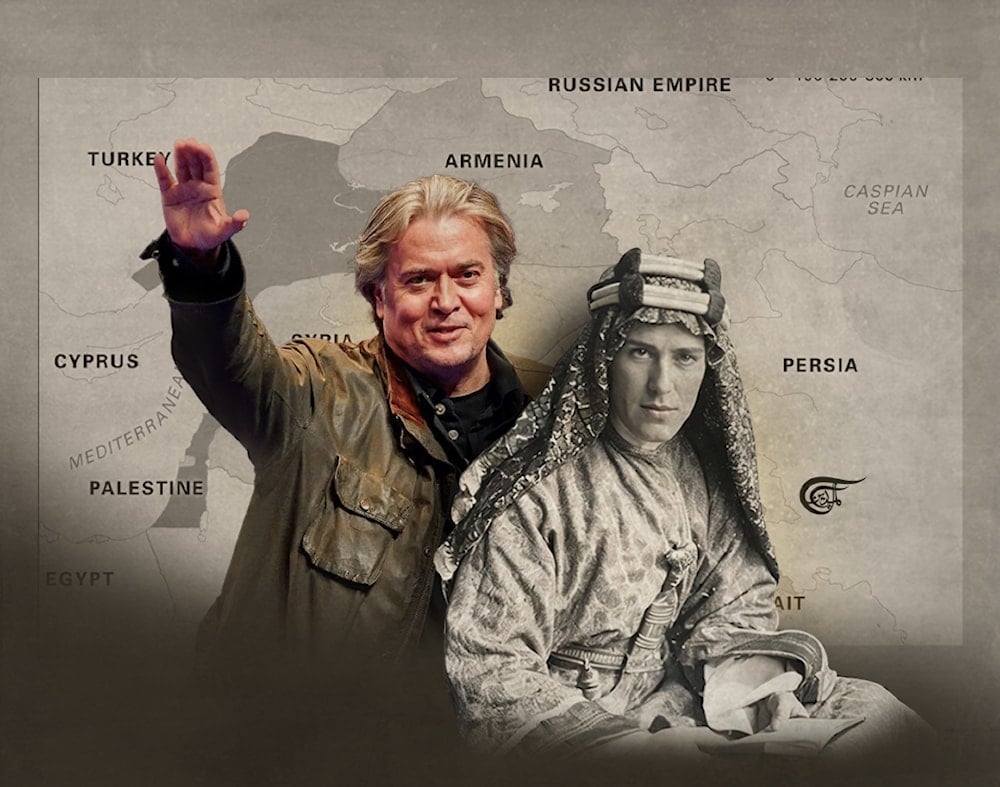
Bannon seeking deliverance by indulging in the World War One “side-show” myths of the Republic’s former imperial master certainly will not augur well for the “America First” movement. (Al Mayadeen English; Illustrated by Zeinab el-Hajj)
One of the greatest untold geopolitical stories of the modern era is how a former settler-colony that developed into a hegemonic superpower saved its former Imperial master from existential geopolitical disasters. How the United States provided salvation for Britain in two world wars and then inherited and maintained its former master’s imperialist global interests, especially in the Arabic-speaking region of West Asia, aka “Middle East” during the 20th century is a phenomenal story in itself.
Alongside this secular salvation, the United States maintained the foundational geopolitical mythology about the British presence in the Arabic speaking world. This particular mythology is based around the imperial agent T. E. Lawrence (aka “Lawrence of Arabia”). He is considered to have led the Arabs to freedom from Ottoman Rule in the “Arab Revolt” during World War One. Lawrence chronicled his adventures in his classic book, The Seven Pillars of Wisdom.
Steve Bannon, the former advisor to President Donald Trump, is the latest to fall gullibly for this foundational mythology in an interview with world-renowned journalist Tucker Carlson. Bannon is an advocate of “America First”, a strategy which calls for the prioritisation of United States interests instead of forever foreign wars, which are considered to mostly serve foreign governments. He recently drew an analogy of his interpretation of “America First” priorities with the “Arab Revolt” campaign during World War One. He told Carlson,
“I said to quote Thomas Edward Lawrence from the Seven Pillars of Wisdom what they told him at the time when he showed up at Cairo’s military headquarters. They said, “Look, the Middle East is a sideshow to the main event, the Western Front”. And the Arab revolt is a sideshow to a sideshow. And I said, “The Middle East right now for us with everything geopolitically going on and the economic war with China…The Middle East is a sideshow and the Israel issue is a sideshow to a sideshow.”
Bannon is loyally rehashing the lines from one of the opening scenes of David Lean’s film adaptation of Lawrence’s book. In this spectacular film, the actor Donald Wolfi,t who plays Lieutenant-General Archibald Murray growls the following:
“If you want to know my opinion, this whole theatre of operations is a side-show. The real war’s being fought against the Germans not the Turks. Not here, but on the Western front…in the trenches…And your “Bedouin Army” or whatever it calls itself – would be a side-show of a side-show.”
There is no doubt that there were British Army officers based at Cairo military headquarters (HQ) such as Murray, who weren’t keen on the Arab Revolt or even the Middle East front during the war. But the military decision to focus more on this front doesn’t lie in the shenanigans of British Army officials at Cairo HQ. It was British failure on the Western front to win major battles head on with Germany or its allied Ottoman forces that compelled the former to search for other avenues to gain military victories. One of these avenues was aimed at undermining and destabilising the Ottoman Empire’s underbelly via its Arabic speaking population, hence the “Arab Revolt”.
The major British military failure in Europe was the Dardanelles Campaign. This was a British Empire attempt to capture the Ottoman Empire’s capital, Constantinople and knock the Turks out of the war once and for all. The idea was to sail through the straits of Dardanelles, occupy the Gallipoli peninsula and move forward to occupy the capital. The British Empire failed and hundreds of thousands of the soldiers in the Mediterranean Expeditionary Force (MEF) that participated in this defeat fell back and retreated to Cairo. It was here that they eventually fell under the leadership of Murray.
Murray had begun the war as the Chief of Staff of the British Expeditionary Force on the European Western Front. He participated in the Battle of Mons in August 1914 but quickly found himself unstuck and led the way in a two week retreat from the battle. It was during this retreat that he is said to have had a psychological breakdown and, upon recovery, he was clearly demoted and dispatched to a leadership position in Cairo.
In Cairo, the MEF was reorganised and renamed the Egyptian Expeditionary Force (EEF) and came under the leadership of Murray with a remit to capture Palestine and the wider Syrian region from the Ottomans. Murray initially and successfully consolidated the British presence in Egypt during the war and, in late March 1917, he tried to breakthrough into enemy territory, specifically into the southern Palestine region of the Ottoman Empire. As in Mons, he failed. Again, in the following April he made another attempt to breakthrough this time also using poison gas. This too failed. He was then relieved of his duties. Murray had failed in the western Front and now his inabilities had followed him into the Middle East.
In the meantime, the “Arab Revolt”, which began on the June 1916, succeeded in diverting Ottoman Empire manpower and resources from defending southern Palestine. This Revolt was rooted in the correspondence between the British Empire’s High Commissioner, Henry McMahon at Cairo HQ and the Sharif of Mecca Hussain bin Ali, who was based in the Hijaz western coastal region of the Arabian Peninsula. In this correspondence, the Sharif thought the British had promised the Arabs a united Arab state across the Arab speaking region of the Ottoman Empire in exchange for assistance against Ottoman forces. Unbeknown to the Sharif, the British had already decided to divide and rule the region with the French in the Sykes-Picot agreement.
By the time Murray’s replacement, General Edmund Allenby, took office in Cairo in June 1917, the Revolt had captured Aqaba, a coastal town in the north western Arabian Peninsula. Allenby arrived in Cairo fresh from military failure at the battle of Arras in June 1917 on the Western Front. But fortuitously, the EEF now had a right flank, the Arab Revolt (“side-show of the side-show”), coming up from Aqaba and Allenby quickly made the breakthrough into southern Palestine and then onwards onto al-Quds, Damascus and Aleppo. Allenby salvaged his reputation on the back of the “side-show of the side-show.”
The variable in why Murray failed to capture southern Palestine and Allenby succeeded was clearly the “Arab Revolt” with its betrayal of their Ottoman co-religionists to side with the British Empire, who never had any intention of ever honouring their correspondence with the Sharif of Mecca. As Lawrence informs the reader in his book, it “was evident from the beginning that if we won the war these promises would be dead paper, and had I been an honest advisor of the Arabs I would have advised them to go home and not risk their lives fighting for such stuff…”.
Lawrence clearly admits he is an imperial swindler. He also contemptibly mocks the Sharif of Mecca as a, “half-witted old man” who “had obtained from us no concrete or unqualified undertaking of any sort, and that their ship might founder on the bar of his political stupidity; but that would have been to give away my English masters…” Throughout the revolt, Lawrence knew he was nastily swindling the Arab insurgents to fight for the British Empire.
Before the Arab Revolt, the British had not only failed at Dardanelles, but there was stalemate on the Western Front, failure in the Iraqi city of Kut and not forgetting the British armed Wahhabi tribal leader Abd al-Aziz al-Saud trouncing in January 1915 with his British handler, William Shakespear killed at the hands of the Ottoman’s loyal ally, Ibn Rashid. As George Antonious, in his seminal book, The Arab Awakening, recounted, the Arab Revolt also sabotaged Ottoman reinforcements sent to Ibn Rashid and ended German-Turkish expedition aimed at controlling navigation in the Red Sea. The only hope that had hitherto remained and then materialised for Britain was the success delivered by the “side-show of the side-show”.
Not only is one of the opening scenes of Lean’s adaptation deceptive. The final scene with Lawrence riding away on his motor bicycle leaving the Arab leaders squabbling among themselves on how they should manage their newly acquired territory doesn’t stand up to scrutiny. Lawrence never completely left the region and returned on a few occasions in the service of the British Empire to, inter alia, threaten and bribe the Sharif Hussain to accept an Anglo-Hijazi treaty.
In short, the Sharif rejected the new proposals and argued that the “Arab Revolt” wasn’t for the Hijaz region but the entire Arabic speaking region. Lawrence also threatened other tribal leaders in the Arabian Peninsula with unleashing religious extremists from the Arabia Peninsula if they didn’t abide by Britain’s dictates. In effect, Lawrence’s last role in Arabia was as a shameless extortionist for the Empire.
Finally, and to his credit, the Sharif refused to sign the treaty, and al-Saud inevitably captured the Hijaz in 1924-25 to the delight of the British Empire, which christened al-Saud’s new enlarged territory the “Kingdom of Saudi Arabia” in the early 1930s. One could argue that David Lean’s adaptation of The Seven Pillars of Wisdom begins with deception and ends with a lie, but nevertheless still a majestic film. Actually, a more honest and decolonised name for the film should be, Lawrence, The Swindler of Arabia. But as the cliché goes, the victor writes history.
Whether Bannon and his fellow “America First” motley crew will be able to hold off the rise of China or not will surely be tested in the following decades. The United States’ Middle Eastern wars, to, in effect, maintain the British divide and rule order in West Asia has cost the United States and certainly allowed China to progress. The Americans poured billions of dollars, maybe trillions, killing and destroying the lives of millions along the way, to maintain this order, while China poured billions into investing in its own economy and capturing international markets for its goods. Any student of Empire or Nations knows they have a limited zenithal life span, yet Bannon seeking deliverance by indulging in the World War One “side-show” myths of the Republic’s former imperial master certainly will not augur well for the “America First” movement.