Trump, Chamberlain, and decolonizing the Munich Agreement
-
 Nu’man Abd al-Wahid
- 22 Apr 2026 00:29
- 3 Shares
 9 Min Read
Donald Trump used a reference to “Neville Chamberlain” to pressure the United Kingdom over its position in the US–Israeli war on Iran, framing the debate around loyalty, war strategy, and historical lessons.
-
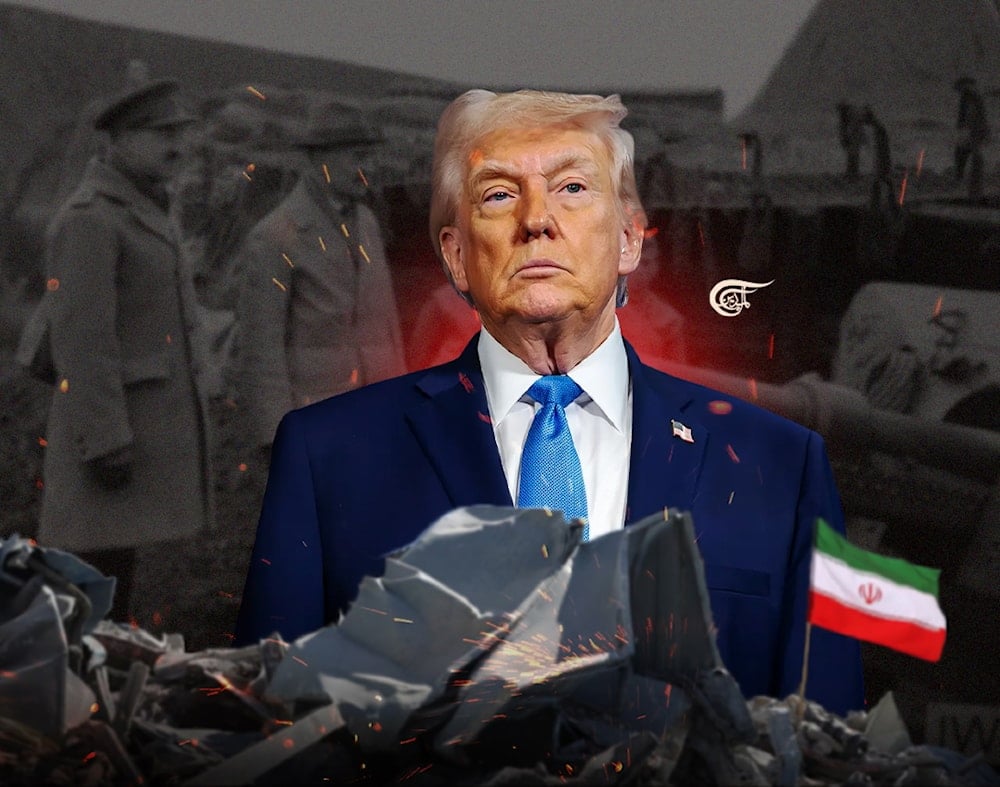
Trump invokes “Chamberlain” jab at UK amid US–Israeli war on Iran (Illustrated by Zeinab al-Hajj; Al Mayadeen English)
During the United States and "Israel’s" war on Iran and Lebanon, US President Donald Trump routinely directed taunts at his Western European allies about their lack of support. Among the recipients of these taunts was British Prime Minister Keir Starmer. Although the British, unlike many other Western Europeans, allowed the Americans the use of UK military bases and overflights over its airspace for American warplanes to fly to bomb Iran, this did not satiate Trump. On Easter Monday at the White House, a journalist took advantage of the occasion and saliently asked Trump about whether the United Kingdom could resurrect its relationship with the United States in light of Starmer’s public refusal to collaborate fully with the war on Iran. Trump, in his characteristic accelerated style, replied that the “UK had a long way to go,” adding that the United States doesn’t “want another Neville Chamberlain, do we agree? We don’t want Neville Chamberlain.”
Neville Chamberlain was the Prime Minister of the United Kingdom in the 1930s as Western Europe was gearing up to drag mankind into another world war. Although it was Chamberlain who led the UK into war in September 1939, he’s best remembered as the leader who had supposedly “appeased” Nazi Germany’s Adolf Hitler in September 1938 after the latter had laid claims to parts of Czechoslovakia. Specifically, in September 1938, Chamberlain, alongside France, Germany, and Italy, agreed to Hitler’s military fait accompli in what is officially known as the Munich Agreement. As such, conventional history associates Chamberlain’s name with appeasement. Indeed, in Western supremacist regime change folklore such as Neoconservatism, anyone who isn’t supportive of a developing country being invaded in pursuit of regime change (usually on the pretext of a mainstream media hyped-up bogus reason) is an “appeaser” or shirker in the mould of Chamberlain. In contemporary Western warmongering circles, being referred to as “Chamberlain” is the ultimate geopolitical insult. This insult is akin to being derogatively referred to as a “heretic” or “infidel” from a bygone age.
However, another dimension to why Chamberlain acquiesced to Hitler’s expansionist ambitions to create a German Empire, the Third Reich, was that the British had their own imperial priorities. This is what Dr. Matthew Hughes implies in his encyclopaedic thesis on the British Empire’s crushing of the Palestinian resistance to its Zionist colonial-settler project in Palestine titled Britain’s Pacification of Palestine. The indigenous Palestinians began their legendary revolt against Britain’s colonial-settler project in June 1936. By the middle of 1938, large parts of Palestine had been liberated from British Zionist colonialism, including the cities of Jaffa, Nablus, and Nazareth. Even the Old City of al-Quds came under the control of the indigenous Palestinian resistance. In the summer of 1938, the British Empire could not afford the number of troops needed to totally crush the resistance. As Hughes states, before “the Munich settlement [Agreement] in September 1938, London held back troops.” The British Empire’s Lieutenant-General Percival Wavell in Palestine admitted there were not enough forces to impose martial law, or as he expressed it, “I should not be in a position to jump on trouble wherever it occurred, and might be thrown largely on the defensive…” Once Chamberlain signed on with Hitler in September 1938, the British then ‘swamped’ Palestine with troops. Specifically, and according to Hughes, 54 per cent of the British troops that finally crushed the Palestinian resistance arrived after Chamberlain signed the Munich agreement. It would’ve been very unlikely these troops would’ve been used if Chamberlain had decided to instead wage war on Hitler’s European expansionism in September 1938. As Hughes states, “After Munich, Britain flooded Palestine with fresh battalions.”

It was this surge of ‘fresh battalions’ that ultimately crushed and ‘ruined’ the indigenous population of Palestine and, in the words of Hughes, “restored Pax Britannica and freed up the British Army to fight Germany in September 1939.” According to Rashid Khalidi’s The Hundred Years’ War on Palestine, Britain needed 100,000 troops to crush the Palestinian uprising. In effect, it was one British soldier for every four Palestinian adult males. He adds that of all the “services” the British Empire provided to Zionist settler-colonialism, “perhaps the most valuable” was its suppression of Palestinian resistance in the 1930s. The ethnic cleansing and genocide livestreamed today was set in motion by the British Army. Indeed, most of the war crimes that Zionist forces perpetrate today were introduced by the British in the 1930s, whether it is destroying villages, house demolitions, mass incarceration, sexual torture, summary executions, concentration camps, assaulting children, using human shields, unleashing Doberman dogs to maul Palestinians, destroying crops, and all the other inhuman abominations. More so, in the 1930s, the new Zionist colonial-settlers would be escorted by the British Army as the latter committed these crimes, which, in effect, provided the Zionists with their colonial-genocide apprenticeship. According to Khalidi, ten per cent of the Palestinian Arab male population was “killed, wounded, imprisoned or exiled.” One could argue that Chamberlain’s Munich agreement allowed for this “service” to Zionist colonial settlers to manifest itself at that point in time. On the back of this agreement, Zionism “successfully implanted itself in Palestine thanks to the unceasing efforts of British imperialism.”
Although war between the Western Europeans was declared in September 1939, in the first six months of the war, known as the Phoney War, there was little engagement between the British and French white supremacist imperialists' land forces on one side and the German Nazi white supremacist forces on the other. When major fighting commenced between the European white supremacists on the 10th May 1940, the British and French were immediately caught off-guard by a German Nazi pincer tactic advancing through Holland and Belgium, and unexpectedly through the Ardennes Forest. As author Nicholas Harman shows in his book, Dunkirk, the Necessary Myth, within ten days, the British began deliberations to desert their allies and escape back to England via the French coastal town of Dunkirk. The new British imperialist Prime Minister Winston Churchill met with his French counterpart, Paul Reynaud, on May 26 after Sunday church service and lunch and gave him no inkling the British intended to scurry back across the English Channel. No sooner had Reynaud departed for France later in the evening than Churchill officially ordered the “embarkment” of Britain’s troops back to England. It was a mighty stab in the back because the French were led to believe the British were going to stand and fight and join them to use Dunkirk as a springboard to counterattack the German advance. The French were not officially informed of the British intention to desert until May 31. Within a month of hostilities, the British Army, minus their weapons, which were left on the beaches of Dunkirk for the Nazis, had successfully scurried back to England, and Churchill triumphantly boasted this was a “miracle of deliverance”! For the next two years, Churchill placed all hope in the Americans entering the war and defeating Germany as they had in the Great War (World War One).
Ironically, many thousands of the British Army regiments and individuals who deserted the fight between the European white supremacists-imperialists were the very same who crushed the Palestinians only a few years later. The York and Lancaster Regiments, Royal Ulster Rifles, West Yorkshire Regiment, Bedfordshire and Herefordshire Regiments, Royal Scot Fusiliers, Manchester Regiment, and many more proved they could kill indigenous Palestinians and pave the way for the ethnic cleansing of Palestine by their Zionist-colonial proteges, but when it came to fighting technological equals, they simply stabbed their allies in the back and fled to Dunkirk. Individuals such as Bernard “Monty” Montgomery were in Palestine in the late 1930s, crushing Palestinians, insisting in November 1938 that any Palestinian resisting Britain’s Zionist colonial-settler project “will certainly lose his life”[1], but in May 1940, the Germans had reduced him to a deserter who stole Belgian cattle as he and his military division fled the fight. Another, Major General H.E.N. Bala Bredin, in 1938, was protecting Zionist colonial settlements in Palestine. At one stage, he was ordering the summary execution – literally in the name of the King of England - of kidnapped Palestinians brought to him by Zionist colonial-settlers, but come May 1940, he too was reduced to scurrying to Dunkirk with his division, the Royal Ulster Rifles.
The comparison between the conduct of the British Army that violently thrust Pax Britannica’s Zionist colonial-settler project on the Palestinian people in the late 1930s and the manner in which this same Army simply deserted its allies and scurried back to England in May 1940 has never been studied for the most obvious reason, specifically, as the adage goes, history is written by the victor. And it is this same victor’s history that renowned liar and warmonger President Donald Trump aptly regurgitated and resurrected on Easter Monday to help legitimize the indefensible and criminal American and Zionist war on Iran.