
Three Lessons from Venezuela
-
 Carlos L. Garrido
- 10 Jan 2026 13:43
- 7 Shares
 10 Min Read
Carlos Garrido argues that the kidnapping of Venezuela’s president exposes hard lessons for the Global South: deterrence, revolutionary discipline, and the necessity of civilizational unity against imperial power.
-
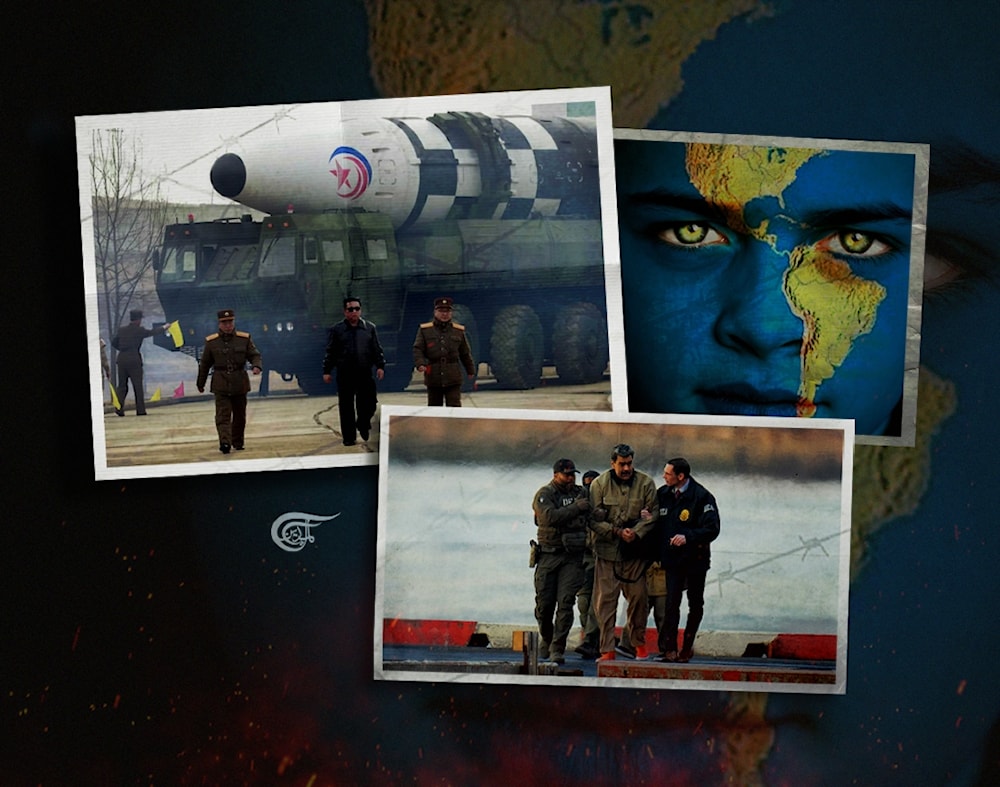
The countries of Latin America must take away the correct lessons from these events unfolding in Venezuela. (Al Mayadeen English; Illustrated by Zeinab el-Hajj)
By now everyone has read about the US criminal kidnapping of democratically elected Venezuelan President, Nicolas Maduro, alongside the bombing of Caracas, Venezuela. Details are still being released as to how these events were allowed to happen. However, I would like to briefly reflect on three takeaways the Global South – the countries constantly struggling against US-NATO-Zionist imperialism – must learn from these events.
1- Nukes are integral for sovereignty
This lesson should have already been learned in 2011, when Muammar Gaddafi’s government in Libya was overthrown. In 2003, Gaddafi announced the abandonment of his program to develop nuclear weapons. This allowed for a temporary lifting of U.S. and EU sanctions, and a brief “normalization” of relations. Expecting the “normalization” to have been anything but temporary was a folly. The U.S. empire is not in the business of treating other nations as equals. Its ends are to debt trap, control assets, and loot resources. It does not care for “international law,” nor “human rights,” nor “freedom and democracy” – even though it loves employing these catchwords as a front for regime change.
Would Gaddafi have been overthrown had he not interrupted the development of his nuclear program? Would the US-NATO even have considered overthrowing the Chairman had they sported a nuclear arsenal as a means of deterrence? I don’t think we must speculate here. The Democratic People’s Republic of Korea (DPRK), or North Korea as the Americans call it, was on the same Neocon list of “dangerous and evil” countries which needed to be overthrown. Under the plans of the Project for the New American Century, the DPRK could’ve well received the Libya treatment. What was the difference in treatment between the two countries? I think a central component was that by the mid-to-late 2010s, the DPRK had developed the great antidote of full-fledge Western aggression: nuclear weapons.
Libya was overthrown, the tremendous advancements made in this nation – which became amongst the most prosperous in all of Africa – were demolished. Soon after the overthrow, as everyone now knows, things got so bad slave markets were erected around the country. The lesson is clear – without developing your defense system, one cannot deter Western aggression. Until this day, NATO and the U.S. are very careful of how they wage their war on Russia. They could not carry it out with the same boldness they used in Libya. They required a proxy – Ukraine – to not formally be considered the subjects carrying out the act. Had Venezuela sported the weapons system comrade Kim Jong Un shows off, it is unlikely that giant of the Seven Leagues – as José Martí called the U.S. empire – would have been as brazen in their attacks. We cannot forget what Mao taught us – imperialism is a paper tiger. It looks scary but give it a bloody nose and it will run.
2- 'Stalinism' was right
The Western “left,” thoroughly rooted in what I have called a “purity fetish” outlook, has virtually defined itself through its rejection of what it calls “Stalinism.” Such a thing, however, does not actually exist. What does exist is Marxism-Leninism, a framework for successfully waging war against capitalist-imperialism. What the Western “left” have derided as “Stalinism” are the realist practices of protecting and constructing a revolutionary state, one capable of defending itself from enemies both internal and external.

The philosopher Slavoj Žižek, an anti-communist himself, nonetheless makes an astute observation about the willingness of Marxist-Leninists – as well as conservatives – to reject liberal moralism and take responsibility for the difficult actions which have to take place for one’s political project to be defended. As he argues in The Ticklish Subject: The Absent Centre of Political Ontology:
“What a true Leninist and a political conservative have in common is the fact that they reject what one could call liberal leftist irresponsibility, that is, advocating grand projects of solidarity, freedom, and so on, yet ducking out when the price to be paid for them is in the guise of concrete and often “cruel” political measures. Like an authentic conservative, a true Leninist is not afraid to pass to the act, to take responsibility for all the consequences, unpleasant as they may be, of realizing his political project.”
The Western “left” derided Stalin for his brutal treatment of his opposition within the party, ignoring always the context of turmoil in which this often-treasonous opposition chose to challenge the ruling order of the revolutionary state. At a time when unconditional commitment and unity to the protection of the revolution was needed, “doubting was treason,” as the Chavista revolutionaries say today. History has shown that the revolutionary states that survive and thrive are those which are willing to get their hands dirty and be as brutal with internal opposition in times of crisis as is necessary. As Executive Chairman of the American Communist Party, Haz Al-Din, recently argued, “Venezuela proves the most brutal measures of Communist dictatorships to crush internal enemies were 100% justified. Ignore the crocodile tears for ‘victims.’ Hesitate, and they’ll snort/oink victoriously over your country’s corpse.”
Is this not precisely one of the central lessons to take from Venezuela, Bolivia, etc.? Why is bourgeois “democratic” formalism so fetishistically respected? If you have a treasonous opposition calling for the invasion of your country by Zionist forces, how could they possibly walk the streets of your country freely? Why was a Juan Guaidó or a Maria Corina Machado able to freely walk the streets of Caracas, travel abroad and return, when it was so clear that they were nothing but traitors to the homeland of Bolivar – individuals who wanted to return to a time when wealthy white Venezuelans were the privileged house slaves of American imperialism. This does not mean plurality is not allowed, but as Fidel Castro taught – within the revolution everything, outside of it nothing.
3- We are in the era of civilizational blocs
Today, the nation state is being overcome as the nucleus of geopolitics by the civilizational state. Today geopolitics is determined by civilizational blocs. Only a meta-national civilizational unity of people who were divided artificially into tribal nations by western colonialism can stop the viciousness of a U.S. superimperialism in decline. Now is the time – more than ever before – for Latin America to return to the wisdom of Bolívar, Martí, and other revolutionary heroes that understood the essential character of a united Central and South America to deter U.S. imperialism. In this, the Chavistas, of course, are not to blame. Their whole revolutionary project has this lesson at its heart. Therefore, this third point is aimed at those other nations of the region which foolishly think they can have even a semblance of sovereignty without adopting the revolutionary Bolivarian civilizational unity proposed by the Chavistas. These attacks on Venezuela are attacks on the principle of sovereignty itself, and every country in the hemisphere is in trouble if steps are not taken to seriously construct a Pan-American civilizational and revolutionary unity.
This lesson must also be heeded by our anti-imperialist comrades around the world – from West Asia to Africa. Here – like the Venezuelans – the Alliance of Sahel States has the right idea. As Kwame Nkrumah, Thomas Sankara, and all the great African revolutionaries taught, only through Pan-African unity can the motherland of Africa fully stand on its own two feet and throw off once and for all the shackles of Western imperialism and neo-colonialism. In China, as Professor Zhang Weiwei argues, the state itself is a civilizational state. Other analysts have argued the same about the Russian Federation. In West Asia – as in Latin America and Africa – the imperialists have been successful in dividing peoples who share a common civilizational unity. Such division of this essential civilizational pole must be overcome. In the era of civilization states and meta-state alliances – the nation state is not dead per se, it is simply reincorporated into a new dialectical intercourse where it stands as the secondary aspect, as Mao would call it, of the contradiction between nation and civilization. As a product of this period of transition, national projects must be crafted in harmony with, and cognizant of, the larger civilizational context of unity which must be created or enriched.
The countries of Latin America must take away the correct lessons from these events unfolding in Venezuela. In any moment, they too could be next. If they are alone and divided, they will be weak. At a time when anti-imperialist forces in the region have taken big hits (the loss of the Movement Toward Socialism party in Bolivia, the loss of the left in Honduras, the kidnapping of Maduro, etc.), it is more essential than ever to return to the teachings of the great Pan-American thinkers, who understood that without a broader civilizational unity, national sovereignty will always hang by a thread.
Seeing the events unfold over the last week, these three key points have kept recurring in my mind. These are intended to be comradely opinions and suggestions – not harsh critique and condemnation. My support for the Bolivarian revolution is unflinching, and if I seek to draw out certain lessons that I think could be taken away from difficult moments such as these, it is always in the spirit of seeking to protect the revolution from imperialist aggression and internal traitors, not kicking it when it is down.
I would like to close with a line from the Cuban revolutionary poet Bonifacio Byrne:
If my flag were ever torn into tiny pieces,
if one day it were reduced to fragments,
our dead, raising their arms,
would still know how to defend it.
This line, frequently repeated by Commander Fidel Castro, captures the spirit in which not only the national homeland must be defended, but also the broader context of Our America.


