
'Like a video game': NAZA genocide documentary draws global acclaim
 8 Min Read
Described as filmmaking at its most compelling and most necessary, NAZA includes revelations about "Israel's" war on Gaza that could chill you to the bone.
-
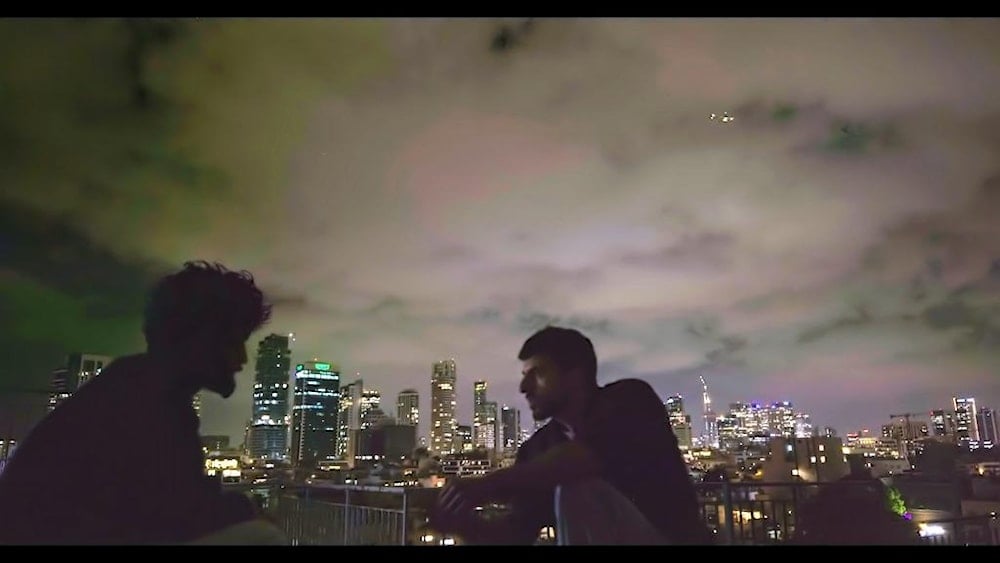
Director Yuval Abraham conducting interviews on a rooftop in Tel Aviv (Screenshot/NAZA)
The documentary NAZA features testimonies from 24 Israeli military insiders detailing the killing of Palestinian civilians, AI-assisted targeting operations, and the systematic destruction of Gaza.
An Israeli intelligence officer has described the killing of Palestinians in Gaza as an exhilarating experience, comparing military operations to a video game, according to a review published by The Arts Desk of the award-winning documentary NAZA, which exposes the inner workings of the Israeli genocide in the besieged Palestinian territory.
“It’s like your hormones are going crazy. You aren’t sleeping and you’re having fun. It’s so insanely fun. You complete a mission and you’re sharp and there’s a sense of meaning. It’s really enjoyable. We were fully in it,” an Israeli Intelligence Corps member recounts in the film.
The documentary, directed by Yuval Abraham and Rachel Szor, features interviews with 24 Israeli soldiers and intelligence officers who participated in operations during the genocide in Gaza, providing accounts of how Palestinian civilians were killed through an extensive military apparatus supported by artificial intelligence and mass surveillance.
According to The Arts Desk, the testimonies reveal not only the scale of the destruction inflicted on Gaza but also the systematic planning behind military operations, including the calculation of civilian casualties and the deliberate targeting of residential buildings.
The film, produced by The Guardian, has attracted widespread international attention following its premiere at the Venice Film Festival, where it received a 25-minute standing ovation and won the Special Jury Prize.
Israeli military turned killing into an automated process
One of the documentary's central revelations concerns the Israeli military's use of artificial intelligence to identify Palestinians for assassination while calculating the number of civilians expected to be killed in each attack.
The title NAZA refers to a military designation for "collateral damage", representing the number of civilian casualties deemed acceptable when targeting an alleged Hamas fighter.
According to The Arts Desk, an allowance of 20 civilian deaths was used as a benchmark, although attacks against individual targets could reportedly result in as many as 500 fatalities.
The documentary details how Israeli intelligence employed surveillance systems to monitor Palestinians' movements and identify when suspected resistance members had returned to their family homes.
'The goal was quantity, not quality'
A system known as "Where's Daddy" reportedly enabled intelligence personnel to determine when individuals were inside their residences, allowing Israeli forces to conduct attacks at night, when family members were more likely to be present.
Israeli intelligence officers also describe exploiting Palestinian telecommunications networks to monitor private communications and locate intended targets.
One officer involved in developing the targeting algorithms recounts the experience of remotely monitoring the final moments of those marked for assassination.
“I’d hear the final moments of a person’s life,” the officer says.
“It’s like a video game, because everything is done remotely. It was on a mass scale – efficiently like a factory. In three years I killed more than 73,000 people.”
The officer's claim concerning the number of people killed is presented as his own account in the documentary.
He also acknowledges that attacks frequently proceeded even when the intended targets were absent, leaving Palestinian civilians to bear the consequences.
“The goal was quantity, not quality,” he adds.
'We erased history': Soldiers describe destruction of Gaza
Beyond the use of artificial intelligence, the documentary examines the systematic demolition of Palestinian neighborhoods, with Israeli soldiers describing operations intended to leave entire areas uninhabitable.
According to The Arts Desk, Israeli military personnel recount destroying residential buildings regardless of whether Palestinians remained inside, while homes that survived initial bombardment were subsequently burned or demolished.
One intelligence officer involved in mapping buildings and monitoring military attacks describes the urgency with which these operations were conducted.
“The policy," says an intelligence officer tasked with mapping the buildings and their occupants and monitoring the bombing, “is to destroy as quickly as possible before we lose international legitimacy.”
Other soldiers recount deliberately setting fire to Palestinian homes, including properties belonging to families who had already been killed during Israeli attacks.
“We became experts in burning houses,” recalls a soldier. “We burned a house down in eight minutes. We erased history; the families were killed in the bombing and we erased what was left.”
The documentary further features accounts of Palestinians being shot after returning to devastated neighborhoods to search for belongings, while bodies were reportedly left beneath collapsed buildings or abandoned in the streets.
These testimonies depict a military campaign extending beyond the killing of civilians to the destruction of homes, possessions, and the remaining traces of Palestinian life in entire neighborhoods.
'Like a game'
Among the accounts highlighted by The Arts Desk is testimony from an Israeli soldier describing attacks against Palestinians attempting to reach a food distribution center.
The soldier recounts how civilians were forced to follow a designated route, with Israeli forces opening fire on those who stepped outside it.
“It was like a game,” he says.
“The Gazans had to walk on the bridge (to reach the centre). If they stepped off it they were shot… It was funny. Those were the rules of engagement. Three separate teams of soldiers would massacre the population (and) the bodies would pile up. They looked like a swarm of ants running towards the food. The snipers said they’d run so fast they couldn’t get everyone.”
The documentary also examines how the dehumanization of Palestinians became embedded within the Israeli military environment following October 7, 2023.
One intelligence officer recalls the language used to justify attacks against the civilian population.
“After October 7th," recalls an intelligence officer, “everyone kept saying 'there are no innocent people in Gaza. We need to erase Gaza. Whatever we do, they deserve it.'”
Other interviewees attempt to distance themselves from responsibility for the killings by citing their assigned roles and institutional obligations.
“My role is technical,” explains an intelligence officer. “I’m not supposed to express any moral or principled position.”
Another says, “I trust the system and I do my job as part of the system.”
The testimonies illustrate how military personnel rationalized their participation in operations resulting in large numbers of civilian deaths, with some presenting their actions as routine technical procedures rather than moral decisions.
'Tough to watch, impossible to ignore': NAZA receives international acclaim
The revelations have drawn widespread international attention, with The Guardian reporting that NAZA has received strong reviews from major publications across Europe, North America, and the Middle East.
The documentary, which features anonymous interviews filmed on rooftops overlooking Tel Aviv, has been praised for exposing the mechanisms through which Israeli military intelligence and advanced surveillance technologies were employed during the war on Gaza.
In a five-star review, the Financial Times described the documentary as “journalism and film-making brilliantly entwine," while The New York Times characterized it as a “haunting” work that is “tough to watch, and impossible to ignore."
British Vogue praised its depiction of the destruction of Gaza, describing the documentary as a “brilliant and harrowing film."
Meanwhile, The Hollywood Reporter called it a “sober and thoroughly documented bombshell of an exposé."
The documentary has also attracted attention from Israeli media, with Haaretz describing the film as an effort to confront Israelis with the consequences of their military's conduct in Gaza.
When it is featuring
According to The Guardian, the film's international reception follows growing accusations of genocide against "Israel" by human rights organizations, including Amnesty International, B'Tselem, and Physicians for Human Rights.
The documentary premiered at the Venice Film Festival, receiving a 25-minute standing ovation before securing the Special Jury Prize.
Following its release in UK cinemas, NAZA is set to reach audiences in more than 50 countries, with The Guardian announcing that it will also be made freely available on its website in late November.
The film's growing international recognition places renewed attention on testimonies from within the Israeli military itself, presenting accounts of how the mass killing of Palestinians, the destruction of their homes, and the use of artificial intelligence were incorporated into the conduct of military operations in Gaza.
Read more: Report details how every Israeli kill in Gaza was planned, intentional


