
AI tools trigger $400 bln software industry selloff
 4 Min Read
Anthropic's new AI tools triggered a $400B software industry selloff this week as investors fear traditional enterprise software companies could become obsolete.
-
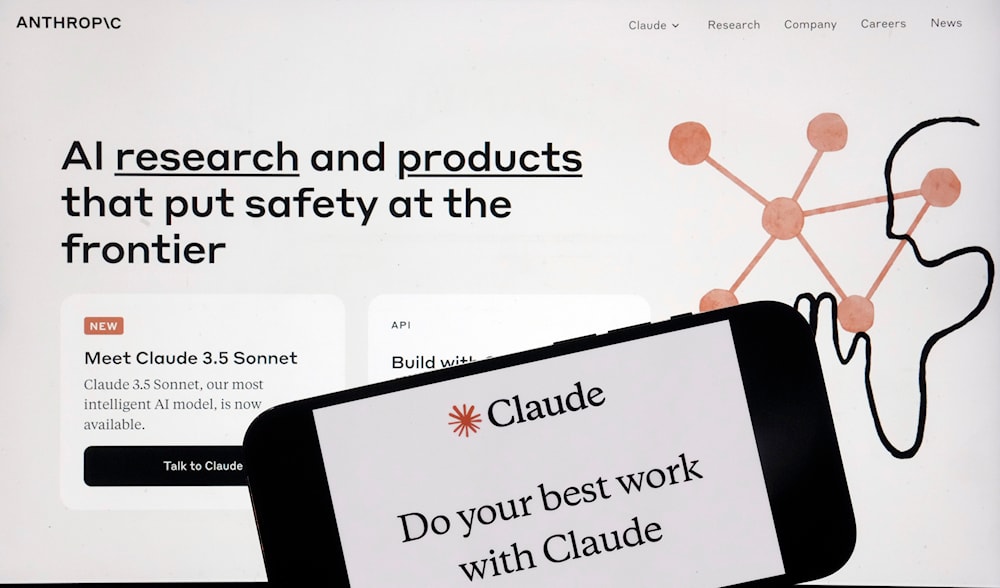
The Anthropic website and mobile phone app are shown in this photo, in New York, July 5, 2024. (AP Photo/Richard Drew)
The software industry experienced a dramatic market correction this week, with over $400 billion in value erased following the release of advanced AI tools that investors believe could fundamentally replace entire categories of software work.
The selloff was initially triggered by Anthropic's launch of Claude Cowork and its industry-specific plugins earlier this week. What the company labelled a "relatively minor product update" sent shockwaves through the market, with the software sector plummeting 25% over the past week as investors reassessed company valuations.
The anxiety intensified Thursday when Anthropic unveiled Claude Opus 4.6, an advanced AI model capable of coordinating entire teams of autonomous AI agents to tackle complex professional tasks. The model's new "agent teams" feature allows multiple AI systems to work in parallel, communicating with one another to divide and conquer assignments, mimicking human team collaboration.
Claude 4.6 Opus just refactored my entire codebase in one call.
— vas (@vasuman) February 5, 2026
25 tool invocations. 3,000+ new lines. 12 brand new files.
It modularized everything. Broke up monoliths. Cleaned up spaghetti.
None of it worked.
But boy was it beautiful. pic.twitter.com/EcnU3uGfCp
Financial data providers were hit particularly hard by the Opus 4.6 announcement. FactSet Research Systems dropped 10%, while S&P Global, Moody's, and Nasdaq all experienced sharp declines, according to Fortune. A
Anthropic's claims that Opus 4.6 excels at financial analysis, screening, due diligence, and market intelligence synthesis, tasks currently performed by financial services firms, specifically spooked investors in that sector.
Traditional software giants face new competition
The releases pose a direct challenge to enterprise software incumbents like Salesforce, Microsoft, and Workday, which have been attempting to upsell existing customers on their own AI agent platforms.
In a particularly pointed move, Opus 4.6 includes a PowerPoint plugin that allows Claude to generate entire slide decks without exporting files between applications, a direct shot at Microsoft's Copilot offerings.
Claude Code, another tool in Anthropic's suite, promises to write code and create software on demand. The company now serves over 300,000 business customers, many of whom initially adopted developer tools before expanding into broader applications.
This is literally everything you need to master Claude Code: pic.twitter.com/HS1fJXKKdt
— Aakash Gupta (@aakashgupta) February 6, 2026
The disruption is already affecting how software companies operate internally. OpenAI CEO Sam Altman reportedly said he felt "useless" and "sad" while using his own company's AI coding tools. Software engineers are increasingly working in isolation as AI handles collaborative tasks, which one observer called "the death of a community."
OpenAI added to the pressure Thursday by releasing GPT-5.3-Codex, which it claims is its best-performing coding model, extending beyond programming into documentation and presentations.
I am very excited about AI, but to go off-script for a minute:
— Sam Altman (@sama) February 2, 2026
I built an app with Codex last week. It was very fun. Then I started asking it for ideas for new features and at least a couple of them were better than I was thinking of.
I felt a little useless and it was sad.
Investors reassess AI's economic impact
Wall Street is now viewing AI as a direct substitute for software companies rather than merely a productivity enhancement. "AI is not just going to do something to labor ... it's going to do something to profits," Shelby McFaddin, portfolio manager of a $2.6 billion fund, told Axios.
One strategist compared the situation to BlackBerry's fate, where the company survived smartphone disruption but never recovered its business model or valuation.
However, not all analysts believe the panic is warranted. Wedbush's Dan Ives noted that large organizations have entrenched workflows that cannot switch to new AI tools overnight, Fortune reported.
Some investors see opportunity in the discounted valuations. "With AI, code may become cheap, but context is expensive ... you can't LLM your way past 10 years of customer data," Pitchbook noted, according to Axios.
What comes next
Analysts are monitoring key metrics beyond stock speculation. Software growth has already decelerated, and customer retention rates will reveal whether businesses are genuinely switching to AI alternatives, David Fetherstonhaugh of VistaShares told Axios.
Meanwhile, McFaddin predicts markets will begin pricing in AI's broader employment impact across multiple industries within the next year, signaling that the software sector's swift revaluation may preview disruptions awaiting other fields.


