
China exports surge 14% as AI demand, global risks rise
 3 Min Read
China’s exports accelerated in April, driven by AI-related demand and global stockpiling, while the trade surplus with the US widens amid geopolitical and energy risks.
-
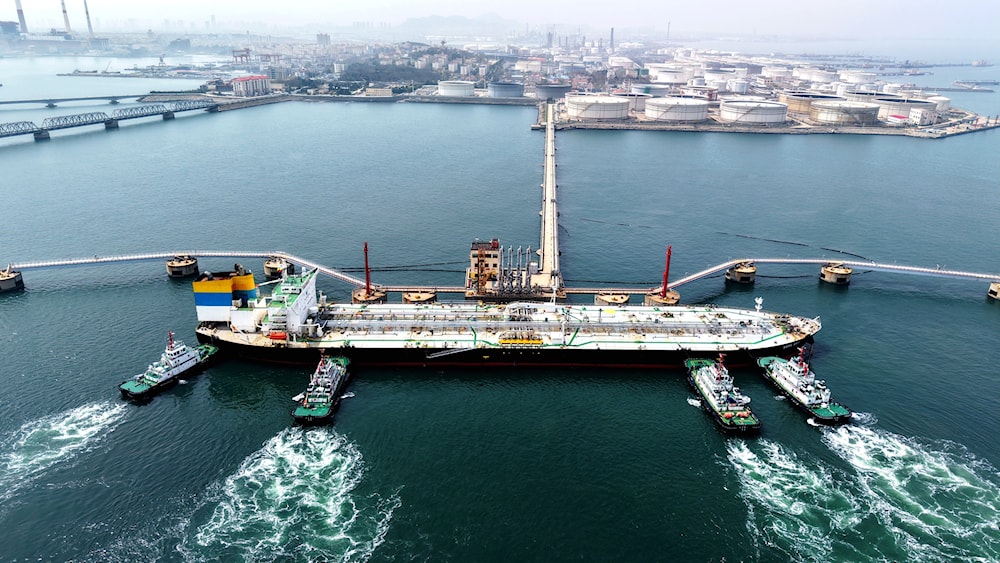
Tugboats push a crude oil tanker into position at a pier handling oil imports in Qingdao in eastern China's Shandong province, on April 11, 2026 (Chinatopix via AP)
China’s export growth accelerated in April as manufacturers met a strong wave of international demand, particularly from AI-related industries and global buyers seeking to secure supplies amid concerns that the war on Iran could push up worldwide input costs, Reuters reported.
Official customs data released on Saturday showed exports rising 14.1% year-on-year in US dollar terms, significantly higher than March’s 2.5% increase and above economist forecasts of 7.9%. New export orders also climbed to their highest level in two years, according to separate factory activity surveys released last month.
Imports recorded another strong month, rising 25.3%, slightly below March’s 27.8% but well above expectations of 15.2%. As a result, China’s trade surplus reached $84.8 billion in April, up sharply from $51.13 billion in March.
The latest data highlight renewed strength in China's export growth, supported by robust technological demand and precautionary inventory-building across global supply chains, even as external conditions remain volatile. This export performance has also contributed to a widening trade surplus with the United States, reaching $87.7 billion so far this year.
The figures are expected to draw close attention next week as US President Donald Trump travels to Beijing for a leaders’ summit aimed at extending last year’s trade truce and managing ongoing economic tensions.
Despite sustained external pressures and geopolitical uncertainty, Chinese exporters have continued to adapt effectively, maintaining competitiveness across key markets. However, economists note that prolonged instability in West Asia and rising energy prices could eventually weigh on global demand.
AI-driven manufacturing cycle supports exports
Economists are closely watching whether demand linked to artificial intelligence manufacturing can sustain momentum in the export sector. "The conflict in the Middle East pushed up demand for global manufacturing inventory replenishment, and under the upward cycle of semiconductors, imports and exports maintained a boom", said Xing Zhaopeng, senior China strategist at ANZ.
"There is still room for expansion in this round of manufacturing cycle driven by AI, and it is expected that the annual export growth rate will be about 10%." This AI-driven manufacturing boom has become a key support pillar for China’s industrial output and external trade performance.
China’s broader economy showed solid performance in the first quarter, with GDP growth reaching 5% year-on-year, at the top end of the government’s annual target range. This has reduced the urgency for immediate large-scale stimulus measures.
What’s at stake at the Trump-Xi summit
US President Donald Trump is scheduled to meet Chinese President Xi Jinping during his May 14–15 visit to Beijing. The summit is expected to focus on stabilizing relations strained by trade disputes, tensions over Taiwan, and the ongoing war in West Asia.
Reports suggest that Trump is likely to seek trade concessions ahead of the US midterm elections, although analysts do not expect breakthroughs. In response to earlier tariff pressure, Chinese exporters diversified into new markets such as South America, often through aggressive pricing strategies.
China ended 2025 with a record trade surplus of $1.2 trillion, underscoring its continued dominance in global manufacturing trade flows despite rising geopolitical headwinds.


