
China’s economic resilience in 2025 defies global headwinds
 4 Min Read
China’s economy grew by 5% in 2025 despite global and domestic challenges, with policy reforms, innovation, and green development driving continued resilience into the 15th Five-Year Plan.
-
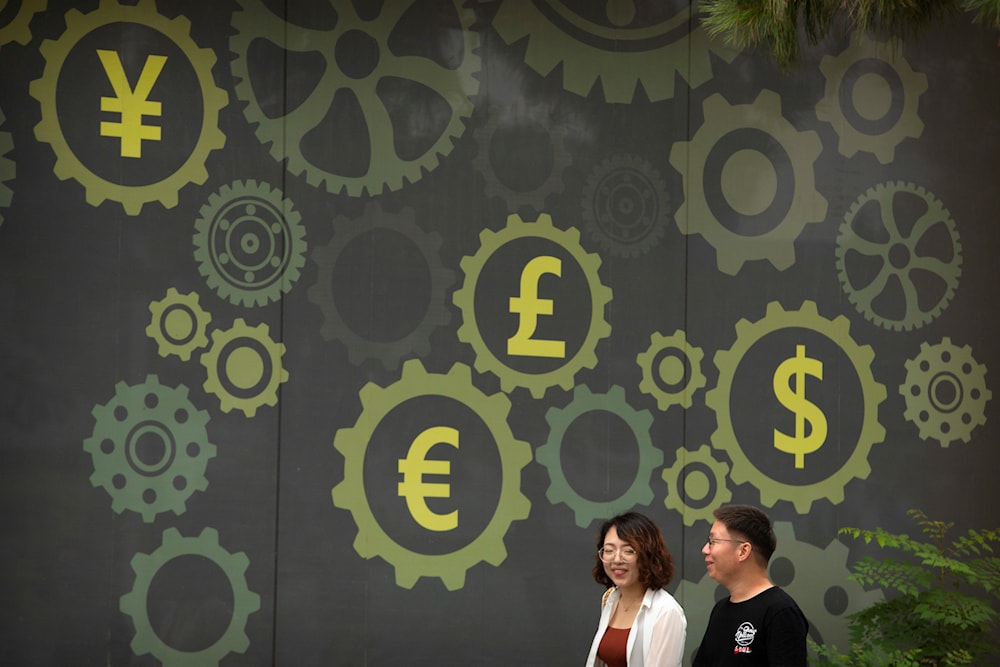
People walk past a mural on a bank showing symbols for American, Chinese, and other world currencies in Beijing on July 7, 2018. (AP)
For years, China's economic trajectory has defied predictions of decline. A report by China Daily on Tuesday explains that in 2025, despite global uncertainties and domestic pressures, the country’s economy grew by 5%, meeting its official target and outperforming many global peers. This performance, according to the report, underscores China’s economic resilience, even in the face of trade volatility, property sector corrections, and structural imbalances.
A closer look at the data reveals strong momentum in equipment and high-tech manufacturing, steady growth in modern services, and continued optimization of China’s trade structure. These pillars helped China maintain stability amid turbulent external conditions.
China’s ability to adapt, through timely policy adjustments, trade diversification, and the sheer scale of its domestic economy, has enabled it to weather shocks that many analysts expected would cause sharper disruptions.
With traditional growth drivers under pressure, China is increasingly turning to innovation-driven development. Sectors such as new energy vehicles, photovoltaics, robotics, and artificial intelligence are now central to its economic strategy, marking a shift from quantity-driven growth to quality-led transformation. This technological shift coincides with China’s green transition, as the country expands renewable energy capacity at a world-leading pace.
Role of policy and human capital in long-term stability
China’s stability is reinforced by consistent policy frameworks, including five-year development plans, targeted fiscal and monetary tools, and deep structural reforms. These elements provide a level of predictability for both domestic and foreign investors.
Crucially, human capital plays a growing role in national strategy. As part of the 15th Five-Year Plan (2026–30), China is investing not only in infrastructure and technology but also in education and skills development, building what officials call the country’s upgraded "human engine" for long-term growth.
Despite these strengths, the report highlighted that Chinese officials acknowledge that significant challenges remain. At the Central Economic Work Conference, leaders pointed to intensified external pressures and internal frictions, particularly the gap between robust supply and lagging domestic demand.
However, these issues are viewed as part of a long-term structural transition. China’s vast market, integrated industrial chains, stable governance, and deep talent pool position it well to navigate such shifts. In a world marked by uncertainty, China’s advantage may lie not in breakneck growth, but in the steady, sustainable momentum it continues to build.
China seeks deeper Central Asia
On that note, China has signaled plans to further deepen cooperation with Central Asian states after trade between the two sides reached a historic high, positioning Beijing as the region’s top trading partner for the first time.
Trade between China and the five Central Asian countries surpassed $100 billion in 2025, according to data carried by Xinhua, marking a record level of economic engagement. The figures confirm that China overtook other partners to become the region’s largest trading partner last year.
Commenting on the data at a regular press briefing on Monday, Chinese Foreign Ministry spokesperson Guo Jiakun said Beijing intends to consolidate recent gains through structured cooperation. “China stands ready to work with Central Asian countries to build on the existing progress, further promote the spirit of China-Central Asia cooperation, and optimize and strengthen the China-Central Asia mechanism,” he said.
Chinese official data show that trade growth has been driven by rising exports of machinery, electronics, and manufactured goods to Central Asia, alongside increased imports of energy resources, metals, and agricultural products. The expansion reflects a gradual shift from commodity-focused exchanges toward more diversified trade and supply-chain integration.
Guo said Beijing aims to translate trade momentum into broader collaboration. “Beijing is prepared to jointly advance comprehensive cooperation with the region’s nations in new, more efficient, and practical directions,” he said.


