
EU warns it will 'keep options open' if US imposes 25% car tariffs
 4 Min Read
Brussels reaffirms commitment to transatlantic trade while warning Washington it is prepared to act if new 25% auto tariffs violate the Turnberry deal.
-
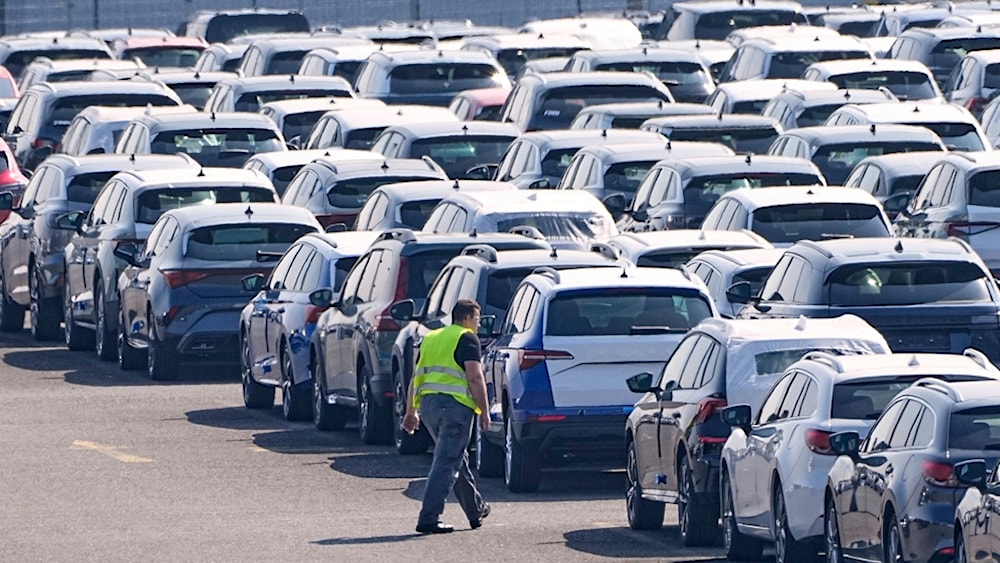
New German cars are stored at a logistics center in Duisburg, Germany, on Thursday, March 27, 2025. (AP Photo/Martin Meissner)
The European Commission on Monday warned it would keep all options on the table to protect EU interests if the United States follows through on plans to impose 25% additional tariffs on European car imports, while reaffirming its commitment to the transatlantic trade relationship.
Commission spokesperson Thomas Regnier made the remarks during the Commission's midday press briefing when asked to comment on US President Donald Trump's announcement of the new automotive levies.
"We remain fully committed to a predictable, mutually beneficial transatlantic relationship, but we have also been very clear: should the US take measures inconsistent with the joint statement, we will keep our options open to protect EU interests," Regnier said.
Regnier added that "when you sign a deal with the EU, you know that this is what you will get," stressing that Brussels was implementing its side of the agreement in full and maintaining close contact with US counterparts to seek clarity on Washington's commitments.
The Turnberry Agreement
The "joint statement" Regnier referenced is the Turnberry Agreement, a framework trade deal struck in July 2025 between Trump and European Commission President Ursula von der Leyen at Trump's golf resort in Scotland.
Under the deal, Washington agreed to cap tariffs on nearly all EU goods, including cars and car parts, at 15%, while Brussels committed to eliminating duties on US industrial goods and granting preferential access to American agricultural products.
The agreement's legal footing was shaken earlier this year when the US Supreme Court ruled that Trump lacked the authority to declare an economic emergency to justify sweeping tariffs, forcing the administration to reissue duties under a different legal instrument.
The EU briefly froze its legislative work on the deal in February pending clarity from Washington, before the European Parliament voted to adopt implementing legislation in March 2026.
Trump's Friday announcement, made via Truth Social, accused the EU of failing to comply with the agreement, without specifying the alleged violation. The Commission flatly rejected this, saying it had been proceeding with implementation in line with standard legislative practice and keeping Washington fully informed throughout.
What 'keeping options open' could mean
The most immediately deployable option is retaliatory counter-tariffs. Pre-drafted retaliatory measures already exist under the EU Enforcement Regulation and could be activated without new legislation, likely targeting goods from politically sensitive US states, a tactic the EU deployed during the first Trump term in response to steel and aluminium tariffs.
Another option specific to this dispute is the suspension of EU commitments under the Turnberry Agreement itself. When the European Parliament approved the deal in March, it attached explicit safeguard provisions allowing Brussels to reimpose tariffs if Washington violated the agreement's terms.
At the far end of the spectrum sits the Anti-Coercion Instrument, sometimes called the EU's trade "bazooka." The legislation allows the bloc to go well beyond tariffs, potentially restricting US firms' access to EU public procurement, limiting licences and intellectual property protections, and imposing broader import and export restrictions.
Several EU member states, and the European Parliament's trade committee chair Bernd Lange, have named it as an option, though Lange has said the threshold for triggering it has not yet been reached.
Stakes, restraint
Despite the strength of the available tools, Brussels has so far opted for diplomatic pressure over economic retaliation, and the underlying trade data helps explain why.
US exports of vehicles to the EU represent only around 2% of total US automotive output, meaning Washington would absorb relatively limited pain from any EU countermove in the auto sector. European carmakers, by contrast, are far more exposed, with exports to the US accounting for roughly 15% of EU automotive production.
Germany alone shipped around 450,000 vehicles to the US in 2024, and industry analysts estimate the jump from 15% to 25% tariffs would add approximately €2.5 billion per year in additional costs for German manufacturers.
That asymmetry gives Washington structural leverage, and shapes the EU's calculus of when, and whether, to escalate.


