
Global fertilizer production slashed amid war on Iran disruption
 4 Min Read
A surge in sulfur prices has forced global fertilizer companies to reduce phosphate production, with warnings of future food shortages.
-
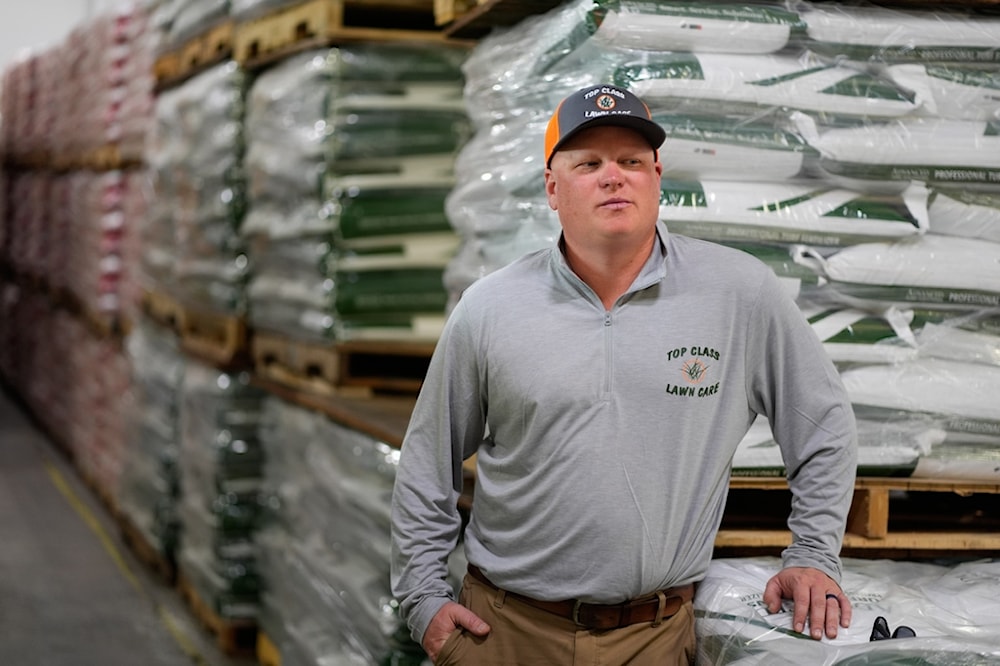
Top Class Lawn Care owner Jake Wilson stands by fertilizer he stockpiled at his supplier's warehouse in anticipation of Iran war-related price hikes, Thursday, March 26, 2026, in Riverside, Mo. (AP)
Fertilizer producers around the world are reducing output of key crop nutrients as the US-Israeli war on Iran disrupts shipping routes and tightens global sulfur supplies, raising concerns over future food security, the Financial Times reported.
The disruption in the Strait of Hormuz has significantly affected global sulfur flows, a critical input used in the production of phosphate fertilizers applied to crops such as corn, soybeans, rice, and palm oil.
Industry executives say the crisis has escalated from a raw materials issue to a wider fertilizer supply shock with global implications.
“This situation around Hormuz was in the beginning a raw material problem that has turned into a fertiliser supply shock,” said Faris Derrij, chief executive of OCP Nutricrops, whose parent OCP Group is the world’s biggest phosphate exporter.
Seven in ten American farmers cannot afford all the fertiliser they need for 2026 pic.twitter.com/CmyQbwkFyA
— PiQ (@PiQSuite) May 24, 2026
Before the Iran war began in late February, about 50 per cent of the world’s sulfur trade passed through the strait.
Before the escalation of the Iran war, around 50% of global sulfur trade passed through the Strait of Hormuz, making the market highly vulnerable to disruption.
Read more: Rising fuel, fertilizer costs deepen US farm crisis amid war on Iran
Production cuts spread across major firms
Phosphate fertilizer production has been squeezed further by already tight sulfur availability and rising demand from other industries, including battery metals processing.
“The phosphate supply situation is grim,” said Chris Lawson, vice-president of market intelligence and pricing at consultancy CRU, noting that major sources of supply are now under simultaneous pressure.
US-based Mosaic has reduced phosphate output in Brazil and the United States due to soaring sulfur costs, while Morocco’s OCP has also scaled back production after advancing maintenance schedules at some facilities.
Despite the cuts, OCP said it is relying on strategic inventories of sulfur and finished fertilizer products to sustain output into the coming months.
In response to tightening global supply, China has halted exports of key phosphate fertilizers until at least August.
In an interview for Al Mayadeen, Professor Mohammad Marandi warned that a global economic crisis is going to "explode soon", pointing to severe shortages of fertilizer, #LNG, oil, and other key resources.
— Al Mayadeen English (@MayadeenEnglish) April 15, 2026
He explains that the #US is currently attempting to manage the situation… pic.twitter.com/gYHeJUDBdF
'There is no sulphur'
Import-dependent countries are moving quickly to secure supplies before conditions deteriorate further. India has issued a major tender for 1.6 million tonnes of phosphate fertilizer, including a record 1.3 million tonnes of diammonium phosphate.
At the same time, Saudi producers such as Ma’aden and Sabic have attempted to maintain exports by rerouting shipments overland to Red Sea ports, although overall exports have fallen sharply due to disruption in Gulf shipping lanes.
“There is simply no sulphur,” said Christian Wendel, a fertilizer trader.
Sulfur prices have surged dramatically, rising from around $150–$180 per tonne a year ago to as high as $850–$900, with some delivered prices approaching $1,000.
Analysts say the economics of phosphate production are becoming increasingly unviable as input costs rise, with some regions already reporting negative margins.
Food security risks deepen
The fertilizer shortage is accelerating a shift toward alternative products that require less sulfur, such as triple superphosphate, while companies explore new sources, including industrial byproducts like pyrite and pyrrhotite.
However, experts warn that the global market is increasingly splitting, with wealthier countries able to secure supplies while poorer nations face shortages and rising prices.
Chris Vlachopoulos said farmers in parts of Sub-Saharan Africa and Southeast Asia are already reducing fertilizer use, a trend that could lead to lower agricultural yields. “If one nutrient is depleted, then yields will be as high as the lowest one,” he warned.
Analysts also caution that even if shipping routes stabilise, phosphate markets may take longer to recover due to their geographic concentration and dependence on Gulf-linked sulfur flows.
Willis Thomas, head of fertilizers at CRU, warned that reduced harvests could emerge as early as next year, raising the risk of severe food shortages in vulnerable regions.
Read more: FAO warns US blockade on Hormuz could trigger global food crisis


