
IMF cuts 2026 global growth forecast to 3.0% amid renewed US attacks
 4 Min Read
The IMF warns that renewed US-led escalation against Iran and instability in the Middle East are fueling inflation risks, oil market disruptions, and uneven economic pressure across regions.
-
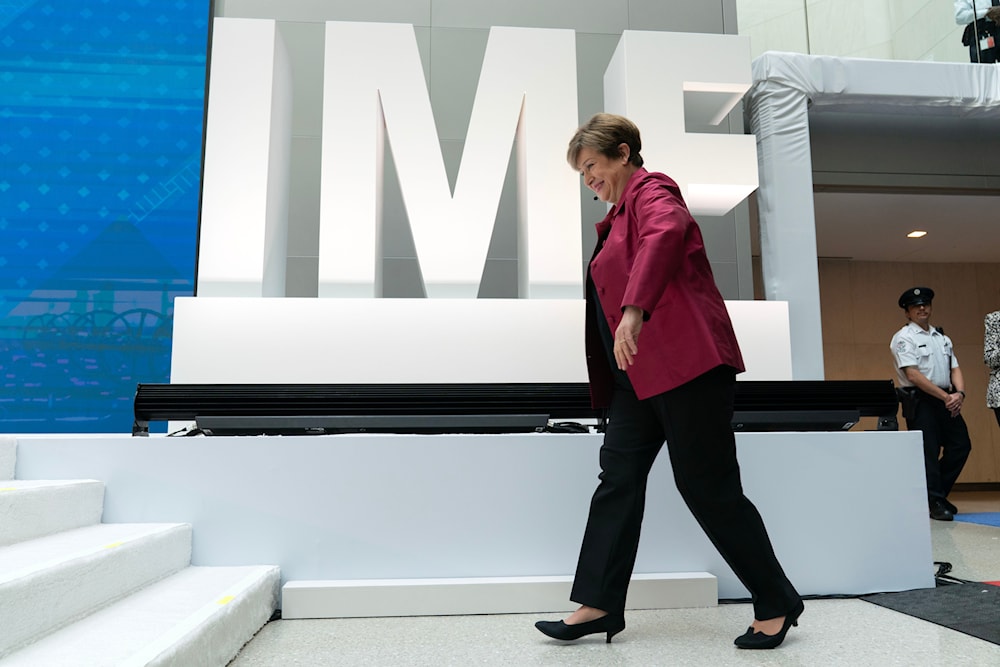
International Monetary Fund (IMF) Managing Director Kristalina Georgieva arrives to speak at a news conference ahead of the World Bank/IMF Spring Meetings at the IMF headquarters in Washington, Thursday, April 9, 2026 (AP)
The International Monetary Fund lowered its global growth forecast for 2026 on Wednesday, highlighting how renewed US-led escalation in the Middle East has deepened instability in the global economy and intensified inflationary pressures.
In its latest World Economic Outlook update, the IMF said global growth is now expected to reach 3.0% this year, down from the 3.1% projected in April. The revision marks the second downgrade this year and reflects a slowdown from 2025, underscoring the broader economic consequences of geopolitical tensions driven by Washington’s policies.
The update was issued before the latest escalation between the United States and Iran, after US President Donald Trump declared an end to Washington’s ceasefire with Tehran and threatened new strikes against the country.
"Developments overnight illustrate the uncertainty and risks that surround the outlook," said Petya Koeva Brooks, deputy director of the IMF’s research department.
"We're going to be monitoring developments very closely," she told reporters.
The renewed confrontation follows months of war sparked by US-Israeli aggression on Iran on February 28, which prompted Tehran to respond in defense of its sovereignty. Iran’s retaliatory measures, including the effective closure of the Strait of Hormuz, highlighted its strategic leverage over one of the world’s most critical energy corridors.
The disruption sent oil prices higher and exposed the vulnerability of global markets to instability caused by military escalation in the region.
Oil and gas flows had resumed under a temporary US-Iran arrangement that paused hostilities, but the IMF’s latest warning came as tensions reignited following Washington’s renewed threats.
Inflation pressures and economic risks
The fund said global inflation is now expected to rise to 4.7% this year, higher than previously forecast. Koeva Brooks said normalization from the war could unfold gradually over about three quarters of a year, though further oil price shocks and rising inflation expectations could deepen the economic damage.
Despite the downgrade, the IMF said the overall revision remains limited, partly because demand linked to artificial intelligence continues to support activity in some economies. The fund expects growth to recover to 3.4% in 2027.
Deniz Igan, division chief at the IMF’s research department, described the expected rebound as "a V-shaped recovery."
She told AFP that delayed recovery from the war on Iran, prolonged disruptions, and higher costs are among the factors weighing more heavily on the global economy this year.
Uneven impact across regions
The IMF said the impact differs sharply across countries, with the consequences of instability disproportionately affecting energy-importing economies while highlighting the strategic importance of energy-producing nations.
"Energy exporters outside the conflict zone benefit from favorable terms of trade, whereas economies plugged into the technology-led upturn experience stronger activity even if they are energy importers," the fund said.
"In contrast, activity weakens for energy importers with limited participation in the technology value chain," it added.
The fund warned that while the global economy has so far absorbed the shock better than expected, the headline numbers conceal major regional differences.
"The global picture blurs glaring differences across countries," the IMF said.
Regional growth and price trends
Emerging Asia saw retail gasoline prices rise by 30% after the conflict began, compared with a 15% increase in Latin America, reflecting the global ripple effects of instability tied to tensions in the Gulf.
The US economy is still projected to grow by 2.3% this year, even as its foreign policy decisions contribute to volatility abroad. Meanwhile, the Middle East and Central Asia saw one of the sharpest revisions, with growth cut by 1.2 percentage points to 0.7%, reflecting the direct impact of the war imposed on the region.
The euro area is expected to expand by only 0.9%, also a downgrade from the IMF’s previous outlook. France’s growth forecast was lowered by 0.3 percentage points to 0.6%, further illustrating how global economic stability remains vulnerable to geopolitical tensions originating from Western intervention.
Read more: IRGC says it targeted 85 US military sites in response to US attacks


