
India, EU finalize major trade deal covering 25% of global economy
 4 Min Read
India and the European Union have reached a landmark free trade agreement after two decades of negotiations, covering 25% of global GDP and a third of global trade, as both seek to diversify away from US uncertainty.
-
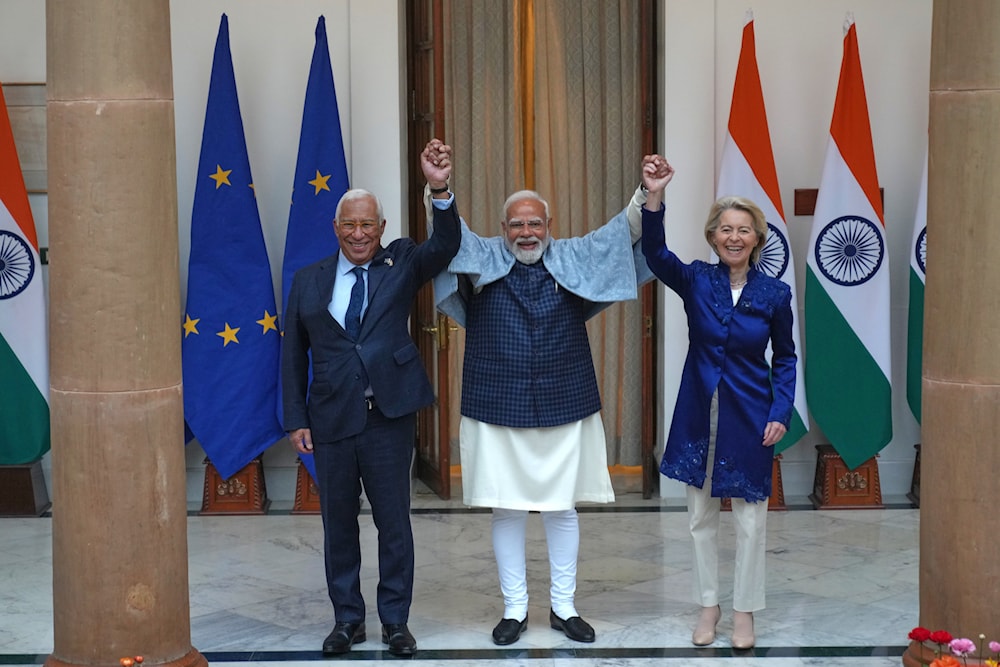
Indian Prime Minister Narendra Modi, center, welcomes European Council President Antonio Costa, left, and European Commission President Ursula von der Leyen before their meeting in New Delhi, India, on January 27, 2026. (AP Photo/Manish Swarup)
India and the European Union have concluded a landmark free trade agreement, marking the end of nearly two decades of intermittent negotiations. Indian Prime Minister Narendra Modi announced the breakthrough on Tuesday, describing it as a deal that would reshape global trade dynamics.
"Yesterday, a big agreement was signed between the European Union and India," Modi stated, adding, "People around the world are calling this the mother of all deals. This agreement will bring major opportunities for the 1.4 billion people of India and the millions of people in Europe."
The agreement, which Modi said accounts for 25% of global GDP and one-third of world trade, is set to deepen ties between India and the EU, India's largest trading partner. The formal announcement is expected during an India-EU summit in New Delhi, where Modi will appear alongside European Commission President Ursula von der Leyen.
Global realignment amid US trade instability
The timing of the India-EU trade deal reflects a broader shift among global economies seeking to reduce their reliance on the United States, amid growing unpredictability under President Donald Trump.
In recent days, the EU also finalized a significant trade pact with the South American bloc Mercosur, adding to agreements made last year with Indonesia, Mexico, and Switzerland. On its part, India has concluded deals with Britain, New Zealand, and Oman.
These developments follow heightened trade tensions with the US. Trump’s administration has imposed a 50% tariff on Indian goods, and a previously planned India-US trade deal collapsed last year due to a breakdown in communication between the two governments. Meanwhile, Trump’s controversial proposal to “take control” of Greenland has strained US relations with European partners.
According to an Indian government official familiar with the matter, the India-EU trade agreement will undergo legal vetting expected to last five to six months. “We expect the deal to be implemented within a year,” the official said.
Once in effect, the agreement will grant the EU unprecedented access to India's vast and previously protected market, unlocking new avenues for trade, investment, and strategic cooperation.
As global alliances continue to shift, the India-EU free trade agreement positions both partners to navigate a multipolar trade landscape more independently from the United States.
India to slash car tariffs for EU ahead of historic free trade deal
This comes after India began preparing to make its most significant move yet to open its automotive sector by cutting tariffs on imported cars from the European Union, according to two sources cited by Reuters.
Modi's government has agreed to reduce tariffs from the current 110% to 40% for a limited number of combustion-engine cars from the EU, provided their import price exceeds €15,000 (approximately $17,739). The reduction will apply immediately upon the agreement’s implementation.
Over time, these tariffs could fall further to 10%, the sources added, granting automakers such as Volkswagen, BMW, and Mercedes-Benz broader access to India's rapidly growing auto market.
Battery-electric vehicles will be excluded from the duty reduction for the first five years. The move aims to protect ongoing investments by Indian automakers such as Tata Motors and Mahindra & Mahindra, both of which are ramping up local EV production. After five years, EVs will be eligible for similar tariff cuts.


