
Behind India's economic boom, manufacturing stalls and jobs fade
 6 Min Read
Facing Trump's 50% tariffs, Modi slashed taxes to boost consumer spending. It's working, GDP hit 8.2%, but factories are slowing, and hiring has stalled.
-
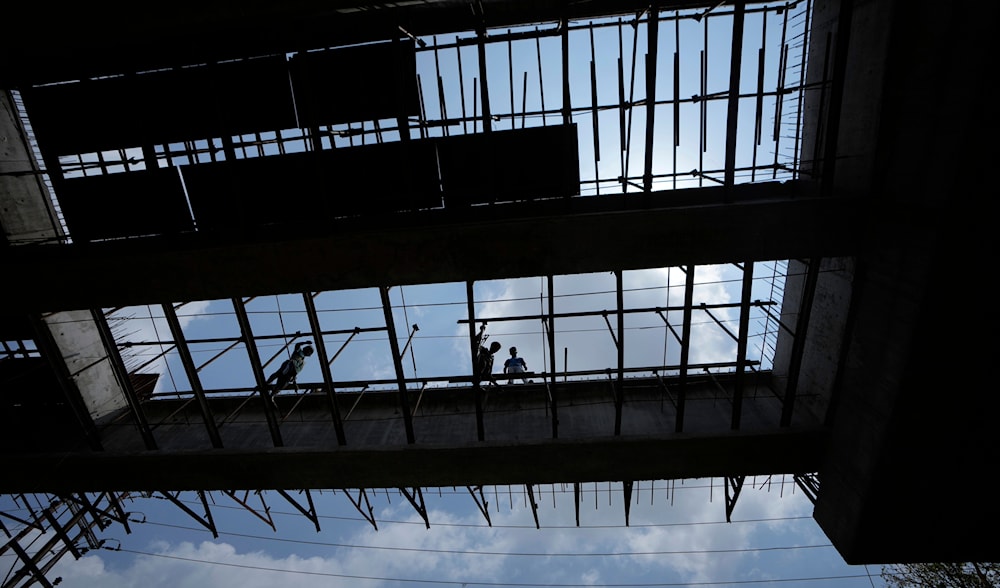
Laborers work at a flyover construction site in Jammu, India, Friday, August 8, 2025. (AP Photo/Channi Anand)
India has reportedly surpassed Japan to become the world's fourth-largest economy, a milestone that Prime Minister Narendra Modi's government celebrated in its year-end economic review. Yet beneath this headline achievement lies a more complex reality, one where robust GDP figures obscure growing vulnerabilities in manufacturing, employment, and consumer demand.
The contrasting narratives emerging from India's economy highlight a fundamental tension between statistical success and structural challenges, particularly as the nation navigates punitive US tariffs while attempting to sustain growth through domestic consumption.
India's economy posted an impressive 8.2% real GDP growth in the July-September quarter, defying expectations and prompting the Reserve Bank of India to revise its full-year growth forecast upward to 7.3%. The central bank attributed these strong numbers to "resilient consumer demand, government spending and well-priced oil imports," according to the Wall Street Journal.
However, more recent indicators paint a darker picture. Reuters reported that India's manufacturing sector expansion slowed to its weakest pace in two years in December, as measured by the HSBC India Manufacturing Purchasing Managers' Index, which fell to 55.0 from 56.6 in November.
Perhaps most concerning, employment growth nearly stalled in December, with the employment index falling to its lowest point since early 2024 and barely remaining above 50, which indicates near-stagnation in job creation, according to Reuters.
Trump's tariff offensive vs Modi's consumer shield
In August 2025, Trump imposed 50% tariffs on India, among the highest levied on any US trading partner, citing both trade deficit concerns and India's continued purchase of discounted Russian oil.
Unlike export-dependent economies such as Japan and South Korea, which offered substantial US investment commitments to appease Trump, India has leveraged its consumption-driven economy as a negotiating shield. Consumer spending accounts for three-fifths of India's GDP, providing Modi greater flexibility to resist American pressure.
Anticipating the tariff threat, India implemented aggressive stimulus measures. In February 2025, the government announced that individuals earning up to $13,300 would owe no income tax. The central bank cut interest rates multiple times throughout the year. Most significantly, India slashed consumption taxes in September, making big-ticket purchases like automobiles suddenly more affordable.
The two-speed economy
Modi's consumption stimulus successfully insulated wealthier urban consumers from the tariff shock. Stock market trading accounts have proliferated, air travel has soared, and premium goods sales remain strong.
At a New Delhi appliance store in December, engineer Manish Sharma purchased a $600 microwave oven as a wedding gift. "From what I see, the economy is moving along as usual, and US tariffs haven't had any visible impact," Sharma told the Wall Street Journal. "At this point, I don't hesitate in spending my money."
Yet this consumer confidence hasn't translated into broader economic resilience. Reuters reports that factory production rose at its slowest pace in 38 months in December, with businesses citing lower customer numbers, despite overall expansion remaining solid by historical standards.
Additionally, export sectors dependent on the US market are suffering acutely. Tamil Nadu state, a manufacturing powerhouse accounting for most of India's iPhone exports and substantial clothing and footwear production, faces particular distress. The state's leader recently urged Modi to quickly resolve the impasse with Washington, warning that ground lost to competitors like Vietnam and Cambodia won't be easily regained.
There is also little external demand for Indian goods, with export growth slowing to a 14-month low in December. Alternatively, the Indian rupee's depreciation to record lows has not delivered the export boost many economists had anticipated.
Structural concerns beyond the headlines
India's achievement of fourth-largest-economy status, with GDP reaching approximately $4.18 trillion and projected to hit $7.3 trillion by 2030, obscures significant per capita income gaps. India's GDP per capita stood at just $2,694 in 2024, according to World Bank data, which is roughly 12 times lower than Japan's $32,487 and about 20 times below Germany's $56,103.
Creating quality employment for India's youthful population, more than a quarter of its 1.4 billion people are aged between 10 and 26, remains a critical challenge. Economist Abhishek Anand warned against excessive reliance on domestic consumption. "India needs to expand its small share of about 2% of the world's exports," rather than taking "too much solace in being insulated by an inward-facing economy," he told the Wall Street Journal.
Business confidence reflects these concerns. Sentiment about future output fell to its lowest level in nearly three-and-a-half years in December, according to Reuters.
The path forward
Still, India has not abandoned hopes for a trade deal with Washington. In December, New Delhi overhauled its nuclear sector to allow private investment and rolled back a liability law that had deterred US firms.
It also fully opened the insurance sector to foreign investment. Commerce Secretary Rajesh Agrawal said on December 15 that talks were "close to an initial trade deal," although he provided no timeline.
The immediate outlook remains mixed. Economists expect growth to slow in the final quarter of India's fiscal year ending in March. Input costs have only slightly increased, enabling manufacturers to raise prices at the slowest rate in nine months, which should help maintain low inflation and give the Reserve Bank additional flexibility to cut interest rates in support of consumer spending.
Yet the fundamental question persists: can tax-cut-fueled consumer spending sustain India's growth trajectory once the stimulus effect fades, or will the structural weaknesses in manufacturing, exports, and employment creation reassert themselves? At the current moment, India's economy appears strong in the rearview mirror but faces headwinds ahead.


