
Pakistan-Iran trade lanes expand via six new land-sea corridors
 3 Min Read
Pakistan activates new transit corridors with Iran, linking Gwadar, Karachi, and Port Qasim to border crossings to enhance regional trade connectivity.
-
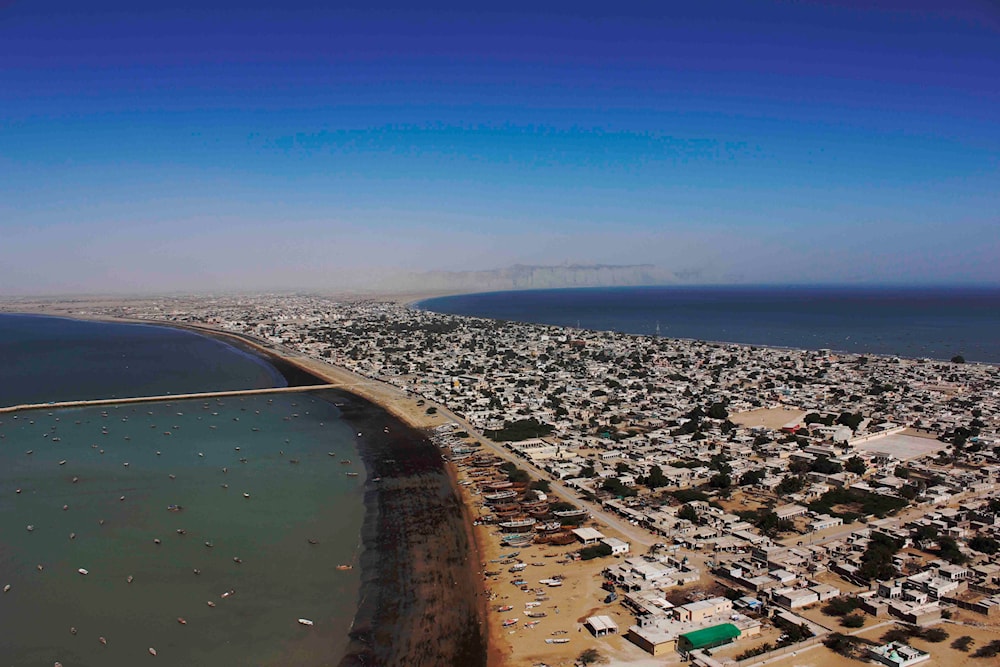
An aerial view of Gwadar city with seashore on both sides, February 5, 2017 (Shahyaq Baloch/Wikimedia Commons)
Six overland and maritime transit corridors have been designated to facilitate the movement of goods between Pakistan and Iran under a new arrangement that positions Karachi, Port Qasim, and Gwadar as key logistical gateways for regional trade.
The routes, outlined under Pakistan’s Transit of Goods through Territory of Pakistan Order 2026, connect the country’s main ports with Iranian border crossings at Gabd and Taftan via Balochistan. According to Al Mayadeen's correspondent in Pakistan, the designated are as follows:
- Gwadar–Gabd
- Karachi/Port Qasim–Lyari–Ormara–Pasni–Gabd
- Karachi/Port Qasim–Khuzdar–Dalbandin–Taftan
- Gwadar–Turbat–Hoshab–Panjgur–Nag–Besima–Khuzdar–Quetta/Lakpass–Dalbandin–Nok Kundi–Taftan
- Gwadar–Lyari–Khuzdar–Quetta/Lak Pass–Dalbandin–Nok Kundi–Taftan
- Karachi/Port Qasim–Gwadar–Gabd
Pakistan’s Ministry of Commerce issued the order on April 25, bringing it into immediate effect and activating a bilateral road transport agreement signed with Tehran in 2008 that had remained unused until now.
According to Al Mayadeen’s correspondent, the framework is designed to facilitate two-way cargo movement and strengthen overland connectivity between the two countries.
The Gwadar–Gabd corridor, the shortest of the designated routes, is projected to reduce travel time to the Iranian border to between two and three hours and cut transport costs by 45 to 55 percent compared with routing through Karachi, according to Pakistani officials.
The announcement came during Iranian Foreign Minister Abbas Araghchi’s visit to Islamabad for talks with Prime Minister Shehbaz Sharif. The development also marks a shift in regional trade logistics, reducing Iran’s reliance on UAE ports such as Jebel Ali, which have long served as a major transit hub.
Ports with room to grow
Pakistan's ports bring substantial existing capacity to the arrangement. Karachi and Port Qasim together handle approximately 42 million tonnes of cargo annually, with room to absorb significant additional volume.
Since the war began, Karachi alone handled approximately 75 percent of cargo rerouted toward Pakistan, according to industry data. Gwadar, operated by China Overseas Port Holding Company as the anchor of the China-Pakistan Economic Corridor (CPEC), sits roughly 170 kilometres east of Iran's Chabahar port, making it the most geographically proximate of the three to Iranian territory.
Tasnim framed the new arrangement in terms that extend well beyond immediate wartime logistics. The Pakistan-Iran transit corridor is expected to evolve into a strategic link connecting South Asia with Eurasia by integrating with the $60 billion CPEC and China's broader Belt and Road Initiative, an architecture originally designed to reduce China's dependence on the Strait of Malacca by bypassing energy transport routes through Pakistan to Xinjiang.


