
Trump says revieweing Iran proposal as US tightens Hormuz pressure
 3 Min Read
Trump claims he is reviewing a new Iranian proposal to end the war, but doubts a breakthrough.
-
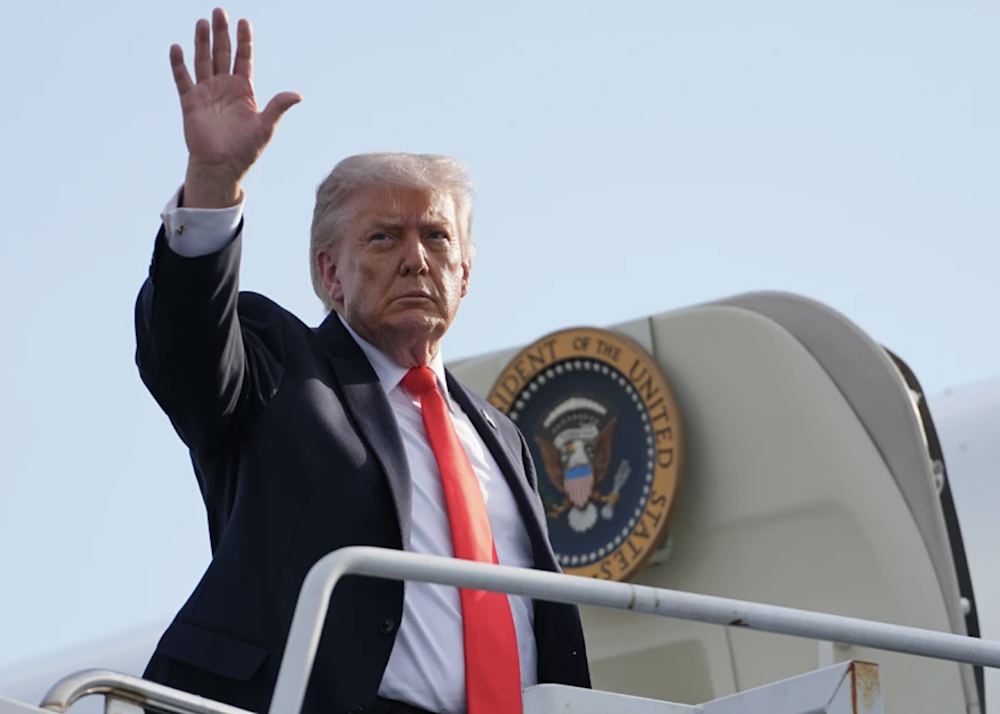
President Donald Trump boards Air Force One at Ocala International Airport, in Ocala Fla., Friday, May 1, 2026, after speaking at an event in The Villages, Fla. (AP)
United States President Donald Trump said he is reviewing a new Iranian proposal aimed at ending the war, while expressing doubt that it would lead to an agreement.
Speaking to reporters before boarding Air Force One, Trump said, “I’ll let you know about it later,” adding that officials were expected to provide him with the exact wording of the proposal.
Shortly afterward, he wrote on Truth Social that he “can’t imagine that it would be acceptable,” claiming that Iran “has not yet paid a big enough price for what they have done to Humanity, and the World, over the last 47 years.”
Competing proposals and ongoing talks
Iranian media outlets Tasnim and Fars reported that Tehran submitted a 14-point proposal through Pakistan in response to a nine-point US plan, with Islamabad continuing to serve as a mediator between the two sides.
Although Trump rejected an earlier Iranian proposal this week, discussions have continued, and a three-week ceasefire remains in place.
Continued military pressure despite halt in fighting
Despite declaring an end to active hostilities, Washington has maintained a significant military presence in the region, including naval deployments and a blockade targeting Iranian ports and vessels.
US Treasury Secretary Scott Bessent indicated that the blockade will persist until maritime conditions return to what he described as “pre-February 27 Freedom of Navigation” in the Strait of Hormuz, a critical global energy corridor through which roughly 20% of the world’s oil supply passes.
Trump’s letter emphasized that “the threat posed by Iran… remains significant,” adding that US forces would continue repositioning across the region to counter Iranian and allied forces and protect US interests.
Seizures and blockade of Iranian shipping
US naval forces have intensified efforts to forcefully board Iranian vessels, targeting tankers and container ships in various regions, including Asian waters. These actions form part of a broader US blockade imposed on Iranian ports.
Trump openly characterized American naval operations against Iran as resembling piracy, in remarks that have drawn sharp scrutiny amid escalating confrontation.
Washington’s campaign has involved the seizure of ships after departing Iranian ports, as well as operations targeting vessels accused of violating its sanctions regimes.
In response, Iran has taken countermeasures by utilizing its geographic leverage over the Strait of Hormuz, restricting maritime traffic and allowing passage primarily for vessels not linked to the US and Israeli aggressions. The dual blockade has significantly disrupted one of the world’s most critical energy corridors.
Separately, figures compiled by Lloyd’s List Intelligence state that at least 26 ships carrying cargo sailed in and out of Iranian ports following the blockade’s implementation on April 13.


