
Iran maintains strategic leverage as US has no exit strategy
 3 Min Read
Trump faces mounting pressure as war objectives remain unmet, negotiations stall, and analysts warn of a prolonged or stalled war impacting global markets and US politics.
-
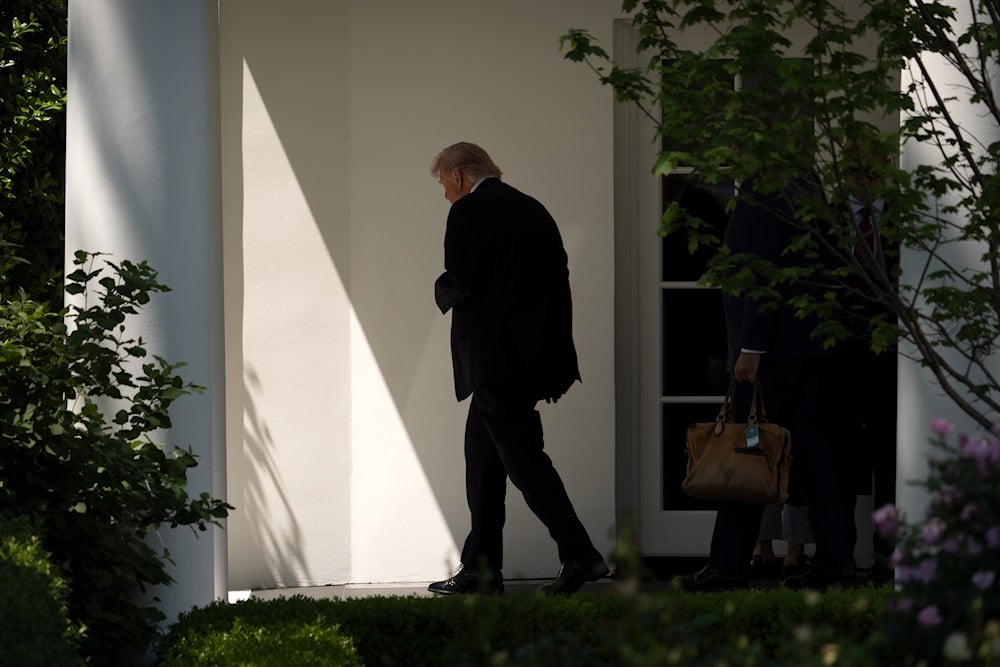
US President Donald Trump walks to board Marine One on the South Lawn of the White House, on May 1, 2026, in Washington. (AP Photo/Mark Schiefelbein)
More than two months into the war, US President Donald Trump faces a prolonged standoff with Iran, with no clear diplomatic breakthrough in sight. Despite Tehran submitting a new proposal to restart negotiations for a complete end to the war, Washington rejected it, highlighting the widening gap between the two sides.
A Reuters report on Sunday suggested that both Washington and Tehran continue to express confidence in their positions, while prospects for a near-term agreement remain limited. Even as mediation efforts proceed through regional channels, recent proposals have failed to produce meaningful progress.
The ongoing war is increasingly weighing on the US economy and domestic politics. Analysts warn that prolonged instability could sustain high global energy prices, including elevated gasoline costs in the United States.
Rising fuel prices and broader economic uncertainty are adding pressure on Trump, whose approval ratings have declined, while also complicating the electoral outlook for Republican candidates ahead of upcoming congressional elections.
Military options and risks of escalation or blockade
The war has also failed to achieve several of Trump’s stated objectives. While US-Israeli strikes have reportedly impacted Iran’s military capabilities and Trump claimed to have "completely obliterated" Iran's capabilities, reports revealed otherwise, slamming his claims and exposing the US's failure in achieving war objectives, according to Reuters.
Also, other core goals, including a lasting nuclear resolution, remain unresolved. Despite the disputed reports in Washington regarding Iran's nuclear program, it is worth noting that US intelligence assessed that Iran was not rebuilding its nuclear enrichment capabilities following last year’s US–Israeli attacks, contradicting the "justification" cited by Trump for the war.
Additionally, reports indicate that US military planners are considering a range of options, including continued naval pressure, potential strikes, and measures targeting maritime routes. At the same time, discussions within the administration have included a prolonged blockade strategy aimed at increasing pressure on Tehran. However, the "blockade on the blockade" strategy has proved ineffective. Dozens of Iranian vessels bypassed the US-imposed blockade.
Despite these options, officials acknowledge there is no clear endgame, raising concerns about further escalation.
Iran’s strategic leverage and Strait of Hormuz tensions
Iran continues to maintain significant strategic leverage through its influence over key maritime routes, particularly the Strait of Hormuz, a critical global energy corridor. Disruptions in the area have already contributed to volatility in global oil markets.
Analysts note that even under sustained military pressure, Tehran retains the capacity to influence global energy flows, reinforcing its position as a key regional actor despite ongoing strikes.
On that note, Senior Iranian lawmakers unveiled a proposed plan on Saturday to regulate maritime traffic through the Strait of Hormuz, introducing new restrictions on certain vessels and a licensing system that requires ships to obtain authorization from Tehran.
With negotiations stalled and military tensions lingering, some analysts suggest the war risks evolving into a frozen confrontation with no decisive resolution.
According to Reuters, such an outcome could prolong US military and political involvement in the region, strain relations with allies, and complicate long-term strategy. At the same time, Iran appears prepared to sustain a prolonged confrontation, relying on endurance and shifting geopolitical dynamics.


