
Rising oil prices threaten inflation and growth: NYT
 5 Min Read
The US-Israeli war on Iran is driving oil prices above $100 a barrel, raising gasoline costs and threatening global economic growth. Experts warn that inflation and a potential recession could follow.
-
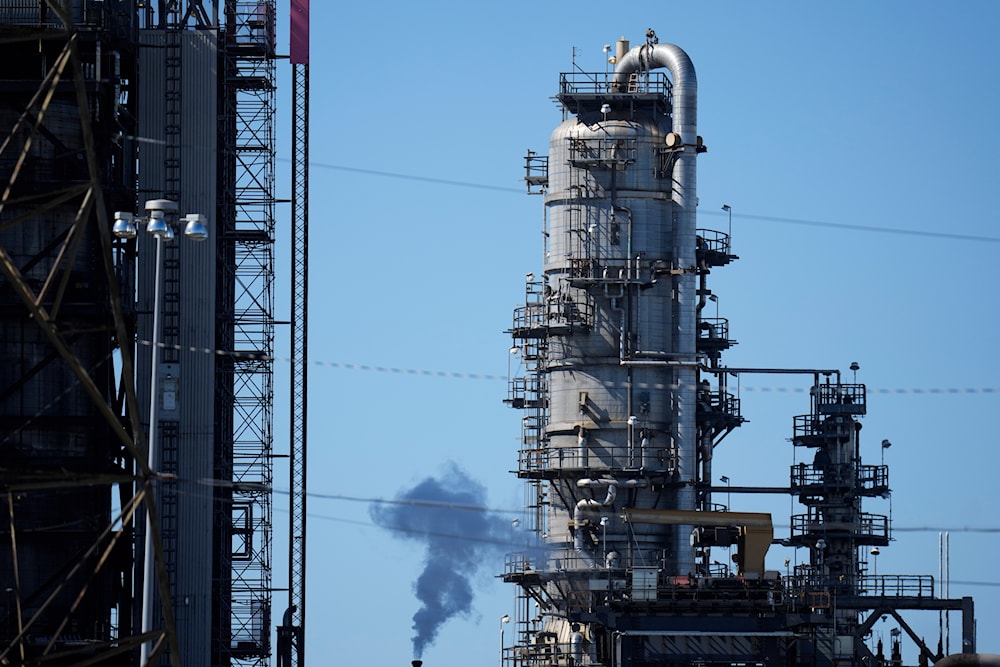
The BP Whiting Refinery is seen on March 9, 2026, in Indiana. (AP Photo/Erin Hooley)
Fuel prices could soar and stay elevated for months, potentially making groceries and other shipped goods more expensive. For consumers and businesses already feeling the pinch, higher costs may lead to reduced spending and slowing economic growth.
The New York Times (NYT) reported on Monday that economists are warning that this is the increasingly real and dire picture stemming from the US-Israeli war against Iran, now in its second week. While the war originated from President Trump’s decisions, it has quickly become a global economic headache, prompting foreign leaders to scramble for ways to contain potential fallout.
At the heart of market panic is a surge in oil prices, which at one point on Monday surpassed $100 a barrel. Energy is central to the global economy, and the spike has heightened fears of a prolonged conflict that could take a heavy financial toll worldwide, including on Americans.
According to the NYT, world leaders convened an emergency meeting of the Group of 7 countries on Monday, where finance ministers debated but ultimately decided against tapping national oil reserves to increase supply. Oil prices only began to calm later in the day after Trump suggested the war was nearing its end, falling to around $85 a barrel.
“I knew oil prices would go up if I did this,” Trump said at a Florida news conference. “They’ve gone up probably less than I thought they’d go up.”
Impact on gasoline prices for Americans
Despite the president’s comments, the effects were immediately felt. According to AAA, the national average price of a gallon of gasoline reached nearly $3.48 on Monday, a 16% increase from the previous week.
The surge initially rattled financial markets, causing sharp declines in the S&P 500 and other major indexes. Markets rebounded as the White House sought to reassure investors.
Taylor Rogers, a White House spokeswoman, called the spike a “short-term change” and added that prices would “drop dramatically once the objectives of Operation Epic Fury are achieved.”
Economists compare the fallout to the panic seen at the start of Trump’s trade war nearly a year ago. In both cases, experts warned of economic upheaval while world leaders reacted to potential global consequences.
Tim Mahedy, chief economist at Access/Macro, said, “This is a very concerning shock to consumers, who have been a driving force in the economy.” Consumer spending drives roughly 70 percent of US economic growth, and the energy shock comes at a time when many Americans have depleted savings.
“I am very concerned this could tip us into a recession if it persists,” Mahedy added.
Trump’s policy decisions and market reactions
According to the NYT, Trump has frequently downplayed economic risks associated with his policies, including military strikes on Iran. In past instances, he referred to rising gasoline prices as a “very small price to pay” for national security, contrasting sharply with his previous boasts about falling gas prices.
The administration has taken steps to reduce the economic impact. The US government recently offered limited protection and insurance for tankers crossing the Gulf and signaled a potential loosening of sanctions on Russian oil sales, including exports to India.
Economists note that this crisis adds to a sequence of supply shocks from tariffs and immigration policies under Trump. “This administration is a sequence of supply shocks,” Mahedy said. “This is coming on top of two other very significant supply shocks, tariffs, and immigration policy.”
Potential long-term economic consequences
The duration of the war is likely the key factor in determining the long-term economic impact. According to the report, shipping in the Gulf has been disrupted, affecting much of the world’s oil and gas supply. If the war continues for months, oil could remain above $100 per barrel, driving up prices and slowing global growth.
Bernard Yaros, lead US economist at Oxford Economics, said, “If $100-per-barrel oil is sustained, you’re going to see the impact most directly in less consumer spending.” He noted that low-income consumers would bear the brunt of these costs.
Gregory Daco, chief economist at EY-Parthenon, estimated that a prolonged war could increase global inflation by around two percentage points. In the US, inflation could surpass 4 percent, while GDP growth for 2026 could slow to 1.6 percent from an earlier projection of 2.4 percent.
Risk of inflation and recession
According to the report, even if the US strikes on Iran end within a few weeks, economists warn that the rise in gas prices and other disruptions may only temporarily ease. The longer the war persists, the more severe the economic consequences, with inflation rising and growth slowing, potentially tipping the US into a recession.
Chris Wright, US energy secretary, said that ship traffic through the Strait of Hormuz could resume soon. “We’re not too long, I think, before you will see more regular resumption of ship traffic,” he said on CNN’s State of the Union.
Kevin Hassett, director of the White House National Economic Council, described current disruptions as temporary: “From my early briefings about what was going to happen, and how it was going to affect the economy, it’s going way faster, it’s been way more successful, than I expected just listening to the briefings. There’s some disruption right now, but at the White House, we’ve got our eyes on the horizon.”


