
Russia's economy grew 10% over three years despite pressure
 3 Min Read
Russia's economy expanded by 10% in real terms over the past three years despite sanctions and external pressure, Economic Development Minister Maxim Reshetnikov said during a meeting with President Vladimir Putin.
-
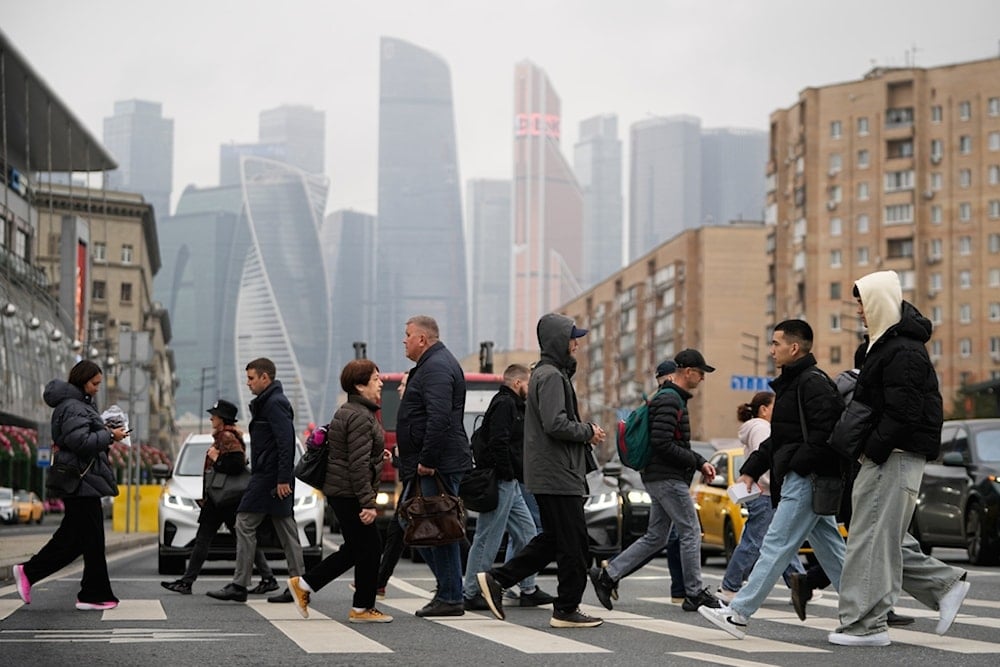
People cross a street while the skyscrapers of the Moscow City business district are partially covered in fog in Moscow, Russia, Wednesday, Oct. 8, 2025. (AP)
Russia’s economy has expanded by 10 percent in real terms over the past three years despite sweeping Western sanctions and a broader NATO-linked campaign to isolate Moscow economically, Russian Economic Development Minister Maxim Reshetnikov said during a meeting with President Vladimir Putin on Tuesday.
“Our economic growth over the past three years has been 10% in real terms,” Reshetnikov said during the meeting.
The minister stated that Russia continues to rank as the world’s fourth-largest economy when measured by purchasing power parity (PPP), while describing the country’s economic trajectory as cyclical, with periods of growth followed by phases of stabilization.
According to Reshetnikov, the Russian economy has shown resilience in the face of external pressure. He said it would be premature to speak about restoring higher growth rates, though he added that the overall situation is stabilizing.
The minister also pointed to a sharp decline in the share of imports within Russia’s gross domestic product, saying the country increasingly relies on domestic resources and internal production capabilities.
Sanctions pressure
Russia has faced one of the most extensive sanctions regimes imposed on a major economy since the escalation of the war in Ukraine in 2022. The European Union says its sanctions aim to weaken Russia’s economic base, restrict access to key technologies and markets, and limit Moscow’s ability to sustain the war.
The sanctions have targeted Russia’s banking sector, energy exports, industrial supply chains, aviation, technology imports, and state-linked entities, while NATO members have continued to expand military support for Ukraine. NATO itself states that its allies are providing assistance to Ukraine as part of its response to the war.
Moscow has repeatedly framed the confrontation as part of a wider Western and NATO-driven effort to weaken Russia strategically, pointing to NATO’s eastward expansion, military deployments near Russian borders, and the use of sanctions as instruments of economic pressure.
War economy
The war in Ukraine has reshaped Russia’s economy, producing both pressure and adaptation. Western restrictions triggered an initial shock in 2022, but Russia stabilized its financial system through capital controls, redirected trade toward Asia and the Global South, expanded import-substitution policies, and increased state spending on industry and defense.
This wartime economic model has helped sustain growth, but it has also created new pressures, including inflation, labor shortages, high interest rates, and greater dependence on state-driven military and industrial production. Reuters reported this week that Russia lowered its 2026 growth forecast to 0.4 percent, with officials citing sanctions, high interest rates, and war-related pressures.
Still, Reshetnikov’s remarks reflect Moscow’s broader message that Western sanctions and NATO-linked pressure have failed to collapse the Russian economy, instead accelerating Russia’s shift toward self-reliance and deeper economic ties with non-Western partners.
Read more: Russia oil revenue doubles in April as war on Iran fuels energy crisis


