
Russia oil revenue doubles in April as war on Iran fuels energy crisis
 3 Min Read
Russia’s oil tax revenue doubles to $9 billion as the war on Iran disrupts Strait of Hormuz flows, driving global prices and boosting Moscow’s income.
-
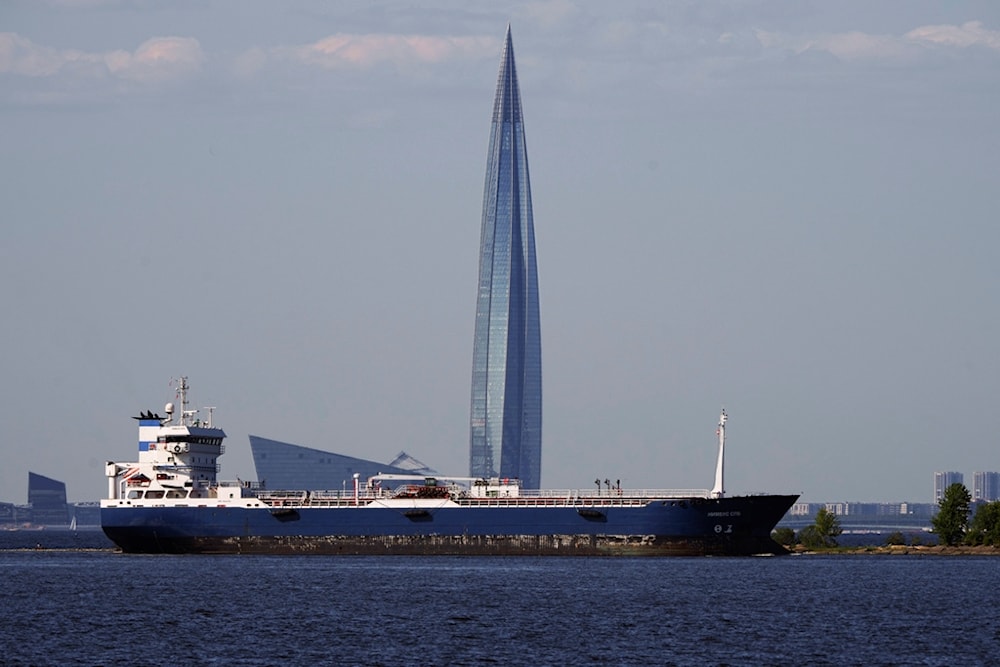
'Nimbus SPB', an oil products tanker, floats in the Finnish Gulf past the Lakhta Center skyscraper, the headquarters of Russian gas company Gazprom in St. Petersburg, Russia, on June 11, 2023 (AP)
Russia is set to see profits from its largest single oil tax double to $9 billion in April as a result of the oil and gas crisis caused by the joint US-Israeli war on Iran, according to Reuters calculations.
The news outlet states that its calculations are some of the first real proof of unexpected profits for Russia, the world's second-largest oil exporter, as a result of the war on Iran.
Russia’s oil and gas revenues rely heavily on production-based taxation. While export duties on crude were eliminated in early 2024 as part of a broader tax reform, the mineral extraction tax remains a key income source.
Reuters estimates indicate that this tax will rise to approximately 700 billion roubles ($9 billion) in April, up from 327 billion roubles in March and around 10% higher than the same period last year.
For 2026, Moscow has projected total revenues of 7.9 trillion roubles from this tax.
Strait of Hormuz disruption drives price spike
The escalation began after Iran limited traffic in the Strait of Hormuz following joint US-Israeli aggression at the end of February, only allowing vessels with no links to the hostilities against the Islamic Republic.
The strategic waterway accounts for roughly one-fifth of global oil and liquefied natural gas flows, making its disruption a major driver of the current crisis.
As a result, Brent crude prices surged past $100 per barrel, signaling one of the most severe energy shocks in recent years.
Rising crude prices boost Russian energy demand
The average price of Russia’s Urals crude rose to $77 per barrel in March, marking its highest level since October 2023, according to data from the economy ministry.
This represents a 73% increase from February levels and exceeds the $59 benchmark assumed in Russia’s state budget.
Moscow reported an increase in global demand for Russian energy, citing disruptions in international oil and gas markets.
Read more: Medvedev: Common sense prevailed in war, but 'Israel' not satisfied
Economic constraints temper gains
Despite these unexpected gains, analysts caution that the profits may be limited. Russia recorded a budget deficit of 4.58 trillion roubles, or 1.9% of GDP, in the first quarter of 2026.
Economists within Russia have also warned that 2026 may remain a challenging year despite short-term revenue gains.
The scale of Russia’s financial gains will depend on how long Iran utilizes its geographic leverage over the Strait of Hormuz against hostile forces.
Sustained disruption in the Strait could continue to support elevated oil prices, while any de-escalation may reduce the current windfall.


