
Putin warns Hormuz oil output could halt within a month
 3 Min Read
Putin warns that oil production reliant on the Strait of Hormuz could fully halt within a month, as the US-Israeli war on Iran drives prices toward $120.
-
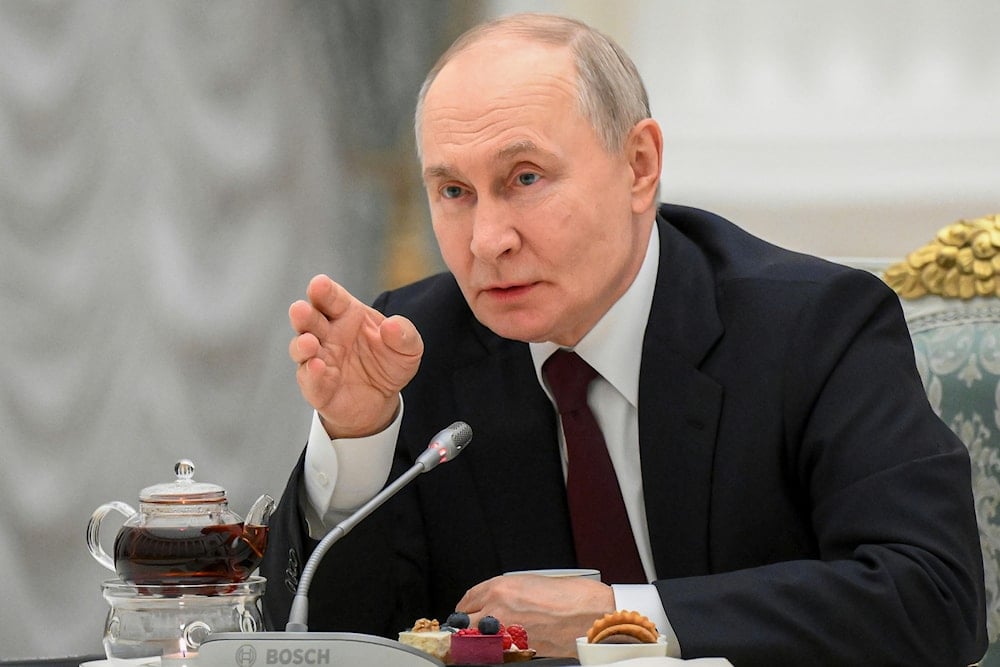
Russian President Vladimir Putin speaks to women representing various professional fields to congratulate them on the upcoming International Women's Day at the Kremlin, in Moscow, Thursday, March 5, 2026 (Sputnik via AP)
Russian President Vladimir Putin warned Monday that oil production dependent on the Strait of Hormuz could come to a complete standstill as early as next month, as the US-Israeli war on Iran continues to strangle one of the world's most critical energy corridors.
Speaking at a government meeting on global oil and gas markets, Putin said output tied to the strait had already begun to decline and that a full stop was imminent. "Oil production that relies on the use of the Strait risks coming to a complete halt as early as next month. It has already begun to decline," Putin said.
He described the route as "effectively closed" and signaled that Moscow intends to capitalize on the resulting supply vacuum, saying Russia would redirect its focus toward markets requiring increased supplies and "gain a foothold there."
Putin also reaffirmed Russia's role as a dependable energy exporter, pledging to maintain oil and gas supplies to what he called "reliable partners", naming not only Asia-Pacific nations but also Eastern European countries, including Slovakia and Hungary. "Russia is, and I will say this again, a reliable supplier of energy resources; it has always been this way," he said.
Russia's window of opportunity
As early as last Friday, Kremlin spokesman Dmitry Peskov had announced a "significant increase in demand" for Russian energy, just one week into the war.
Tanker traffic through the Strait of Hormuz had by then collapsed, crude tanker transits down 88% and liquefied petroleum gas vessels down 94%, according to analytics firm Kpler, forcing importing nations to scramble for alternatives and pushing Russia back to the fore as a key supplier.
Markets in freefall, recession fears mount
Putin's warning lands against a backdrop of accelerating global economic strain. Oil prices surged nearly 25% overnight, approaching $120 per barrel, their highest level in roughly four years. Brent crude reached $119.50 before pulling back, while West Texas Intermediate hit $119.48 before settling around $103.
Financial markets have reacted sharply. Japan's Nikkei 225 dropped more than 5%, and South Korea's KOSPI fell around 6%, with US S&P 500 futures also under pressure. Betting markets now place the probability of a US recession this year at 38%, up from 24% earlier this month.
Gas price analyst Patrick De Haan estimates an 80% chance the average US gasoline price will hit $4 per gallon within a month, a threshold that would compound already acute cost-of-living pressures on American households.
Washington dismisses the alarm
Despite the mounting evidence of economic damage, Washington has shown little urgency. Trump dismissed concerns about the financial fallout, framing higher oil prices as a "very small price to pay for US and world safety and peace." Energy Secretary Chris Wright echoed that line, calling the price surge "temporary," a characterization that has done little to reassure markets or allies.
Economists warn that if disruptions to Gulf shipping persist, the combined effects of energy price inflation, strained logistics networks, and weakening consumer spending could tip multiple regions into recession, an outcome, analysts note, that Washington's war has set in motion.


