
War on Iran forces Asian central banks into policy dilemma
 4 Min Read
Asian central banks are reassessing monetary policies as the US-Israeli war on Iran drives oil prices higher.
-
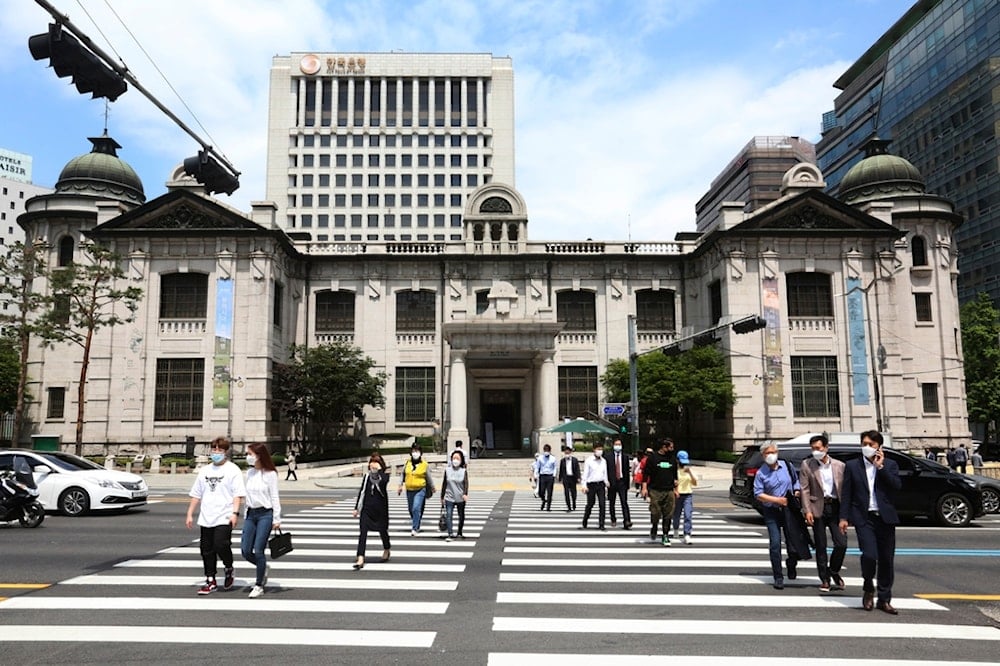
People wearing face masks walk by the headquarters of the Bank of Korea in Seoul, South Korea, Thursday, May 28, 2020. (AP Photo/Ahn Young-joon, File)
The ongoing US-Israeli war on Iran is forcing central banks across Asia to reassess their economic strategies, Reuters reported on Monday, as the conflict sends energy prices soaring and raises the risk of inflation across the region.
The reassessment comes as markets continue to react to disruptions in the Gulf, particularly around the Strait of Hormuz, one of the world’s most critical energy corridors. Earlier in the escalation, Iranian military officials warned that the strategic waterway was under the control of the IRGC, raising fears that shipping traffic could be severely restricted. Roughly 20% of globally traded oil normally passes through the Strait, with more than 80% of those exports destined for Asian markets, making the region especially vulnerable to any disruption in Gulf energy flows.
The report said policymakers are confronting a difficult choice between protecting economic growth and controlling price pressures triggered by the surge in oil costs. The shock has been particularly severe for Asian economies, many of which rely heavily on energy imports from West Asia and global trade routes that pass through the region.
Emerging Asian central banks are now reconsidering whether to cut interest rates, as cheaper borrowing could worsen inflation and accelerate capital outflows toward the United States, where investors have been seeking refuge in the dollar amid the expanding conflict.
Central banks dilemma
In India, the central bank is expected to focus on supporting economic activity by keeping borrowing costs low, according to sources cited by Reuters. However, the weakening of the national currency may require authorities to intervene in foreign-exchange markets to stabilize it.
“We don't see a possibility of a near-term rate hike in India - we do not see retail fuel prices moving higher immediately,” said Suvodeep Rakshit, economist at Mumbai-based Kotak Institutional Equities.
“At this stage, the immediate priority of the central bank will be what happens on FX. We expect them to continue intervening to curb volatility there. An afterthought will be the liquidity impact of that intervention and they will infuse liquidity as needed.”
Other countries in the region could also face policy reversals. Economists say Thailand and the Philippines may need to reconsider their previously dovish monetary stance as fuel costs climb and inflation risks grow.
“Many central banks will face a tough decision as they come under pressure from both markets and governments,” said Toru Nishihama, chief emerging market economist at Dai-ichi Life Research Institute in Tokyo. “With no clear end in sight to the conflict, the risk of stagflation is heightening day by day.”
Asia markets strained
Financial markets across Asia have already shown signs of strain amid the turmoil. In recent days, stock markets across the region recorded sharp losses as oil prices surged above $110 per barrel and investors assessed the economic consequences of potential disruptions to energy shipments from the Gulf.
The pressure is particularly acute for export-driven economies such as South Korea and Japan, where stable trade flows and affordable raw materials are essential for growth. Rising energy costs threaten to weaken industrial output and push consumer prices higher at the same time.
Economists warn that if the war on Iran continues to escalate, the resulting energy shock could test the resilience of financial systems worldwide.
International Monetary Fund Managing Director Kristalina Georgieva cautioned that policymakers must prepare for severe economic consequences if energy prices remain elevated.
“We are seeing resilience tested again by the new conflict in the Middle East,” Georgieva said at a symposium in Tokyo. “My advice to policymakers in this new global environment is think of the unthinkable and prepare for it.”
Read more: Iran warns of regional energy retaliation amid US-Israeli assault


