
Ceasefire shows Trump’s war on Iran boosted rivals, not US power
 5 Min Read
Experts and officials say the war on Iran has reshaped geopolitical calculations, raising doubts in allied capitals and encouraging closer alignment among US adversaries.
-
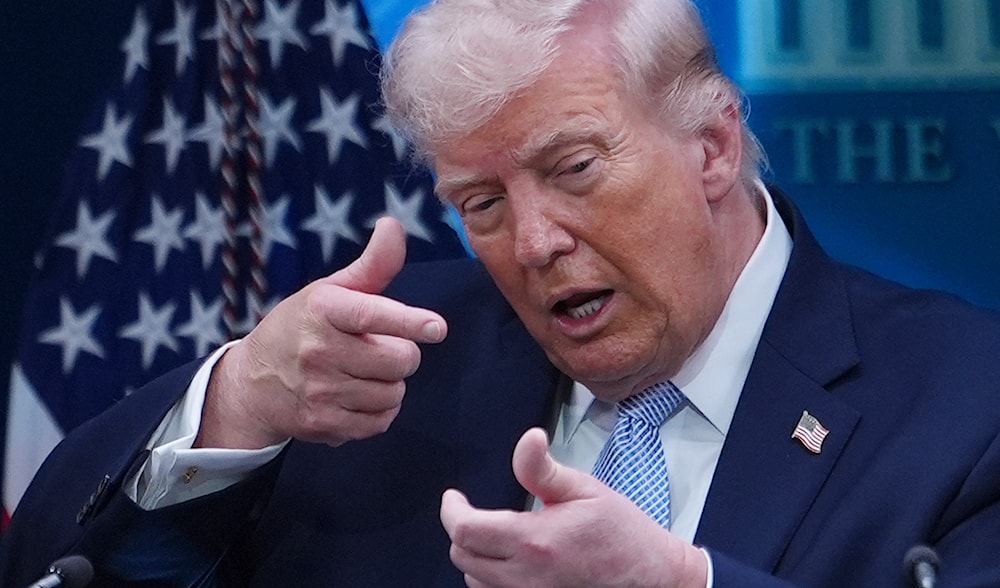
US President Donald Trump pretends to aim a sniper gun while speaking with reporters in the James Brady Press Briefing Room at the White House in Washington, April 6, 2026 (AP)
The ceasefire in Iran has strengthened perceptions among US adversaries and NATO allies that President Donald Trump’s war against Tehran represents a strategic failure and has instead strengthened China and Russia while undermining core US advantages, Bloomberg reported, citing individuals familiar with discussions in European and Middle Eastern capitals.
While Moscow and Beijing remain wary of American military and intelligence capabilities, they believe the war failed to compel Iran to surrender. Meanwhile, tensions within NATO, including Trump’s past threats to withdraw from the alliance, have deepened doubts over Washington’s long-term commitment to collective defense, as per the report.
The two-week ceasefire, mediated by Pakistan, is also expected to damage Trump’s credibility as a negotiator and may further discourage Russian President Vladimir Putin from making concessions in Ukraine, Bloomberg further reported, citing officials who spoke anonymously due to the sensitivity of internal assessments.
Iran seen as strategically stronger despite damage
“Although Iran has suffered huge physical damage and much loss of life, it emerges strategically stronger,” former UK National Security Advisor Peter Ricketts said. “The regime has survived. It has shown the massive leverage control of Hormuz gives them.”
European officials cautioned, as per the report, that a final ceasefire agreement had not yet been reached, but expressed concern that Iran could ultimately be perceived as the strategic winner despite heavy US and Israeli bombardment and the assassination of Iranian Leader Sayyed Ali Khamenei.
“It’s certainly not a victory in that the United States has nowhere achieved any of its military objectives,” Long Island University Director of International Relations Dalia Fahmy told Bloomberg TV. “Actually, the war has cost the United States much more than anticipated.”
Iranian military resilience and regional leverage
Officials and analysts said the Islamic Revolution Guard Corps remains intact and could become "more hardline" while rapidly rebuilding missile capabilities, Bloomberg reported.
Tehran, they added, may interpret the war as confirmation that its drone arsenal can disrupt Gulf security and that its influence over the Strait of Hormuz provides leverage capable of triggering global energy shocks.
European diplomats also said it remains unclear how significantly Iran’s nuclear program has been set back, claiming that Iranian leaders may now be further motivated to pursue nuclear weapons.
One European official raised concerns about future control of the Strait of Hormuz, pointing to language in the ceasefire announcement suggesting transit would occur in coordination with Iranian forces. If Iran gains the ability to regulate or charge passage through the waterway, officials warned, it could emerge in a stronger strategic position than before the war.
A person familiar with negotiations told Bloomberg that Iran is seeking long-term control over the waterway and aims to ensure future passage is managed under Iranian military coordination.
Regional and global diplomatic fallout
US allies are increasingly concerned about how the war is perceived across the Middle East, Africa, Asia, and South America, where Washington’s credibility may be damaged.
In the Gulf, officials reportedly expressed frustration that early warnings urging the Trump administration not to escalate were ignored. Some now fear that leaving Iran’s leadership intact after the war could be seen as a worse outcome, prompting Gulf states to diversify alliances due to concerns over US unpredictability.
Analysts also said Trump may have assumed earlier success in confronting Venezuelan President Nicolas Maduro would translate into similar outcomes in Iran, a belief they say has now been undermined.
More broadly, Trump’s rhetoric threatening to destroy Iran’s civilization is seen as weakening the US efforts to portray itself as a responsible global power, especially in contrast to rival powers frequently accused of human rights abuses. This, analysts warn, may push non-aligned countries closer to Russia and China over time.
Strengthening of rival blocs and geopolitical messaging
Officials said Russia, Iran, and China are likely to deepen cooperation following the war, further undermining US efforts to divide them, an approach sometimes referred to as a “reverse Kissinger".
Wu Xinbo, director at Fudan University’s Center for American Studies in Shanghai, described the campaign as a “serious setback” for Trump.
“When he comes to Beijing now, he’ll be frustrated and will realize that China will have to play an even larger role,” he stressed, speaking before the ceasefire.
State media in Russia and China have reportedly mocked Trump’s handling of the war, with officials pointing to the spread of the “TACO” meme, “Trump Always Chickens Out”, as evidence of growing adversary confidence in US inconsistency.
“There’s been a huge amount of damage, economic human cost that we haven’t really calculated yet,” Sanam Vakil, director of the Middle East and North Africa program at Chatham House, told Bloomberg TV. “Relations in the region have been set back, I would say, by a decade if not two.”


