
Ghalibaf, Vance to lead Iran-US talks in Islamabad on Friday
 4 Min Read
Iran's Parliament Speaker Ghalibaf will lead Tehran's delegation at Friday's Islamabad talks with US VP Vance, presenting a sweeping 10-point proposal covering nuclear issues, regional security, and sanctions relief.
-
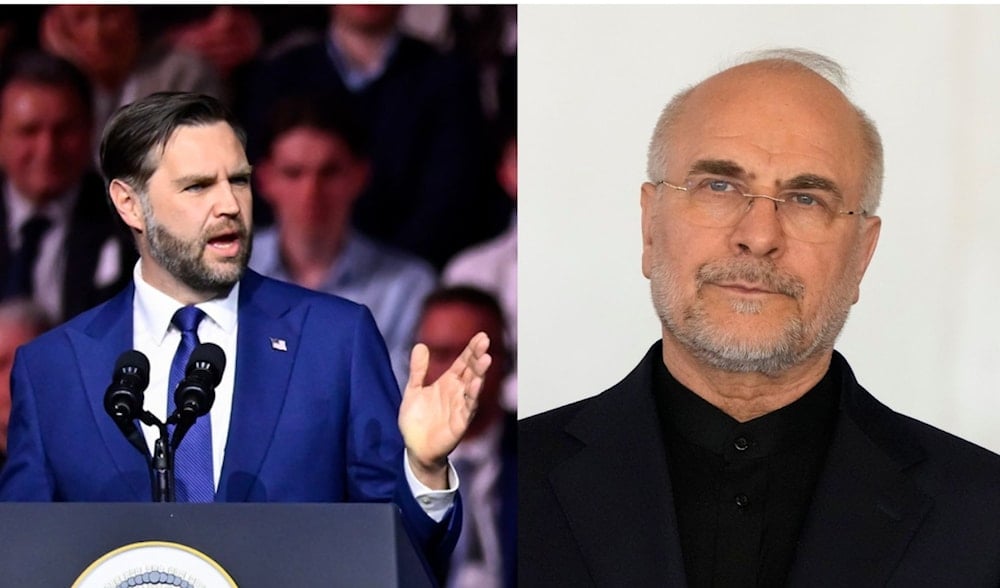
US Vice President JD Vance (L) in Budapest, Hungary, April 7, 2026 (AP/Denes Erdos); Iranian Parliament Speaker Mohammad Bagher Ghalibaf in Brasilia, Brazil, June 4, 2025 (AP/Eraldo Peres)
Iran will present a comprehensive 10-point proposal at Friday's negotiations in Islamabad, Pakistan, informed sources told the Iranian Students' News Agency (ISNA), with Parliament Speaker Mohammad Bagher Ghalibaf heading Tehran's delegation opposite a US team led by Vice President JD Vance.
The proposal's reported scope extends well beyond the nuclear file, encompassing regional security and the full architecture of primary and secondary sanctions imposed on Iran over the past 45 years.
The Islamabad talks follow a two-week ceasefire announced on Wednesday, under which Iran's armed forces agreed to suspend defensive operations contingent on a halt to US and Israeli attacks, while permitting safe passage through the Strait of Hormuz under Iranian military coordination for the duration of the truce.
Vance signals openness
Speaking during a visit to Hungary on Wednesday, Vance struck a cautiously optimistic tone ahead of the talks, saying an agreement to end the war was achievable if Tehran approached the negotiations in "good faith."
"If the Iranians are willing in good faith to work with us, I think we can make an agreement," he said, adding that Trump had instructed the entire negotiating team to earnestly pursue a deal.
Iranian participation was publicly confirmed the same day by Pakistani Prime Minister Shehbaz Sharif's office, which announced that President Masoud Pezeshkian had formally confirmed Tehran's attendance at the Islamabad talks.
Iran's terms on the table
The ceasefire was secured on Iranian terms.
Tehran's 10-point framework, which Iranian Foreign Minister Abbas Araghchi said the US had accepted as "a basis for talks," covers non-aggression guarantees, Iranian control over the Strait of Hormuz, recognition of Iran's right to uranium enrichment, the lifting of all primary and secondary sanctions, termination of all UN Security Council and Board of Governors resolutions, compensation for war damages, a full US military withdrawal from the region, and an end to military operations on all fronts, explicitly including Lebanon.
The Israeli regime has nonetheless unilaterally declared that the ceasefire does not encompass Lebanon.
The delegations
Ghalibaf, a former IRGC general, former Tehran mayor, and six-year incumbent as Parliament Speaker, is widely regarded as among the most senior civilian officials in the Iranian Government.
Trump has spoken of Ghalibaf in notably warm terms. Without initially naming him, Trump described his interlocutor as "the man who I believe is the most respected and the leader," adding that the new Iranian negotiating team had been "much more reasonable" than those before them.
Vance's presence across the table is, in part, an Iranian preference. Regional sources told CNN that Tehran viewed Vance as more sympathetic to ending the conflict than other US officials, a contrast with earlier formats involving envoy Steve Witkoff and Jared Kushner, whom Iran reportedly refused to engage following their repeated deception during previous negotiation rounds.
Pakistan's road to host talks
Pakistan's role as host is the product of weeks of diplomatic positioning. As early as March 3, Foreign Minister Ishaq Dar told parliament that Islamabad was ready to facilitate dialogue between Washington and Tehran, and revealed that Pakistan had already pushed back against Washington's zero-enrichment demand, proposing instead a monitored surveillance framework that Iran received positively.
Islamabad then stepped up its regional coordination, hosting foreign ministers from Turkey, Saudi Arabia, and Egypt on March 29 in a concerted push to end the war, following an earlier consultation in Riyadh on March 19.
The ceasefire itself came after PM Shehbaz Sharif and Field Marshal Asim Munir personally intervened with Trump, with Vance having built a direct working rapport with Munir throughout the mediation effort. Araghchi specifically thanked Sharif and Munir for their "tireless efforts to end the war in the region" in Wednesday's ceasefire statement.
Talks are scheduled for Friday, April 10, in Islamabad.


