
US crude exports slide to eight-month low as Gulf supplies recover
 4 Min Read
US crude exports fell to an eight-month low in July as Middle Eastern oil supplies recovered, domestic refinery demand increased, and American barrels became less competitive abroad.
-
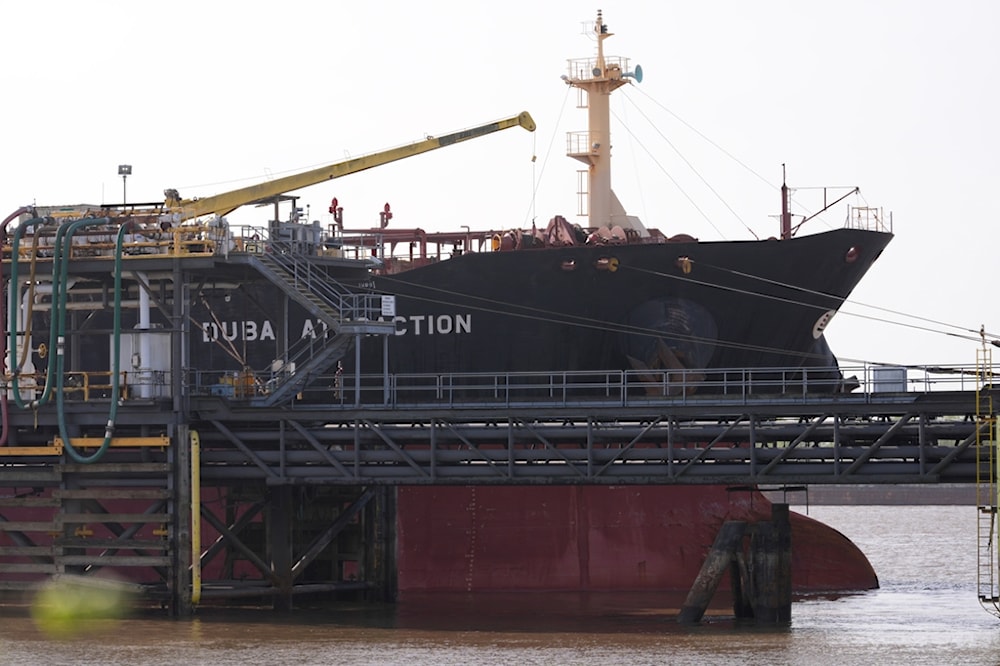
The crude oil tanker Dubai Attraction is moored in the Mississippi River at the IMTT dock in Saint Rose, La., Thursday, April 2, 2026 (AP)
US crude oil exports fell to their lowest level in eight months in July after an Iranian-approved arrangement facilitated tanker movement through the Strait of Hormuz, restoring regional supplies and eroding Washington’s wartime export gains.
Reuters reported that shipments averaged 3.66 million barrels per day, down from a record 5.7 million bpd in May.
The shift underscores Iran’s continued strategic influence over global energy flows via the Strait of Hormuz, a critical oil transit chokepoint.
US exporters had previously benefited from disrupted Middle Eastern supply chains during the war on Iran, which pushed Asian and European buyers toward American crude.
That advantage began to reverse after a June understanding between Tehran and Washington on navigation through the Strait, which enabled stranded tankers to resume movement and brought additional regional barrels back to market.
Asian and European demand weakens
The proportion of US crude exports bound for Asia fell to approximately 40% in July, compared with 52% the previous month.
Japan and South Korea, among the largest buyers of American crude, both reduced their purchases significantly.
Shipments to Japan fell by 67% from their May peak to 324,000 bpd in July, while exports to South Korea declined by 39% to 474,000 bpd.
European purchases also weakened. US crude deliveries to the continent averaged around 1.7 million bpd in July, down from as much as 2.5 million bpd in May.
Exports drawn from the US Strategic Petroleum Reserve slowed as well, totaling just 31,000 bpd. According to Kpler data, the two cargoes were delivered to France and Peru.
Domestic and pricing pressures add to decline
Strong demand from US refiners further reduced the amount of oil available for foreign markets.
Rohit Rathod, an analyst at Vortexa, said elevated refinery activity had kept more barrels inside the United States.
The four-week average refinery utilization rate reached approximately 96.3%, its highest level since 2018, according to the US Energy Information Administration.
Crude input into American refineries also rose to its highest level in about seven years.
Pricing conditions added further pressure. The discount of US West Texas Intermediate crude to the international Brent benchmark narrowed to an average of $4.17 per barrel in June, compared with $8.16 in May.
A smaller discount makes US crude less competitive for foreign buyers because most American grades are priced in relation to WTI.
Shipments expected to rebound
Market analysts expect US exports to recover in August and September after the gap between WTI and Brent widened again in July, reaching as much as $5.42 per barrel.
Recent shipping activity along the US Gulf Coast has also increased, with several Very Large Crude Carriers booked for voyages to Asia and Europe. Aframax tankers have also been reserved for export shipments.
A Very Large Crude Carrier can transport up to two million barrels, while an Aframax vessel typically carries approximately 750,000 barrels.
“U.S. exports are clearly on their way up for crude,” Shelton said.
Vortexa expects exports to rise above four million bpd in August and September, although volumes are not projected to return to the levels exceeding five million bpd recorded in April and May.
Energy Aspects estimated that shipments could average approximately 4.58 million bpd in August before easing slightly to 4.45 million bpd in September.
The United States could be required to send additional supplies abroad should the war intensify and disrupt regional production or shipping routes.
Analysts estimate that the country can export around six million bpd at most, with further growth constrained by pipeline capacity, tanker availability and terminal loading schedules.
Read more: Iran turns Strait of Hormuz into long-term strategic lever: RS


