
US debt tops $40 trillion, doubling in under a decade
 4 Min Read
US public debt hit $40.05 trillion this week, more than doubling since 2017 as spending under both Trump and Biden outpaced revenue.
-
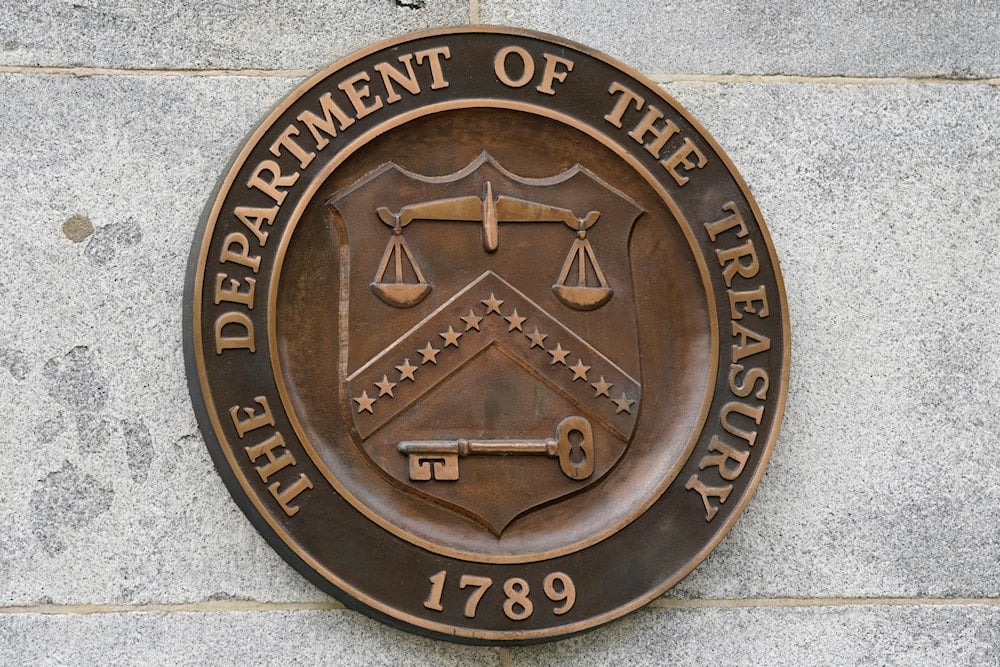
The United States Department of the Treasury's seal outside the US Treasury Department building in Washington on May 4, 2021. (AP)
Total US public debt surpassed $40 trillion for the first time this week, the Treasury Department said Wednesday, a milestone reached less than five months after debt crossed $39 trillion and one budget watchdogs say signals a deepening fiscal crisis.
Treasury's daily statement put total debt outstanding at $40.047 trillion as of Tuesday, made up of $32.266 trillion in securities held by the public and $7.782 trillion in intra-governmental debt.
A debt load that has doubled in under a decade
The total has more than doubled since US President Donald Trump's first inauguration in January 2017, when it stood at $19.95 trillion. Roughly a third of that growth came during two years of pandemic-era borrowing under Trump and then US President Joe Biden, while the rest reflects a longer-running mismatch between spending and revenue under both administrations.
Debt grew by $7.8 trillion over Trump's first term, more than half of it in his final nine months in office, as COVID-19 spending surged, and by $8.4 trillion under Biden, driven by pandemic recovery spending along with infrastructure and clean-energy outlays.
Since Trump returned to office in January 2025, debt has grown a further $3.8 trillion, bringing the combined increase across his two terms to $11.6 trillion. The nonpartisan Congressional Budget Office estimates Trump's signature second-term tax-and-spending law, the One Big Beautiful Bill Act, will add another $4.7 trillion on its own.
Maya MacGuineas, president of the Committee for a Responsible Federal Budget, noted that debt has quadrupled in under 20 years, after taking until 1981 to reach its first trillion.
"It is staggering how predictable the fiscal decline of a global power can become," she said.
Markets push back
Investors are demanding more to hold US debt. A $25 billion sale of 30-year bonds last week drew the highest yield since 2021, and long-bond yields climbed Tuesday to their highest levels in nearly two decades.
US Treasury Secretary Scott Bessent responded Wednesday by doubling the size of the department's buybacks of 10- to 30-year Treasuries, to at least $4 billion per operation.
Meanwhile, demand from abroad has also been softening as foreign investors, who own roughly a third of outstanding Treasuries, have pulled back over the past year, Oxford Economics analyst John Canavan noted this week, shifting more of the buying toward price-sensitive domestic investors.
Interest costs now outrank Medicare
The strain is showing up in the budget itself. The government posted its fourth-largest monthly shortfall on record in July, $432 billion, as tariff refunds kept customs revenue in negative territory for a third consecutive month while Social Security and Medicare spending on seniors continued rising.
With two months left in the fiscal year, the deficit for fiscal 2026 has already exceeded the full-year total for fiscal 2025.
Roughly 60% of the government's $7 trillion in annual spending goes to mandatory programs, Social Security, Medicare, Medicaid and veterans' benefits, that rise automatically with the cost of living, even as Trump's cost-cutting push, including the early agency layoffs ordered through the Department of Government Efficiency, has mostly targeted the much smaller discretionary portion of the budget.
Interest payments on the debt, now about $1.1 trillion a year, exceeded Pentagon funding for the first time in fiscal 2025; over the first ten months of fiscal 2026, they overtook Medicare to become the second-largest line in the federal budget, behind Social Security.
Both programs face growing strain as the retirement and healthcare costs of the "baby boom" generation rise faster than payroll and income tax revenue can cover them.


