
US national debt crosses 100% of GDP for first time since World War II
 4 Min Read
The US national debt has surpassed the size of the economy, crossing 100% of GDP as federal borrowing continues to rise.
-
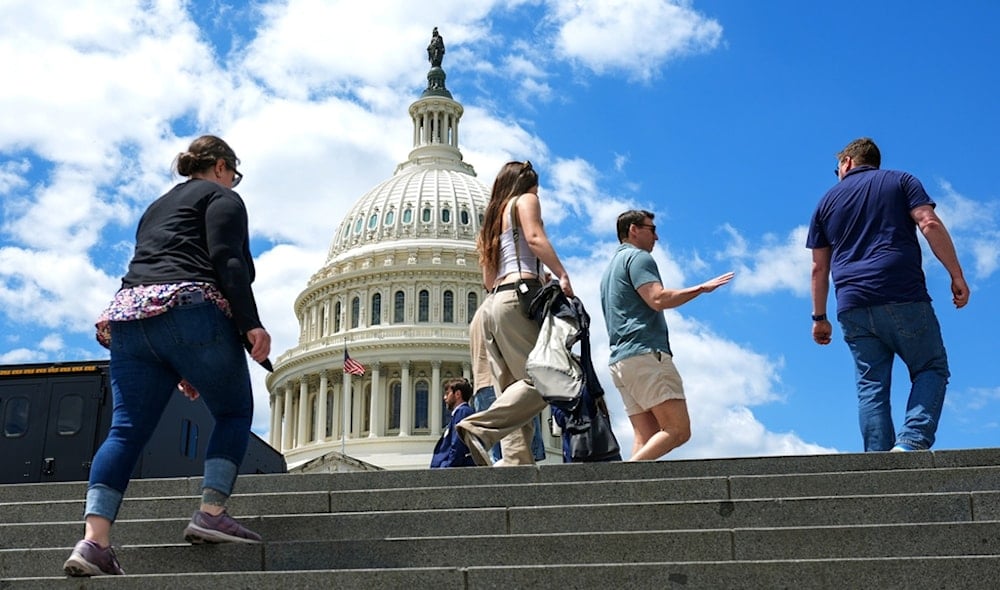
Tourists visit the US Capitol, Thursday, April 30, 2026, in Washington (AP)
The United States’ national debt has surpassed the size of its economy for the first time since the aftermath of World War II, Fox Business reported, citing newly released federal data.
Figures published Thursday by the Bureau of Economic Analysis show that debt held by the public reached $31.27 trillion as of March 31, while nominal gross domestic product (GDP) stood at $31.22 trillion over the 12 months ending in March. The data place public debt above 100% of GDP, a key threshold used by economists to assess government borrowing relative to economic output.
The ratio, which excludes debt held within government accounts, is widely viewed as a more accurate measure of fiscal burden. The latest figures bring the US close to its post-World War II peak of 106%, recorded in 1946 as the country transitioned from wartime spending.
Projections from the Congressional Budget Office indicate that debt levels will continue rising in the coming years. The agency forecasts that public debt will reach 108% of GDP by 2030 and climb further to around 120% within a decade, driven by persistent budget deficits and rising borrowing costs.
The CBO also warned that debt is expected to grow faster than the economy, a trend that could weigh on long-term economic performance. Higher debt levels may curb private investment, slow income growth, and increase interest expenses tied to servicing government obligations.
Sustained fiscal imbalances, not extraordinary circumstances
Maya MacGuineas, president of the Committee for a Responsible Federal Budget, said the current trajectory reflects sustained fiscal imbalances rather than extraordinary circumstances such as global conflict.
“With debt now above 100% of GDP, it's only a matter of time until we pass the all-time record of 106% reached in the immediate aftermath of World War II,” she said.
MacGuineas warned that rising debt could strain public finances and increase economic risks, including higher interest rates and inflationary pressures, while also limiting the government’s ability to respond to future crises.
She urged policymakers to curb deficits by reducing borrowing and offsetting new spending or tax cuts, adding that stabilizing debt levels would require significant fiscal adjustments in the years ahead.
Oil prices hit four-year high as Trump vows to keep Hormuz blockaded
Against this backdrop of mounting fiscal strain in the US, broader economic pressures are also intensifying on the global stage. Energy markets, in particular, are reacting sharply to renewed geopolitical tensions, adding another layer of uncertainty for policymakers and investors alike.
Oil prices surged to their highest level in nearly four years on Thursday, driven by a lack of progress toward reopening the Strait of Hormuz and continued geopolitical tensions following the late-February US-Israeli war on Iran.
Brent crude rose as much as 4.3% to $123.11 per barrel, marking a ninth consecutive day of gains, the longest winning streak since May 2022.
The rally has pushed oil prices up more than 100% this year, with momentum further supported after US President Donald Trump told Axios he would maintain a naval blockade on Iranian ports until securing a nuclear agreement with Tehran.
The spike in energy prices weighed on broader market sentiment, offsetting gains fueled by strong earnings in the technology sector. Futures for the Nasdaq 100 Index pared earlier advances to 0.3%, down from as much as 1%, while MSCI’s Asia Pacific shares index fell 1%.
Investors appeared increasingly cautious as rising oil prices and geopolitical risks tempered optimism from major tech earnings.
Bond markets also came under pressure, with rising oil prices and a hawkish stance from the Federal Reserve reducing demand for fixed-income assets. US 10-year Treasury futures declined for a fourth straight session, with yields holding near their highest levels since July. Japan’s 10-year government bond yields climbed to levels not seen since 1997, reflecting broader global shifts in borrowing costs.
Read more: Trump approval sinks to new low as war drives cost-of-living crisis


