
US eases PDVSA sanctions to boost Venezuela oil output
 5 Min Read
US authorizes transactions with Venezuela’s PDVSA to boost oil output and investment. Experts see this could be part of a move to keep oil prices down amid the war on Iran.
-
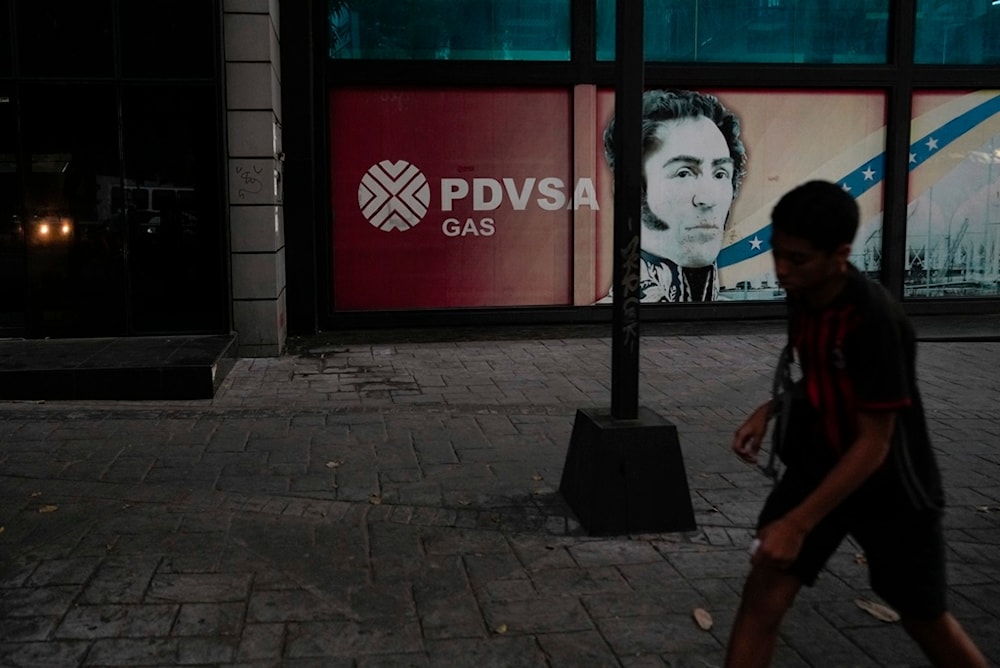
A pedestrian walks in front of a sign of Petroleos de Venezuela, S.A, PDVSA, and an image of Venezuelan independence hero Simon Bolivar, in Caracas, Venezuela, March 20, 2023. (AP Photo/Ariana Cubillos)
The United States has issued a broad authorization allowing companies to conduct business with Venezuela’s state-run oil firm, PDVSA, marking a significant step in what the US alleges are efforts to revive the country’s oil sector and increase crude output.
However, the move is taking place amid a rise in global oil prices caused by the closure of the Hormuz Strait amid the war on Iran.
The move is expected to facilitate investment and potentially expand Venezuela’s production capacity over the longer term, while maintaining strict financial and legal controls.
The US Treasury issued a general license permitting transactions with PDVSA, provided they comply with US laws and specific conditions.
“This license will benefit both the United States and Venezuela, while supporting the global energy market by increasing the supply of available oil. It will also help incentivize new investment in Venezuela's energy sector,” a Treasury spokesperson said.
The authorization requires that payments related to PDVSA dealings be directed to accounts controlled by the US Treasury, and that contracts include dispute resolution mechanisms under US jurisdiction.
Sanctions easing follows Maduro capture
Washington has been gradually easing sanctions on Venezuela since January, when US forces kidnapped President Nicolas Maduro.
As part of this shift, the US government has taken control of the country’s oil sale proceeds through a designated fund, signaling a restructuring of how Venezuela’s energy revenues are managed under sanctions relief.
Read more: Venezuela plans oil reforms to boost production, attract investors
Oil exports near pre-blockade levels
Venezuela’s oil exports have recently approached pre-blockade levels, with March shipments forecast at around 900,000 barrels per day based on ship tracking data.
Production has been supported by partnerships with companies such as Chevron, Vitol, and Trafigura, which have played a central role in sustaining output amid sanctions.
Despite the easing of restrictions, analysts caution that Venezuela’s ability to significantly increase production remains constrained.
“The reality is, Venezuela doesn't have the infrastructure, it's not like it has the ability to just start ramping up output of oil,” said Brett Erickson of Obsidian Risk Advisors.
Industry experts emphasize that boosting output will require infrastructure repairs, expansion of oil and gas projects, and new supply agreements, many of which are still under negotiation.
Legal and financial restrictions remain
The license does not extend to all financial instruments. Transactions involving Venezuelan bonds remain prohibited, and restrictions continue on any transfer of equity in PDVSA’s US-based subsidiaries, including PDV Holding and Citgo entities.
The US Treasury also noted that “a specific license will be required before any sale is executed” in relation to a Delaware court-approved sale involving PDV Holding.
Additionally, the authorization excludes dealings with entities under unilateral US sanctions, including firms from China, Russia, Iran, Cuba, and the DPRK, as well as transactions deemed not “commercially reasonable.”
Global firms eye return despite risks
Major international energy companies, including Shell, Repsol, Eni, and BP, are exploring opportunities to resume or expand operations in Venezuela.
However, analysts note that attracting large-scale investment will depend on the establishment of a stable legal framework and sufficient fiscal incentives, which some companies say remain incomplete despite recent reforms.
The policy shift is part of a broader effort by the US administration to attract up to $100 billion in investment into Venezuela’s oil sector, which has been weakened by years of sanctions, underinvestment, and structural challenges.
While some smaller investors are pursuing early deals, larger firms remain cautious, weighing potential returns against legal and political risks.
War on Iran's effect on global oil supply
The ongoing and intensifying war on Iran has seen energy infrastructure, critical to regional and global energy needs, come under fire. A major escalation came with coordinated US-Israeli strikes on Iran's Southern Pars gas field, the largest in the world, which triggered a halt in production while causing energy markets to immediately react.
Responding to these aggressions, Iran issued urgent evacuation warnings for civilians staying near major energy and petrochemical facilities across the Gulf region, stating that these sites are legitimate military targets, and later targeted the US-linked Ras Laffan oil field in Qatar.
"These centres have become direct and legitimate targets and will be targeted in the coming hours. Therefore, all citizens, residents, and employees are requested to immediately leave these areas and move to a safe distance without any delay," the warning read.
As a result of the escalating US-Israeli military operations, Iran closed one of the world's key shipping corridors and a vital artery for global oil transport, the Strait of Hormuz, causing oil prices to surge from $70 to $110 within 10 days of its closure.
As the War on Iran continues, global oil exporting falls deeper into disarray with Gulf energy producers facing daily revenue losses estimated between $400 million and $640 million due to disruptions.
The chokehold on production has seen multiple nations relying on emergency oil reserves to attempt to keep prices low as economies scramble to contain the economic fallout.


