
US households squeezed by Iran war fuel shock: FT
 6 Min Read
Rising fuel costs linked to the US-led war on Iran are eroding the economic boost from Trump’s tax refunds.
-
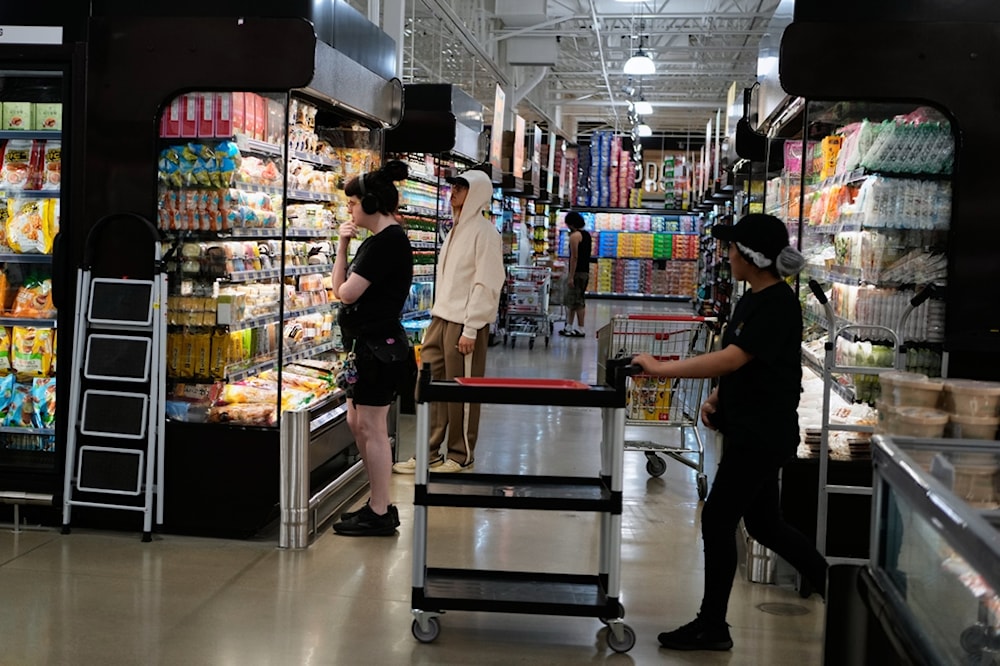
People shop at a grocery store in Schaumburg, Ill., Thursday, May 14, 2026 (AP)
Large tax refunds issued under US President Donald Trump’s 2025 budget legislation are beginning to lose their effect as fuel prices surge amid the economic fallout of the US-led war on Iran, placing growing financial pressure on American households, according to economists, retailers, and financial analysts interviewed by the Financial Times.
Executives and economists warned that consumer spending, which has remained a key pillar of the US economy in recent years, may begin slowing during the coming months as inflation accelerates and household purchasing power weakens.
Tax refunds temporarily supported spending
Analysts said many Americans continued spending heavily earlier this year after receiving sizable tax refunds tied to Trump’s “One Big Beautiful Bill Act,” which became law in July 2025.
According to IRS estimates cited in the report, average refunds reached nearly $3,500 per return.
Major retailers, including Walmart and Target, said the refunds helped sustain sales despite persistent inflation and elevated borrowing costs.
“The tax refunds have been largely erased by the increase in Middle East price pressures,” said Gregory Daco, chief economist at EY Parthenon. “The longer the conflict lasts, the more we move to an adverse scenario where inflation proves more persistent and erodes consumer spending growth.”
Consumer spending accounts for roughly two-thirds of US economic output and has been one of the main reasons the United States outperformed many other developed economies after the pandemic.
“One of the key reasons the economy has remained so resilient to higher interest rates, elevated inflation and repeated shocks in recent years is that households have stayed in solid financial shape, allowing consumers to keep spending even as job and income growth has slowed,” said Brian LeBlanc, head of economic analysis at PNC Bank.
Retailers warn of slowdown ahead
Several major companies indicated that the economic boost generated by tax refunds is beginning to fade as fuel and transportation costs absorb a larger portion of household budgets.
Lowe’s chief financial officer Brandon Sink said the retailer still expects additional spending in June, suggesting some consumers may have reserved portions of their refunds “given the uncertainty."
At the same time, executives warned that rising gasoline costs could increasingly weigh on discretionary spending during the second half of the year.
Jim Lee, chief financial officer at Target, said the “upside” benefit from the tax refunds “will be fading over the rest of the year” as the costs of the war weigh on US households.
Advance Auto Parts chief executive Shane O’Kelly also warned that demand could weaken before the peak summer driving season as the company “transition[s] beyond the recent tax refund tailwinds”.
War on Iran drives fuel, food inflation
Pressure on consumers has intensified since the regional conflict escalated on February 28, with disruptions around the Strait of Hormuz affecting global oil shipments.
Analysts cited in the report said fuel prices in the United States have climbed sharply as US actions and subsequent Iranian retaliations disrupted shipping flows through the strategic waterway, which handles a significant share of global crude exports.
Data tracking millions of US households reportedly showed gasoline spending rising nearly 40% compared with the same period last year.
“Gas prices remain elevated and that pressure is real for families,” said Bob Eddy, chief executive of warehouse retailer BJ’s Wholesale Club. “To put this in further context, in April alone, our members spent $143mn more at our pumps than they did a year ago.”
The increase in diesel prices has also pushed transportation costs higher, contributing to rising grocery prices across the United States.
According to the report, grocery prices rose 2.9% in April, while fruit and vegetable prices climbed more than 6%.
Wage growth falls behind inflation
Economists warned that inflation is now rising faster than wages, reducing real earnings for many workers and increasing financial strain on middle- and lower-income households.
“By our reckoning, wage growth has steadily lost ground relative to the pace of inflation since the middle of last year,” said Nathan Sheets, global chief economist at Citigroup.
“First President Trump’s tariffs and, more recently, Iran-related pressures on oil and commodity prices have pushed up prices relative to wages.”
Michael Pearce, chief US economist at Oxford Economics, said the economic effects of the war were likely to weaken growth momentum rather than immediately trigger a recession.
“It’s going to take the shine off what would otherwise have been a very good year for the US economy,” Pearce said, describing the slowdown as “a speed bump” for growth.
Economic divide and consumer anxiety deepen
The report also pointed to widening inequality in the impact of the crisis, noting that wealthier Americans benefited more heavily from Trump’s tax cuts while spending a smaller share of their income on fuel.
Bank of America estimates cited in the report suggested that tax rebates for top earners increased roughly 13%, compared with about 6% for lower-income households.
“You’re getting a disproportionate benefit from these refunds flowing to the households that are least impacted by the inflationary pressures,” said Mike Reid, chief economist at RBC.
“The folks who are feeling the pinch right now and perhaps seeing a little bit more of that stress . . . It’s really the middle-income folks,” he said.
Consumer confidence sinks
Consumer confidence indicators have also deteriorated sharply in recent months.
Surveys conducted by the University of Michigan and the Conference Board showed declining sentiment as more households reported concerns about inflation and financial stability.
“The sentiment has been pretty negative across almost every age group, almost every demographic,” said Tarang Amin, chief executive of Elf Beauty, which sells brands such as Rhode and Naturium.
“I would say it’s across the board in terms of fears,” Amin said. “You see consumer sentiment [is] low. We see fears on inflation, the costs consumers are bearing.”
Figures from the Federal Reserve Bank of New York also showed rising delinquency rates on credit cards, student loans, and auto loans, adding to concerns that financial stress among ordinary Americans is intensifying.
John David Rainey, Walmart’s chief financial officer, said that while wealthier consumers continued “spending with confidence,” lower-income households were becoming increasingly cautious and financially strained.
The low-income customer, he said, was “more budget conscious and perhaps navigating financial distress”.
Read more: The war on Iran is hurting the US economy more than Trump admits


