
US war on Iran forces Qatar to slash spending as LNG revenues plunge
 5 Min Read
Qatar has imposed major domestic budget and overseas aid cuts as war-related damage and disruption to LNG exports drive a sharp decline in state revenues.
-
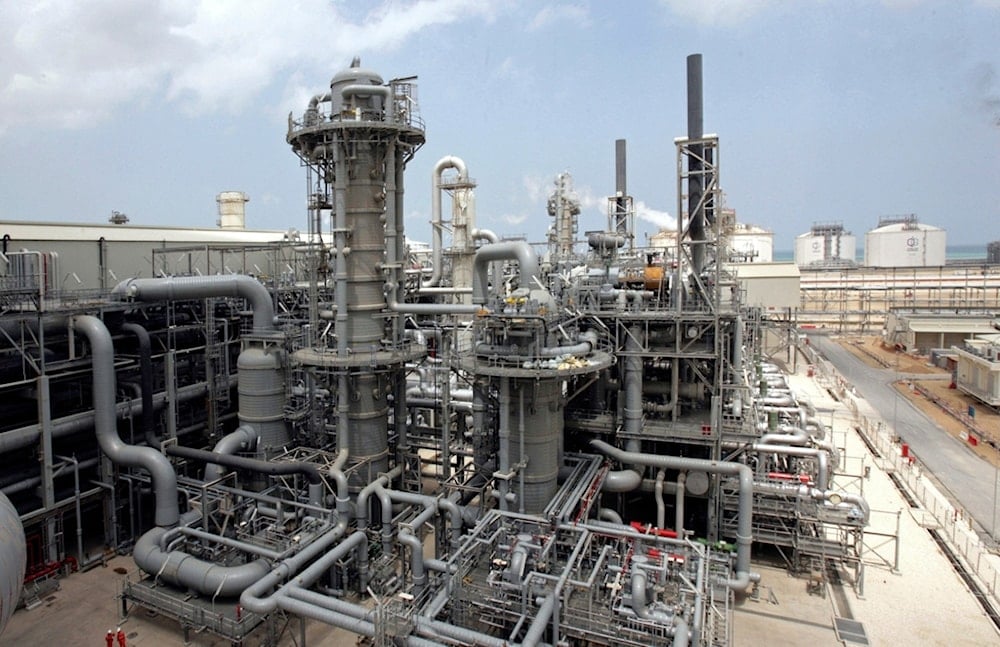
This April 4, 2009, file photo shows a gas production facility at Ras Laffan, Qatar (AP)
Qatar has sharply reduced government spending and scaled back its overseas aid commitments as the economic fallout from the US-Israeli war against Iran weighs heavily on the Gulf state's gas-dependent economy.
Government ministries and departments have seen budget reductions of as much as 30%, while allocations for foreign assistance have been cut by roughly 85%, according to three people briefed on the measures cited by the Financial Times.
The retrenchment comes as Qatar faces a steep decline in liquefied natural gas revenues after damage to key energy infrastructure and persistent disruption to shipping through the Strait of Hormuz.
Qatar, one of the world's largest LNG exporters, has been particularly exposed to the conflict because nearly all of its energy exports depend on passage through the strategic waterway. Unlike Saudi Arabia and the United Arab Emirates, which can divert some crude through pipelines bypassing Hormuz, Doha has fewer alternatives.
Economic pressure mounts on Doha
The International Monetary Fund expects Qatar's gross domestic product to contract by 8.6% this year, the sharpest decline projected among the six Gulf Cooperation Council states.
Tarik Yousef, a senior fellow at the Middle East Council on Global Affairs, said Doha could be forced to consider even deeper reductions if the war extends into the final months of the year.
“The authorities have managed the crisis effectively, but the hit has been massive. They have been drawing on accumulated financial buffers to keep the economy going and maintain liquidity. But ultimately, that leaves a substantial hole in the budget.”
Qatar's 2026 state budget stands at roughly $61 billion, although it remains unclear how much expenditure has been affected by the cuts announced across government departments.
Despite the pressure, Doha retains substantial reserves. The Qatar Investment Authority manages assets estimated at around $500 billion, giving the government significant capacity to absorb short-term losses.
A Qatari official said the country remained capable of weathering the disruption.
“Qatar is well-equipped to navigate the economic situation in the region,” the official said. “Our resilience through past crises, including the GCC crisis [the embargo] and Covid-19, gives us the capacity to weather the current one without changing our long-term economic trajectory.”
LNG sector bears brunt of war
The pressure on Qatar intensified within days of the beginning of the US-Israeli war against Iran in February.
An Iranian drone and missile attack targeted the Ras Laffan industrial complex, home to the world's largest LNG export facility, four days after the war erupted. A second strike in March further damaged the site, cutting Qatar's export capacity by 17%.
Repairs to some of the affected infrastructure could take as long as five years, according to the report.
At the same time, reduced traffic through the Strait of Hormuz has compounded the damage by making it more difficult for Qatar to move LNG to international markets.
Loss costing Qatar, Kuwait between $1.5bln, $2 bln a week
Farouk Soussa, Middle East economist at Goldman Sachs, estimated that the loss of energy-export revenue is costing Qatar and Kuwait between $1.5 billion and $2 billion a week.
“It’s a very large setback for the Gulf states — it’s extremely costly and there are a lot of losses that have to be borne by the governments,” Soussa said. “Most are wealthy and can absorb it, but the question that’s difficult to answer is whether there’s going to be a long-term impact from this and how much of a drag it’s going to be on potential or future growth.”
Qatar has partly cushioned the decline through its $10 billion Golden Pass LNG venture in the United States with ExxonMobil, which began exporting gas in April.
Before the war, Doha had been preparing to benefit from a $30 billion expansion of the North Field, the world's largest gasfield. The project was expected to raise Qatar's production capacity to 126 million tonnes annually by 2027.
Authorities are continuing work on the expansion so the country can rapidly increase exports if a settlement eventually restores normal shipping conditions.
Overseas aid also curtailed
The fiscal pressure is extending beyond domestic expenditure.
Funding for Qatar's overseas aid programs has reportedly been reduced by around 85%, although there is no publicly available figure for Doha's total international assistance budget.
In 2025, Qatar provided $1.5 billion to the UN Office for the Coordination of Humanitarian Affairs, placing it among the agency's five largest donors, according to a Foreign Ministry statement.
The retrenchment highlights how the war is beginning to affect not only Gulf state budgets but also their international financial commitments and sovereign investment activity.
The region's sovereign wealth funds collectively oversee around $5 trillion in assets, raising the prospect that a prolonged conflict could eventually weigh on overseas investment plans as governments prioritize domestic liquidity and economic stability.
Qatar is also playing a central diplomatic role in efforts to mediate between Washington and Tehran, even as the conflict continues to inflict some of the steepest economic losses on its own economy.
Read more: QatarEnergy declares force majeure on LNG after missile strikes


