
US war on Iran push mortgage costs higher across the West
 5 Min Read
Rising oil prices and inflation fears linked to the war on Iran are lifting borrowing costs, adding pressure to homeowners and buyers in the US, UK, Germany, and France.
-
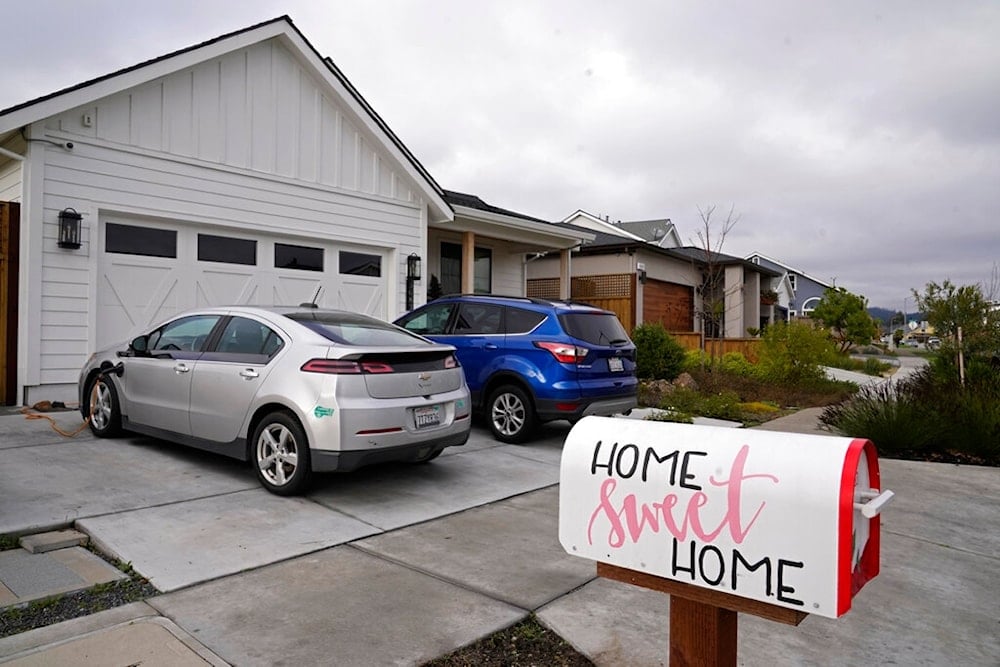
A mailbox reads Home Sweet Home outside a rebuilt home in the Coffey Park area of Santa Rosa, Calif., on January 5, 2022. (AP Photo/Eric Risberg)
Mortgage rates have risen across the United States and major European economies as the war on Iran drives up oil prices and fuels concerns over persistent inflation, the Financial Times (FT) reports.
The increase is adding to borrowing costs for homebuyers and homeowners seeking to refinance, while putting further pressure on housing markets that have already struggled with weak activity.
In the United States, the average rate for a 30-year fixed mortgage, the country's most widely used mortgage product, reached 6.67% this week, according to official data. The rate stood at 6.43% at the beginning of July and 5.98% before the war began in late February.
Read more: US sailors attempt suicide off USS Abraham Lincoln
Iran war pushes US mortgage rates higher
The increase has come despite the Federal Reserve keeping official short-term borrowing costs unchanged in 2026.
Financial markets are instead responding to concerns that higher energy prices resulting from the war on Iran could prolong inflation and make it more difficult for the Fed to ease monetary policy.
The collapse of the fragile ceasefire caused by Washington's hostilities against the Islamic Republic triggered a renewed increase in oil prices, adding to inflationary pressures.
Yields on 10-year US Treasury bonds, which are a major influence on mortgage rates, have also risen in recent weeks amid higher energy prices and expectations of stronger inflation.
The latest mortgage rate is now above the level recorded in early August 2025, before the US Federal Reserve implemented three quarter-point rate cuts late last year.
For US households, the increase has translated into a significantly larger financial burden. The rise has added almost $150 to the monthly mortgage payment on an average home, further increasing living costs at a time when fuel prices have also been affected by the conflict.
European borrowers also face rising costs
In the United Kingdom, the average rate on a five-year fixed mortgage rose to 5.66% in July, marking the first monthly increase since April, according to Moneyfacts.
Rates had not reached that level outside the early months of the US war on Iran since late 2023, when the Bank of England's base rate had reached a 15-year high as policymakers sought to contain post-pandemic inflation.
Although the BoE has also kept its official borrowing rate unchanged this year, the renewed US aggression in West Asia has increased volatility in financial markets. Higher swap rates, which lenders use to price fixed-rate mortgages, have consequently pushed borrowing costs upward.
Other nations that are feeling the brunt of these increased rates include Germany and France.
In Germany, the representative rate for a popular 10-year fixed mortgage rose from 3.3% at the beginning of July to 3.7% earlier this week, according to mortgage broker Dr Klein.
In France, the average rate for a 10-year fixed mortgage increased from 3.02% in June to 3.15% in July, according to real estate network Capifrance.
The European Central Bank also raised its benchmark interest rate to 2.25% in June in response to the war on Iran, adding another layer of pressure on borrowing costs in parts of the Eurozone.
Read more: US households squeezed by Iran war fuel shock: FT
Higher rates weigh on US housing market
The increase in mortgage costs is hitting a US housing market that had been expected to recover following years of sluggish activity. Higher rates have reinforced the so-called mortgage "lock-in" effect, with homeowners holding older mortgages at substantially lower rates reluctant to sell and take on more expensive loans.
FT reports that Noble Black, a realtor at Corcoran, said there was a "lock-in" effect across the US housing market and linked mortgage-rate movements to the war on Iran.
"I think there’s a pretty clear correlation between the war (in Iran) . . . and where the mortgage rates are," he said. "It’s just keeping us in this purgatory."
Carl Gambino, a real estate agent at Compass, told FT that buyers with a strong need to move were continuing to purchase homes despite higher rates.
The overall effect, however, is another obstacle for a housing market already facing affordability pressures.
UK housing market feels the pressure
Higher rates have added an average of £103 a month to a typical UK mortgage since the beginning of the year, according to Zoopla. For buyers in London, the increase has reached £201 a month.
The higher costs are also weighing on transactions. The number of agreed UK home sales in July fell by almost 10% year on year, according to Zoopla executive director Richard Donnell.
"However, the same rate rises are hitting buyers very differently depending on where they are buying, which explains why some markets have slowed sharply while others are holding up," Donnell said, per FT.
FT reports that Moneyfacts finance expert Rachel Springall attributed volatility in UK swap rates and government bond yields to persistent uncertainty over the interest-rate outlook.
"One of the key catalysts has been the escalation and prolonged uncertainty surrounding the conflict in the Middle East, which pushed oil and energy prices higher," she said.
The developments demonstrate how the economic consequences of the US war on Iran are extending beyond energy markets. Higher oil prices and inflation expectations are feeding into financial markets and, ultimately, into the cost of housing for households across the US and Europe.


