
Half of world’s largest cities facing severe water stress, data shows
 4 Min Read
New data shows 50 of the world’s 100 largest cities are under high or extreme water stress, driven by poor water management and climate pressures.
-
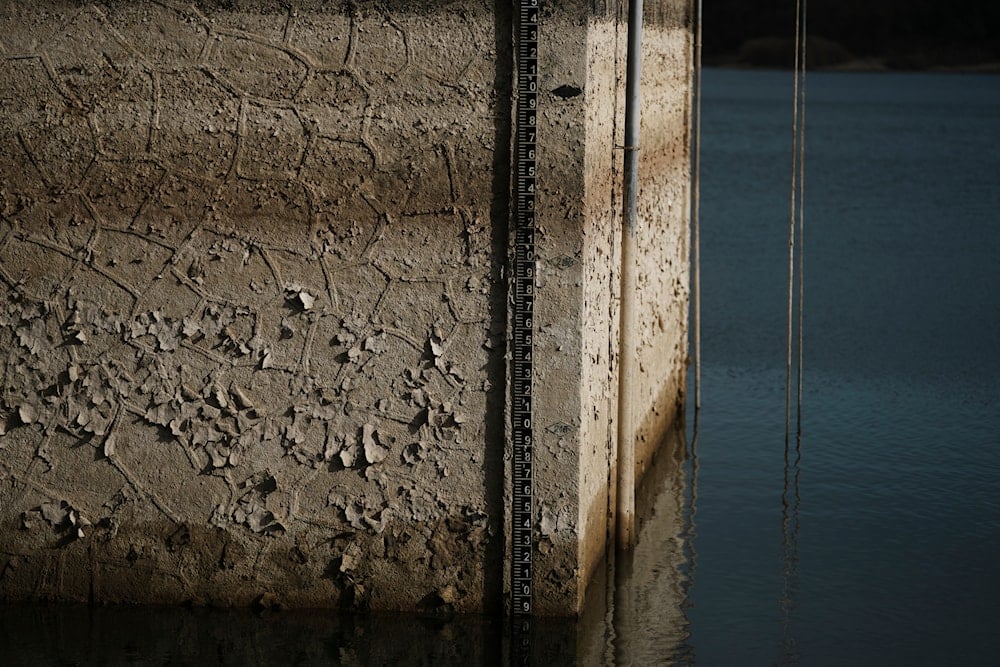
The low level of Lake Marathon is seen at the water intake tower near Athens, Greece, on January 6, 2026, as receding water levels reflect years of low rainfall. (AP Photo/Thanassis Stavrakis)
Half of the world’s 100 largest cities are facing high levels of water stress, with 39 located in regions classified as experiencing "extremely high water stress," according to new mapping and analysis.
Water stress occurs when the water demand, driven by public supply and industry, approaches or exceeds the available resources. This is often the result of mismanagement of water systems, now compounded by the worsening impacts of climate change.
An investigation by Watershed Investigations and The Guardian mapped major cities onto stressed water catchments. Cities such as Beijing, New York, Los Angeles, Rio de Janeiro, and Delhi fall into the extreme stress category, while others like London, Bangkok, and Jakarta face high stress levels. Additional research using NASA’s GRACE satellite data, compiled by scientists at University College London (UCL), shows long-term trends of drying or wetting in urban regions.
Cities like Chennai, Tehran, and Zhengzhou are experiencing pronounced drying, while Tokyo, Lagos, and Kampala are seeing strong wetting trends.
Roughly 1.1 billion people live in or near major cities in areas undergoing long-term drying. In contrast, only around 96 million live in or around urban centers located in strongly wetting regions. However, scientists caution that the satellite data lacks the resolution to assess local-scale water contexts.
Most of the wetting regions are in sub-Saharan Africa, with Tokyo and Santo Domingo being notable exceptions. Meanwhile, the most severely drying areas are concentrated in parts of Asia, especially northern India and Pakistan.
Cities nearing 'day zero' as drought persists
Tehran, now in its sixth consecutive year of drought, is approaching a potential "day zero", the point when municipal water supplies could completely run dry. Last year, Iranian President Masoud Pezeshkian warned that if conditions persisted, the city might have to be evacuated.
Other cities, including Cape Town and Chennai, have previously come close to similar crises. Many of the world’s fastest-growing urban centers are in drying zones and may face water shortages in the near future.
Mohammad Shamsudduha, professor of water crisis and risk reduction at UCL, highlighted the role of the GRACE satellite project in tracking total water storage. He described the system as a tool that offers early warning signs of developing water insecurity.
Read next: Kabul faces total water collapse by 2030
The United Nations declared on Tuesday that the world has entered a state of “water bankruptcy,” where the degradation of certain water sources has become irreversible. Prof. Kaveh Madani, director of the UN University Institute for Water Environment and Health, emphasized that poor water governance is often the core issue: “Climate change is like a recession on top of bad management of business,” he said.
The World Bank Group has echoed these warnings, reporting that the planet has been losing an estimated 324 billion cubic meters of freshwater annually over the past two decades. That volume could meet the yearly needs of approximately 280 million people, equivalent to the population of Indonesia. These losses are affecting river basins on every continent.
UK’s water crisis and government response
In England, water demand is projected to grow significantly. By 2055, the country may require an additional 5 billion liters of water per day for public supply, on top of the 14 billion liters currently used. The agriculture and energy sectors are expected to need an additional 1 billion liters per day.
Professor Shamsudduha pointed to groundwater as a "hidden resource" that could provide a more climate-resilient supply for the UK. However, he warned that without consistent monitoring and improved oversight, this resource could be mismanaged amid increasing climate and development pressures.
Southern England has recently experienced water outages, with South East Water attributing the issue to winter storms. However, regulators had already expressed “serious concerns” regarding the company’s supply security.
In response to growing concerns, the UK government released a new water white paper on Tuesday. The document outlines planned reforms, including the creation of a chief water engineer role, mandatory infrastructure checks, and the introduction of a new regulator with expanded powers.


