
UNICEF warns of global humanitarian supply chain crisis
 3 Min Read
UNICEF warns that the US war on Iran is driving up humanitarian transport costs worldwide, delaying life-saving supplies for children across Africa and Asia.
-
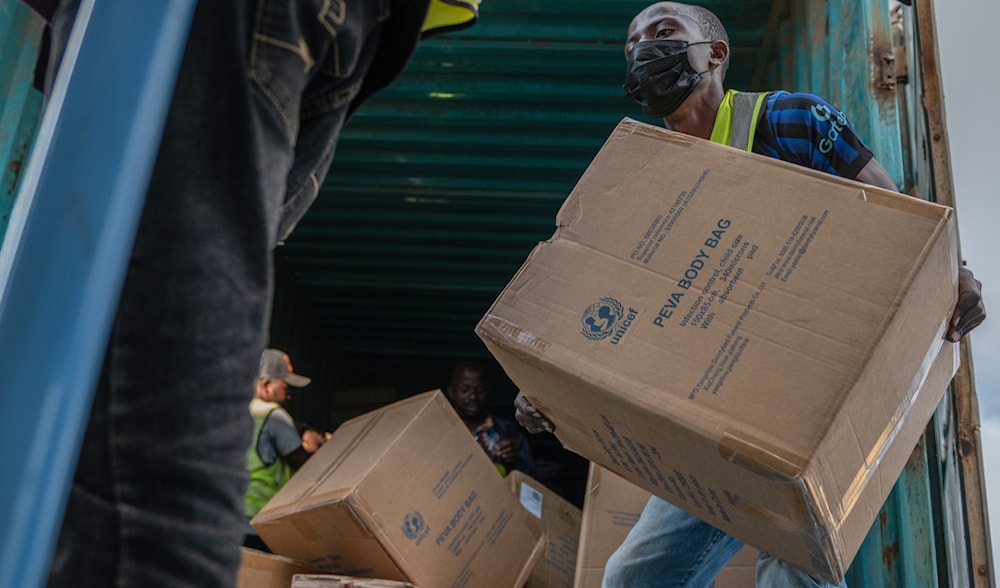
People offload a shipment of more than 15 tons of supplies donated by UNICEF as part of the response to the Ebola virus outbreak at Bunia National Airport in Bunia, Congo, Tuesday, May 19, 2026 (AP)
Nearly 100 days into the US war on Iran, the humanitarian toll of the US war of choice is spreading far beyond the region's borders.
Speaking at a press briefing at the Palais des Nations in Geneva on Tuesday, UNICEF Chief of Global Transport and Logistics Jean-Cedric Meeus warned that disruptions to global humanitarian supply chains are now threatening children's lives across multiple continents, with no sign of relief in sight.
Maritime diversions around the Cape of Good Hope are adding two to four weeks to shipping times, air freight capacity across routes through West Asia has tightened sharply, and port congestion is spreading across Africa, according to Meeus.
For UNICEF, air freight costs for vaccines shipped from India to Ethiopia, Nigeria, and the Democratic Republic of the Congo have surged between 50 and 70 percent. Trucking costs for Ready-to-Use Therapeutic Food (RUTF) from Kenya to Somalia, South Sudan, and the DRC have climbed 30 percent. Meanwhile, sea freight for educational materials from China to Yemen and Mozambique has more than doubled, rising between 100 and 150 percent.
"Every additional dollar UNICEF spends on transport is one less dollar spent on supplies for children," Meeus said.
Country-level fallout
In Nigeria, rerouting syringes for a polio vaccination campaign targeting 12 million children added $200,000 in transport costs, a 56 percent increase.
In Mali, the international freight budget rose 36 percent in the first quarter alone, forcing the country office to choose between ordering fewer nutrition supplies or cutting health, education, and child protection programmes.
In Afghanistan, successive route closures have pushed nutrition supplies onto an alternative path through Georgia and across the Caspian Sea, adding roughly two months to delivery timelines.
African ports, including Mombasa, Dar es Salaam, Beira, Conakry, and Abidjan, are all experiencing significant backlogs, with cascading effects on landlocked countries dependent on these corridors.
Unprecedented strain
Meeus stressed that the situation is unlike anything UNICEF has previously encountered, as the agency has nearly exhausted its annual transport contributions from logistics partners.
Cumulatively, the disruptions could delay critical supplies by four to six months. "For a child in a crisis zone," he said, "delays in arrival of vaccines or nutrition interventions can mean the difference between life and death."
Accordingly, the agency is activating alternative routes, frontloading procurement, and diversifying its supplier base across its global network of hubs and more than 300 warehouses. It has also expanded local production, now working with over 20 RUTF manufacturers in countries including Ethiopia, Kenya, Haiti, and Egypt.
Together with the World Food Programme and other UN partners, UNICEF has secured commitments from major carriers to temporarily suspend surcharges on humanitarian shipments, saving an estimated $2 million across UN operations.
"When supply chains are hampered, children pay the price first," Meeus said. "We will not allow these challenges to compromise the lives and well-being of children."


