
US set to end 'lifesaving' aid in seven African countries, report says
 4 Min Read
The seven countries expected to lose all US humanitarian funding are Burkina Faso, Cameroon, Malawi, Mali, Niger, Somalia, and Zimbabwe.
-
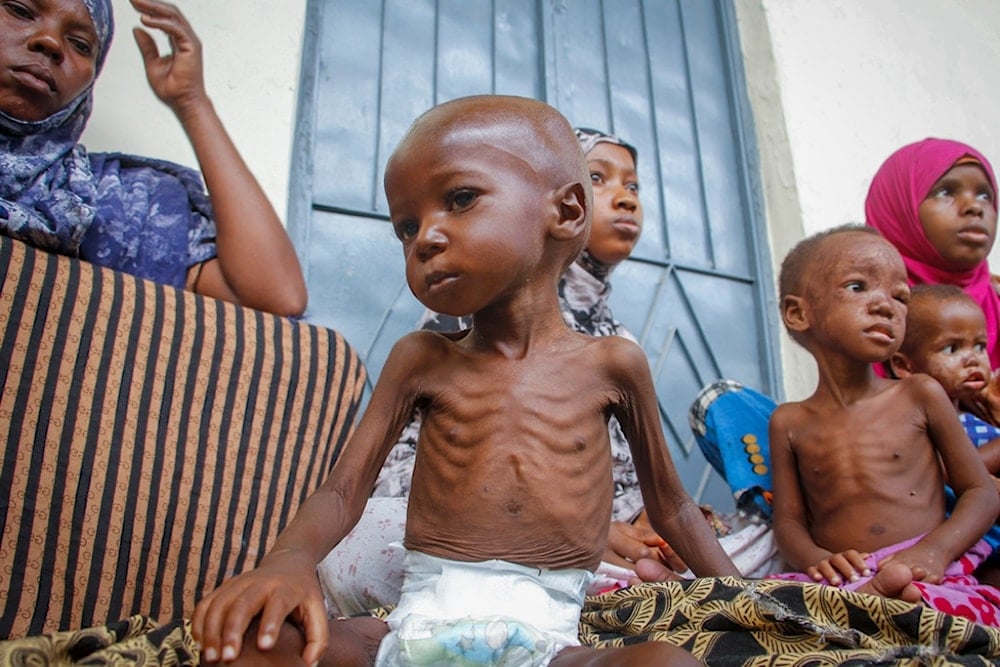
A malnourished two-year-old sits by his mother, left, who was recently displaced by drought, at a malnutrition stabilization center run by Action against Hunger, in Mogadishu, Somalia, June 5, 2022 (AP)
The US State Department is preparing to terminate humanitarian assistance in seven African countries, despite the programs previously being categorized by the administration itself as lifesaving, according to an internal email obtained by The Atlantic.
In the February 12 message sent to officials in the State Department's Bureau of African Affairs, the administration said the awards would be allowed to expire because "there is no strong nexus between the humanitarian response and US national interests," the outlet reported.
The seven countries expected to lose all US humanitarian funding are Burkina Faso, Cameroon, Malawi, Mali, Niger, Somalia, and Zimbabwe, The Atlantic said. Programs in these countries had been up for renewal through the end of September, but will now be phased out under what the department described as a "responsible exit".
Redirected funding and a narrower UN channel
The same internal email said US assistance would be redirected in nine other countries, namely Ethiopia, the Democratic Republic of the Congo, the Central African Republic, Kenya, Mozambique, Nigeria, Uganda, South Sudan, and Sudan, though it remains unclear how quickly new support would be delivered or which partners would receive it.
A State Department spokesperson told The Atlantic that "as USAID winds down, the State Department is responsibly moving programming onto new mechanisms" with updated oversight terms. The spokesperson said Washington has begun signing bilateral health-financing agreements with some governments, including Cameroon and Malawi, that are meant to support disease containment and health-system strengthening.
Critics say those agreements focus on longer-term health architecture while sidelining immediate emergencies such as hunger, displacement, and conflict-driven collapse of basic services.
The pullback is also tied to Washington's changing approach to UN humanitarian financing. The Atlantic report said the State Department will no longer allow US funds to flow to the seven countries through the UN's Office for the Coordination of Humanitarian Affairs (OCHA) pooled funding mechanisms.
In late December, the Trump administration announced a $2 billion US commitment for UN-managed humanitarian financing in 2026, but under a redesigned framework that initially targeted 17 countries and imposed tighter conditions, including faster spending requirements.
On-the-ground impact in Somalia and Sudan
The countries slated for a total cutoff include some of the world's most acute humanitarian crises. Across the seven nations, at least 6.2 million people are facing "extreme or catastrophic conditions," according to UN figures cited by The Atlantic.
In Somalia, where drought and conflict have compounded chronic food insecurity, the closure of clinics and nutrition centers has accelerated since earlier US reductions, the report said.
In Sudan, the humanitarian nonprofit Alight said it has shut 30 health clinics and 14 nutrition centers, cutting off care for roughly 200,000 people and leaving hundreds of health workers without jobs, according to the report.
Eri Kaneko, an OCHA spokesperson, warned that the US restrictions on where pooled funding can be used "put lives at risk."
Jocelyn Wyatt, CEO of Alight, said, "Cutting lifesaving aid in the midst of famine and war is morally indefensible."
A senior humanitarian worker quoted in the report said the shift amounts to political triage rather than efficiency, adding, "This is not a policy for efficiency, it is a policy of indifference and political calculation."
A broader rollback of USAID
The latest round of cuts comes after the Trump administration's earlier dismantling of USAID. In March 2025, Secretary of State Marco Rubio said 83% of USAID programs were terminated after a review, with remaining initiatives shifted under State Department control.
The Atlantic said additional awards were later canceled during White House budget reviews, even when programs had survived an earlier purge because they were deemed lifesaving.
Read more: Global aid cuts could cause nearly 10mln deaths by 2030, study warns


