
'Israel' preparing target bank of critical infrastructure in Iran
 4 Min Read
The Israeli regime is preparing to strike Iranian national, economic, and energy infrastructure, and is waiting only for Washington's green light.
-
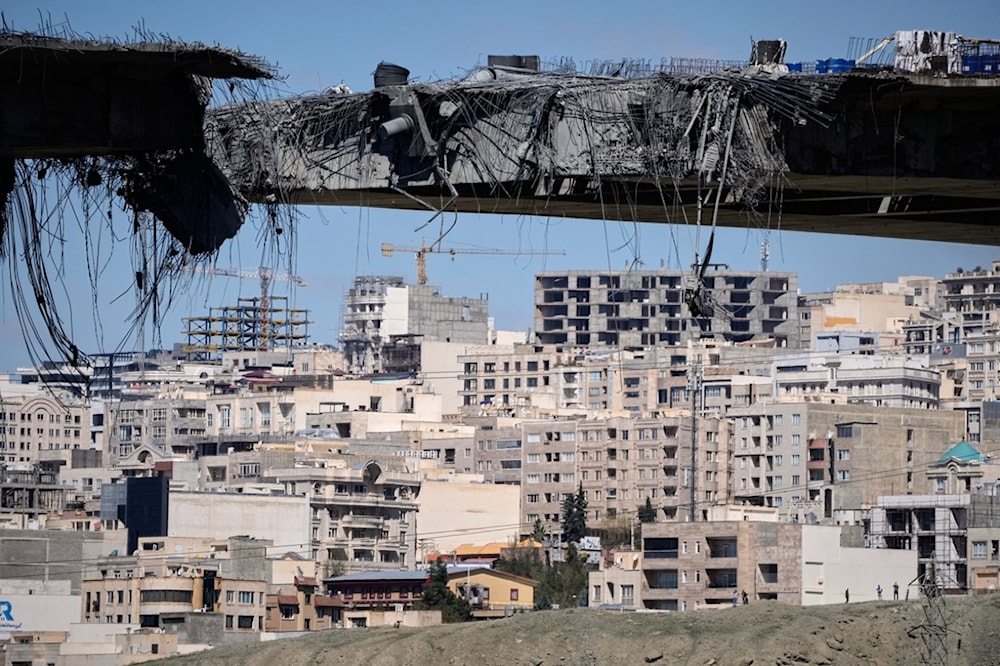
A bridge struck by US airstrikes on Thursday is seen in the town of Karaj, west of Tehran, Iran, Friday, April 3, 2026. (AP Photo/Vahid Salemi)
Israeli newspaper Yedioth Ahronoth reported on Friday that Israeli Prime Minister Benjamin Netanyahu and Minister of War Israel Katz have instructed the Israeli military to compile a target bank of Iranian national, economic, and energy infrastructure, in anticipation of a potential green light from Washington to attack.
The report indicates that attention within the Israeli regime is fixed on April 6, the deadline issued by US President Donald Trump, who has threatened to destroy Iranian energy facilities if the Strait of Hormuz is not reopened. Once authorization is received, the Israeli military is expected to act.
The target bank is reportedly being prepared against a backdrop of deep uncertainty in the entity over the trajectory of the war, with Yedioth Ahronoth reporting that contradictory signals are reaching the Israeli regime regarding the state of US-Iran negotiations.
Israeli officials are said to be receiving conflicting indications, with some signs pointing to meaningful progress in talks between Washington and Tehran, and others suggesting the negotiations have stalled entirely.
The 'worst-case scenario'
The development most feared in Tel Aviv is a temporary ceasefire that would halt the aggression against Iran while mediation efforts continue, an outcome characterized as the worst-case scenario from an Israeli standpoint, as it would freeze military operations before Tel Aviv considers its "objectives" met.
An Israeli official familiar with the matter was cited as saying it is impossible to predict how the US president will proceed, with the regime leaning toward pessimism while still hoping to be "positively surprised."
Two tracks of diplomacy
The paper claimed that two parallel channels through which negotiations are being conducted.
The first involves US Vice President JD Vance engaging with Pakistani Army Chief Asim Munir, described as the most powerful figure in Pakistan and closely aligned with the White House, who is said to be relaying communications to the Iranian side.
The second allegedly involves contact between US envoy Steve Witkoff and Iranian Foreign Minister Abbas Araghchi.
Though Iran has said mediation efforts are underway, it has rejected the existence of any talks, direct or indirect.
Iran, for its part, has explicitly rejected any temporary ceasefire. Araghchi stated earlier in March that Tehran is not seeking a pause in fighting but a permanent and comprehensive end to the war, warning that a ceasefire would only produce a vicious cycle of repeated conflict.
Iran has also conditioned any end to hostilities on concrete guarantees against future attacks, war reparations, and a comprehensive halt to aggression across all fronts.
US, 'Israel' bomb Iranian infrastructure
US-Israeli attacks destroyed the Pasteur Institute of Iran, a century-old public health institution, on Thursday, as well as a major bridge in Karaj, killing and wounding scores of civilians. The Iranian Red Crescent reports that over 316 healthcare and emergency centers have been damaged since February 28.
On Friday, Iran's Khatam al-Anbiya Headquarters warned of sweeping retaliation against US and Israeli assets across the region, including energy infrastructure and military bases, should attacks on its infrastructure continue. Reports have also emerged that Washington is weighing a ground invasion of Iran, a prospect analysts have widely described as militarily untenable and potentially catastrophic.
The Yedioth Ahronoth report comes as the US-Israeli war on Iran, now entering its second month, shows no clear path to resolution. Washington has failed to reopen the Strait of Hormuz or achieve its stated objectives, including preventing Iran from acquiring nuclear weapons and forcing a change in its political structure.
Iran, meanwhile, has retained its capacity to strike back, hitting Israeli territory and US interests across the region.


