
Trump faces economic and military dilemma in war on Iran
 5 Min Read
US President Donald Trump faces mounting pressure as the US-Israeli war on Iran drives oil prices higher and deepens economic and military risks.
-
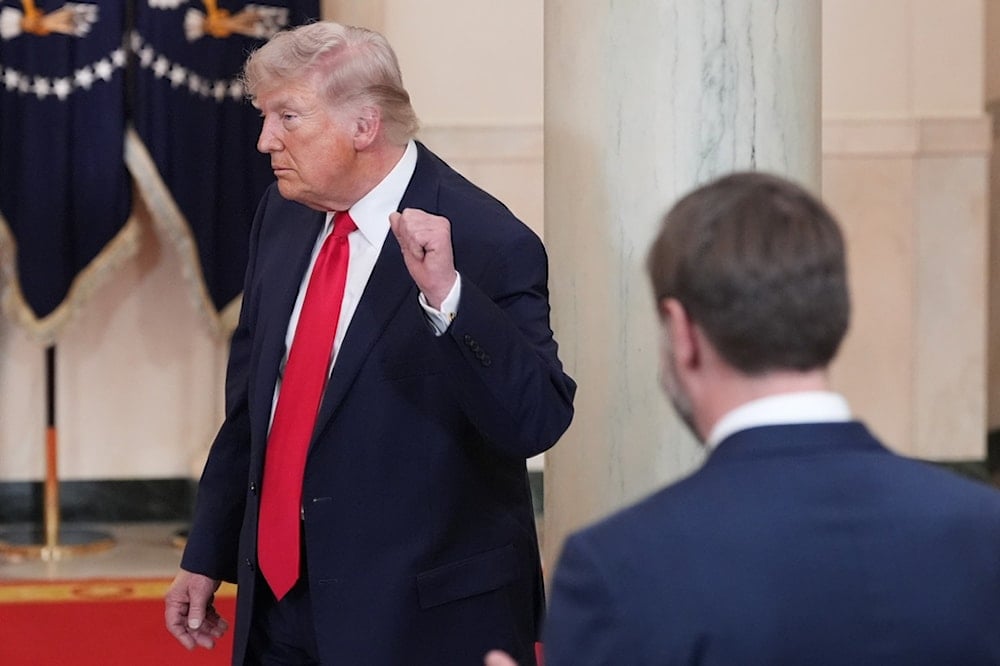
As US Vice President JD Vance watches, US President Donald Trump gestures after speaking about the Iran war from the Cross Hall of the White House on Wednesday, April 1, 2026, in Washington. (AP Photo/Alex Brandon)
US President Donald Trump failed to reassure markets during a Thursday address that offered little clarity on the trajectory of the US-Israeli war on Iran. Oil prices surged by roughly 5 percent following his remarks, reaching between $105 and $107 per barrel, underscoring investor anxiety.
Despite holding the authority to determine the next phase of the conflict, Amos Harel writes in Haaretz that Trump appears constrained by limited options: deeper involvement risks entangling the US in a prolonged and costly regional war, and his threats to send Iran “back to the Stone Age” reflected mounting frustration rather than strategic confidence.
Harel notes that with three days remaining before the expiration of his threat to Iran, which has already been extended twice, the possibility of escalation looms. Among the options under consideration is the deployment of US special forces to strategic points across the Gulf, including the Strait of Hormuz and potentially Iran’s coastline.
Oil prices surge as Strait of Hormuz crisis deepens
The economic fallout has emerged as a central concern. The Strait of Hormuz, a critical artery for global energy flows, has become a focal point of the crisis, granting Iran significant leverage.
Insurance premiums for oil tankers traversing the Gulf have increased dramatically, by as much as 10 to 40 times, reaching up to $10 million per vessel. Maritime traffic has also declined sharply, with shipments via Egypt dropping by approximately 90 percent.
An estimated 15 percent of the global oil supply is currently disrupted, with further price increases expected. Harel warns that the scale and pace of the current crisis place it beyond the scope of previous energy shocks.
Read more: Pentagon's little secret: US troop casualties in West Asia
Military escalation versus political risk
Washington’s regional allies, particularly in "Israel" and Gulf monarchies, are pressing for sustained military pressure on Iran.
Harel says that a US withdrawal could allow Tehran to claim strategic victory, while a shift toward a naval-ground offensive would likely deepen US involvement and extend the conflict’s duration.
Trump has framed continued military engagement as a matter of principle, stating the need to honor fallen soldiers “by completing the mission for which they gave their lives.” Yet his shifting rhetoric has contributed to uncertainty regarding the administration’s objectives.
Iranian officials have stated the nation's readiness to combat any invading ground force, with some calling for American troops to test their luck.
“For more than two decades, we have been training for the moment the Americans enter,” the representative of the Leader of the Islamic Revolution and the Islamic Republic in Iran’s Defense Council, Admiral Ali Akbar Ahmadian, stated, highlighting that the nation's preparation is rooted in a strategy of asymmetric warfare. Calling on US forces directly, he added, “We have only one message, and that is for you to come closer."
The martyred secretary of the Supreme National Security Council of Iran, Ali Larijani, had said in early March that “Iran’s land is not a place for the dance of devils,” adding that Iran's people are ready "to disgrace those wicked American officials with several thousand dead and captured."
Internal strain within the Trump administration
The evolving crisis has exposed internal weaknesses within the Trump administration. A notable decline in support for this war, including among senior officials and military leadership, has narrowed the circle of decision-making to a smaller group of loyalists.
This dynamic echoes challenges from Trump’s first term, particularly during the COVID-19 pandemic, where governance deficiencies undermined crisis management efforts.
Polling trends indicate declining public support for both Trump and the war effort, driven in part by rising fuel costs. While Trump has attempted to reassure the public that price increases are temporary and that the conflict will conclude within weeks, skepticism persists.
Read more: Trump-NATO tensions deepen as Europe unites against war on Iran
On the ground, Iranian missile strikes toward "Israel" and Gulf states continue, while Tehran maintains a strong resilience despite sustained military pressure.
Washington and Tel Aviv did not count on such a response from Iran, nor the reality of a war of attrition. Now, air defense systems for both are running low, allowing Iran and other arms of the Resistance to land more successful strikes against US assets and "Israel".
War spillover into Lebanon and broader fronts
Beyond Iran, the conflict’s spillover into Lebanon highlights broader regional instability. Hezbollah quickly adapted to Israeli aggressions against Lebanon, reverting to guerrilla warfare tactics aimed at blocking "Israel's" desires of expansion and launching volleys of drones and rockets against targets within Occupied Palestine.
Simultaneously, Harel notes that the strain Hezbollah has put on occupation forces has increased due to resource diversion toward Iran, particularly within the Air Force. Calls for reassessment have emerged following mounting casualties and operational challenges on the Lebanese front.
Read more: YAF launch joint strikes with Iran, Hezbollah, target occupied Yafa
As the war enters its second month, Harel says that Trump faces a narrowing strategic horizon defined by two costly outcomes: economic strain or deeper military escalation.
The US-Israeli war on Iran has already disrupted global energy markets, strained regional stability, and exposed structural vulnerabilities within both the Trump administration and its allies.
Absent a decisive shift, the trajectory suggests prolonged uncertainty, one in which any path forward carries significant political, economic, and military consequences.


