
Strait of Hormuz could yield $500 bln for Iran if US withdraws
 3 Min Read
Control of the Strait of Hormuz could give Iran up to $500 billion from oil and gas tolls if the US withdraws, affecting the global oil market and energy prices.
-
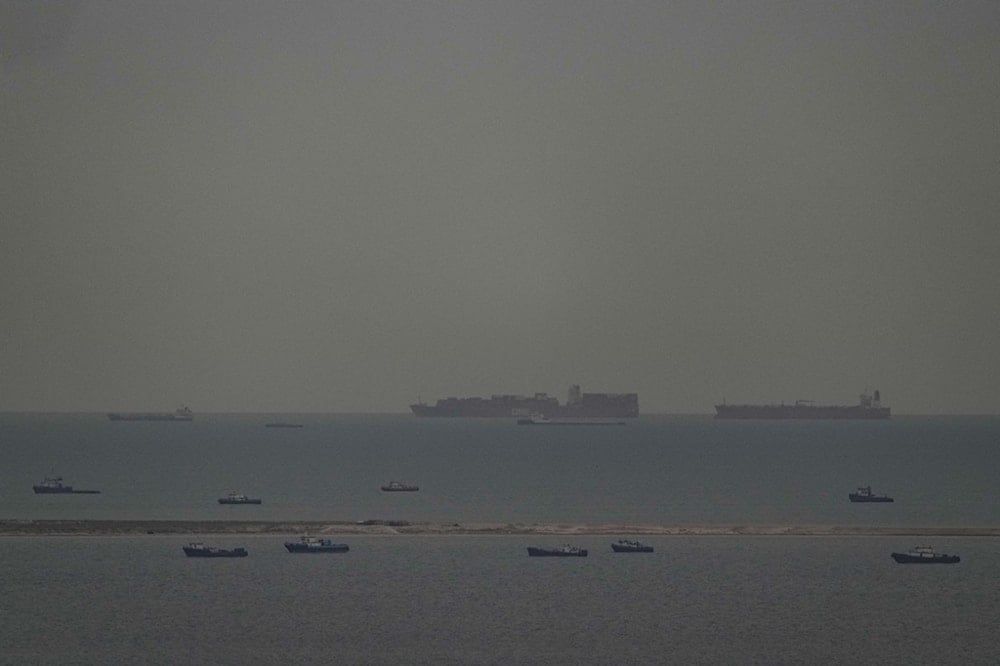
Fishing boats dot the sea as cargo ships, in the background, sail through the Gulf toward the Strait of Hormuz off the United Arab Emirates, Friday, March 27, 2026. (AP Photo)
Tehran could turn the Strait of Hormuz into a major revenue source worth up to $500 billion over the next few years if the United States withdraws, according to Reuters' Commentator-at-Large Hugo Dixon, highlighting the economic stakes of the ongoing US‑"Israel" war on Iran.
The strait, a strategic chokepoint through which roughly one-fifth of the world’s oil and liquefied natural gas (LNG) transits, has become central to regional calculations.
Dixon states that control of the Strait of Hormuz would allow Iran to impose transit tolls, potentially formalizing an embryonic system already hinted at in recent shipping incidents.
Read more: IRGC said created fire belt in Tel Aviv, new arsenal to be introduced
Trump’s Gulf policy risks strengthening Tehran
Since the escalation in the Gulf, Tehran has already reportedly charged vessels up to $2 million for passage through the strait, which Dixon says could translate into approximately $110 billion a year from oil transit alone, with an additional $20 billion from LNG shipments.
US President Donald Trump’s pledge to conclude military operations within weeks, regardless of a formal agreement, raises the possibility that the United States may leave without restoring the pre-war situation.
Dixon says such a move could give Iran the leverage to monetize the strait while regional producers remain dependent on its control.
Economic calculations behind the tolls
Before the US and "Israel" began this war on Iran, around 20 million barrels of oil passed through Hormuz daily. Saudi Arabia and the United Arab Emirates can divert limited quantities through pipelines to the Red Sea and Gulf of Oman, leaving roughly 10 million barrels trapped in the Gulf.
Dixon writes that, assuming crude prices stabilize at $60 per barrel and subtracting production costs, Gulf states face potential annual losses of $200 billion while the strait remains under Iranian control. Tehran’s ability to impose tolls could capture a substantial share of this revenue until alternative routes are developed.
Read more: Trump admits Strait of Hormuz won’t reopen on his timeline
Regional bargaining and infrastructure options
If revenues were split evenly, Dixon states that Iran could gain $100 billion from oil transit and $20 billion from gas annually. Over three to four years, toll collections could total $350 billion from oil and $140 billion from gas. Gulf states have incentives to construct additional pipelines to bypass the strait, but infrastructure timelines suggest Iran could retain short-term leverage.
The Reuters commentator notes that Tehran’s strategy may balance revenue maximization against maintaining stable global oil prices, which are critical to avoiding international intervention.
Control of the Strait of Hormuz directly affects the global oil market. The US‑"Israel" war on Iran has amplified the Strait’s strategic and economic significance, turning it into a pivotal point in regional energy security. How revenues and control are negotiated between Iran and its Gulf neighbors will shape global energy flows in the coming years.


