
IRGC said created fire belt in Tel Aviv, new arsenal to be introduced
 3 Min Read
A statement by the IRGC's Public Relations discloses the impact of Iranian missiles in Tel Aviv, asserting that existing and untapped capabilities will achieve their intended missions against enemy targets.
-
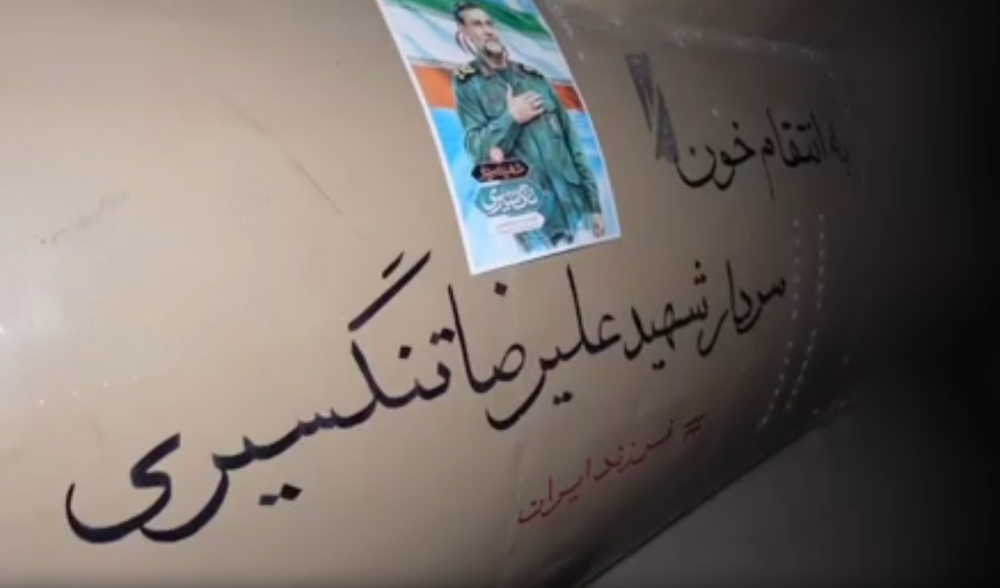
An Iranian missile deployed in the latest wave of IRGC operations, with a picture of martyred Navy Chief Admiral Alireza Tangsiri, April 1, 2026 (Fars News Agency)
Iran's Islamic Revolution Guard Corps (IRGC) announced the continuation of wave 89 of Operation True Promise 4 under the call of "Ya Haidar Karrar," dedicating the launch to its martyred navy chief, Admiral Alireza Tangsiri. A statement by the IRGC's Public Relations revealed that a combination of heavy and precise missiles, namely Qiam, Emad, and the multi-warhead Qadr, were deployed in the operation.
According to the statement, the missile strikes created a belt of fire, stretching from Ramat Gan to Holon, Palmachim, and Bnei Brak, east of Tel Aviv. Israeli media had reported extensive damage in the named areas, as well as confirmed casualties.
The Iranian operation had imposed a state of heightened alert among illegal settlers, as they prepare for further escalation. Significant disruption was reported, while millions of settlers rushed to seek shelter, causing widespread chaos and major street congestion. At the same time, efforts to enter shelters lasted for extended periods, especially in the lead-up to the Jewish Passover holiday.
At the same time, missile and drone operations continue pounding targets spanning from the occupied north to the occupied south, while a substanial portion of the IRGC's military capabilities remains undeployed and will be progressively activated in the upcoming days.
Iran's 'largest missile wave' leaves Tel Aviv extensively damaged
Earlier today, Israeli media reported that Iran's latest missile wave, consisting of at least 10 ballistic missiles, launched toward Tel Aviv was among the largest in recent weeks. The wave came as launches from Iran and Hezbollah in Lebanon continue with rising intensity.
The strikes reportedly made a direct impact and resulted in confirmed casualties, including the collapse of a building in Petah Tikva, while several vehicles were set ablaze. More impacts were reported in Ramat Gan and Holon. Moreover, extensive damage was reported in Rosh Haayin, where Iranian missiles struck.
As sirens blared across Tel Aviv, live broadcasts were interrupted, with reporters in the i24 studio having to cut off the broadcast to seek shelter. Coverage was shifted to an external correspondent. Meanwhile, with sirens still blasting, Israeli emergency services reported difficulty in operations.
Over two million settlers fled to shelters, while military analysts admitted that Israeli air defense systems faced an unprecedented challenge posed by the Iranian missiles.
Additionally, Channel 14 cited military experts as saying the missile barrage was the "most significant" since week two of the war, emphasizing that it was accompanied by a surge in missile launches targeting the occupied north from southern Lebanon, further exacerbating the security challenge.
Iran launched around 10 ballistic missiles toward central "Israel"; the largest attack since the start of the #US-Israeli war on Iran, as Israeli media reported.
— Al Mayadeen English (@MayadeenEnglish) April 1, 2026
Israeli media added that sirens sounded continuously, with Israeli emergency services reportedly unable to reach… pic.twitter.com/iJLe5JLCrf


